If you run a GPS tracking company, you probably started the sensible way. You bought reliable trackers, rented a white-label platform, put your logo on it and started selling subscriptions. A few hundred devices later, the questions change. Why are we paying a monthly fee for every object on the platform? Why can’t we build the report our biggest customer keeps asking for? Why does the mobile app look exactly like our competitor’s?
The short answer to “who can build my own platform” is a software development company with real experience in device protocols, high-volume data and multi-tenant SaaS. A team that only builds websites or general mobile apps is not enough. You can also extend an open-source platform such as Traccar, or stay with white-label and build custom tools around it. Each route suits a different stage of a GPS business.
This guide is written for GPS tracking company owners weighing that decision. It explains what a custom GPS tracking platform involves, how device integration works, what drives the cost, and how we at Sigosoft would approach the project.
When a white-label GPS platform stops being enough
White-label platforms are a good way to launch. You get maps, alerts and apps on day one, with support for hundreds of device models. The limits tend to appear as you grow.
The challenge usually starts with margins. Most white-label platforms charge per tracked object or per account, so your costs rise with every device you sell. Then customers start asking for things the platform does not do: fuel sensor reports in a specific format, integration with their ERP or dispatch system, a school bus app for parents, or a driver app in Arabic or French. You can raise a feature request, but your roadmap belongs to someone else.
There is also the question of ownership. Your customer data, device history and branded apps sit on another company’s infrastructure. If their pricing changes or their service has an outage, your customers call you.
None of this means white-label is a mistake. It means that at some point a GPS company has to decide whether its product is the device, the service or the software.
A practical scenario: 5,000 devices on a white-label platform
For example, consider a GPS tracking company with about 5,000 active devices, mostly vehicle trackers sold to transport, school bus and construction customers. This is an illustrative scenario, not a Sigosoft client. The company runs everything on a white-label platform billed per tracked object.
Three things push it to look at its own software. First, the platform fee is multiplied by 5,000 every month, and it grows with each device sold. Second, its school bus customers want a parents’ app with pickup alerts, which the platform does not offer. Third, its dealers in two other cities want their own logins, their own customers and their own invoices, and the platform has no proper dealer layer.
The data side matters too. If every device reported every 30 seconds around the clock, that would be about 14.4 million positions a day. Real numbers are lower, because parked vehicles report less often, but the system still has to be designed for that kind of volume.
Before recommending a complete rebuild, we would first examine:
- Device mix.
Which device models and firmware versions make up the 5,000, and which protocols they use. - Revenue split.
Which customers and features earn the most, and what the dealers actually need. - Migration plan.
What history must move across and how devices will be reconfigured. - Phasing.
Whether a phased plan works: own platform for new customers first, then migration of the existing base in batches.
For a company at this size, owning the platform usually changes the business more than the technology. Software stops being a cost per device and becomes a product it can price, package and sell through dealers.
Who can develop GPS tracking software: your four options
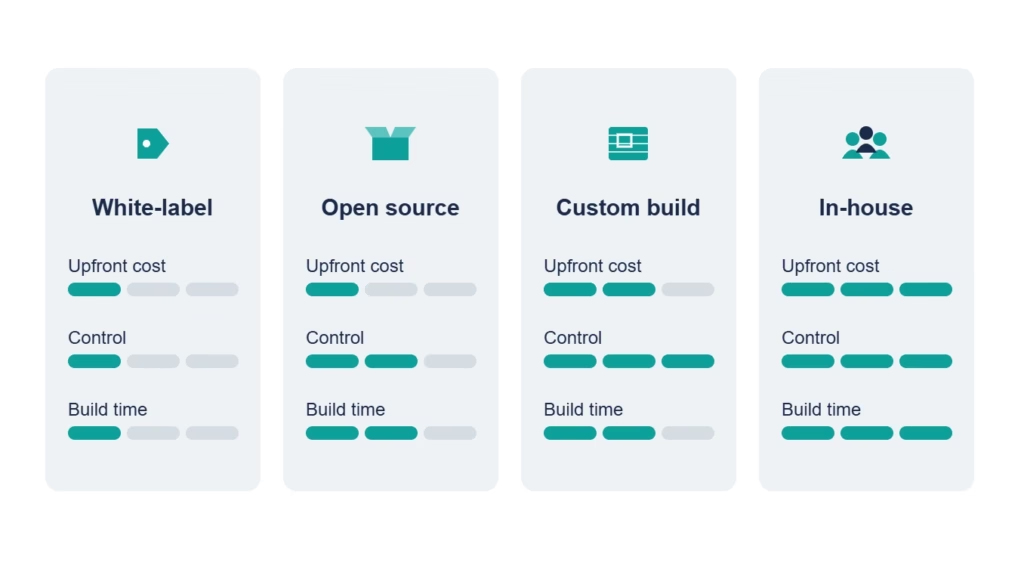
| Option | What you get | Works well when | Watch out for |
|---|---|---|---|
| White-label platform (Wialon, GPSWOX, Navixy and similar) | A ready platform under your brand | You are launching or have a small device base | Per-object fees, limited custom features, shared roadmap |
| Open-source platform customised by a freelancer (usually Traccar) | A self-hosted server with your branding | You need low cost and basic tracking | Limited product depth, single-person dependency, scaling and support |
| Custom platform built by a software development company | Your own product, designed around your customers | You have a growing base and specific features to sell | Higher upfront cost and a longer build than a rebrand |
| In-house development team | Full control | You already have engineering leadership | Hiring, retention, and slow early progress |
There is a useful middle route that many GPS companies overlook. A development team can use an open-source tracking server for the device layer and build your own platform, apps and integrations on top of it. You avoid rewriting hundreds of device protocols on day one, and you still own the product your customers see.
The Traccar project describes its server as supporting more than 200 GPS protocols and more than 2,000 device models (Traccar on GitHub). That is a strong foundation for the device layer. But device support is not the same as a finished product. Billing, reseller hierarchies, industry-specific reports, customer apps and integrations still have to be designed and built.
What a custom GPS tracking platform should include
A platform for a GPS company is different from a fleet app for a single business. You are building software that you will sell to many customers, each with their own users, vehicles and expectations. Features fall into four layers.
Business features a GPS tracking company needs
This is the layer generic fleet software misses, and the one that runs your business day to day.
| Feature | What it does for your business |
|---|---|
| Device activation | Register a device by IMEI, link it to a SIM and a customer vehicle, and switch it on for billing in one step |
| SIM management | Track SIM numbers, operators, data plans, expiry dates and suspended SIMs, so you are not paying for idle connections |
| Device inventory | Stock, sold, installed, faulty and returned devices, by model and firmware |
| Reseller and dealer management | Dealers get their own login, customers, devices and branding, and you see everything above them |
| Subscription plans | Monthly, quarterly or annual plans per device, with feature tiers such as basic tracking, fuel reports or video |
| Customer-level billing | Invoices per customer account, renewals, reminders, and automatic suspension when a subscription lapses |
| Dealer commissions | Revenue share or wholesale pricing per dealer, calculated from active devices |
| Support console | A device’s last messages, signal, battery and command history, visible to support staff in seconds |
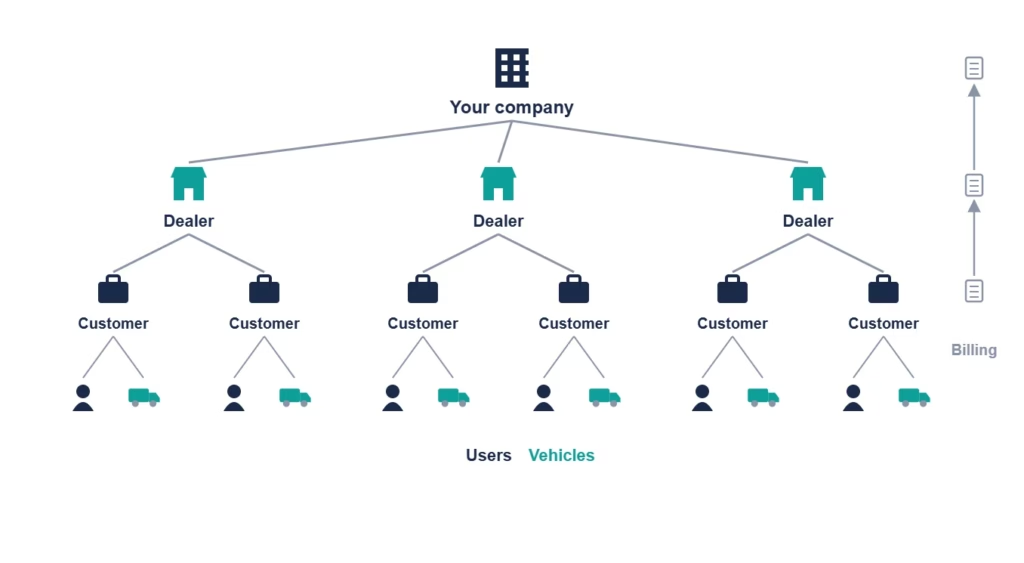
The hierarchy usually runs from your company, to dealers, to customer accounts, to users and vehicles. Every screen, report and API call has to respect that hierarchy, so it should be designed into the data model on day one rather than added later.
Customer features, apps and integrations
For your customers: a live map with vehicle status, trip history and playback, geofences, alerts for speeding, idling, ignition and SOS events, driver behaviour reports, fuel and temperature sensor reports where devices support them, scheduled reports by email, and user roles.
Mobile apps: a customer app for owners and fleet managers, and where useful a driver app for jobs, proof of delivery or trip logging. Our custom mobile app development team usually builds these in Flutter so Android and iOS share one codebase.
Integrations: a documented API for customers who want data in their ERP, TMS or dispatch tools, plus webhooks for real-time events, and integration with SMS, WhatsApp and email providers for alerts.
The features you build first should be the ones your customers will pay more for, not the ones every platform already has.
GPS device integration: where most of the complexity sits
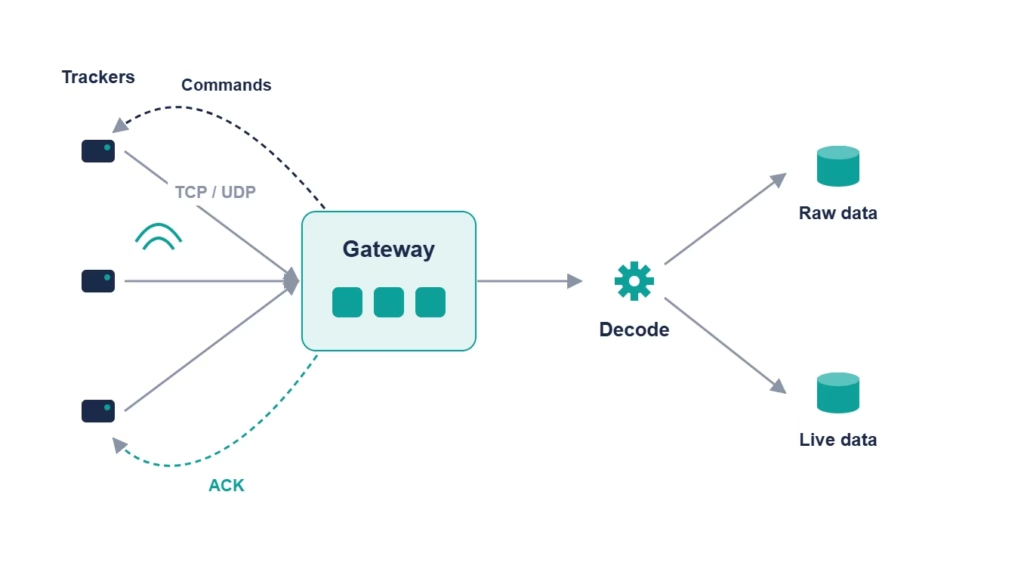
Device integration is where GPS tracking software development is most often underestimated. Every manufacturer has its own protocol, and many have several.
Take Teltonika as an example, because its devices are widely used in professional fleets. They send data using Codec 8, Codec 8 Extended or Codec 16, over TCP or UDP (Teltonika Wiki). Codec 8 Extended uses 2-byte fields for IO IDs and counts where Codec 8 uses 1 byte, and it supports variable-length IO values. That matters when you read CAN bus or advanced sensor data. Over TCP, the device first sends its IMEI and the server replies “01” to accept it. After each data packet, the server must reply with the number of records received, as a 4-byte integer. If the count does not match, the device sends the data again. Commands back to the device, such as an immobiliser or a configuration change, use a separate protocol, Codec 12. Many lower-cost trackers use entirely different protocol families, so each model you sell has to be checked.
In practice, a device integration layer has to:
- Listen on a dedicated port for each protocol, over TCP or UDP.
- Identify the device, usually by IMEI, and check it belongs to an active account.
- Decode the binary packet into location, speed, ignition, battery and sensor values.
- Acknowledge the packet quickly so the device does not resend or disconnect.
- Store the raw packet as well as the decoded values, so you can reprocess data if a parser is fixed later.
- Send commands to the device and track whether they were confirmed.
When developing a GPS tracking platform, the choice of device protocols and data architecture affects future scalability more than any user-facing feature. Our recommendation would be to list every device model you sell today and plan to sell, with its firmware version and the features your customers use. That list decides the integration effort.
The architecture behind a scalable GPS tracking platform
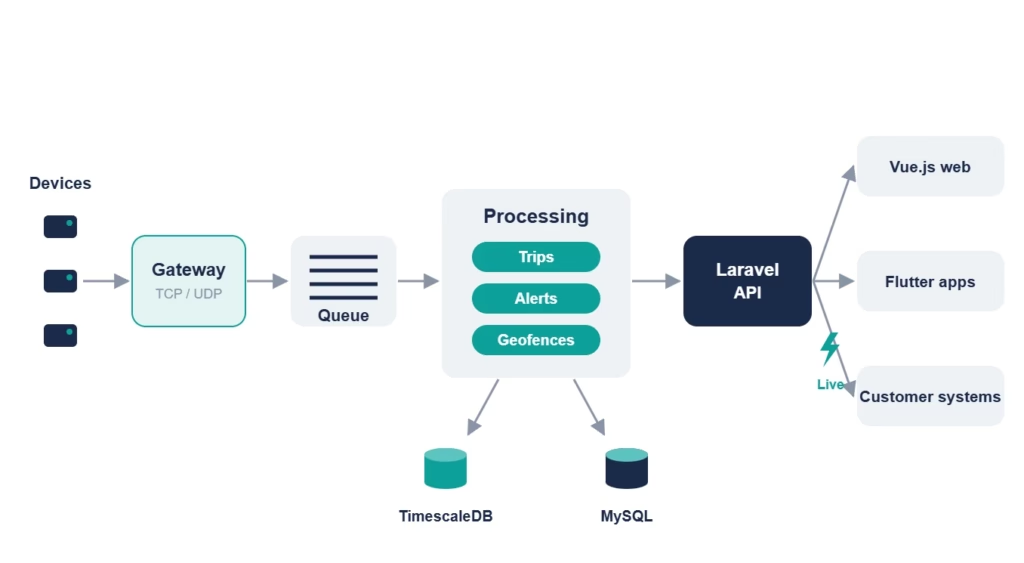
GPS data grows quickly. Tiger Data, the company behind TimescaleDB, estimates that a 100-vehicle fleet sending GPS position and 10 OBD-II signals once a second generates about 4 million data points an hour (Tiger Data). Most trackers report less often than that, but the point stands: location history behaves like time-series data, not like ordinary business records.
A platform that scales usually separates the work into layers:
- Device gateway.
Protocol listeners that receive and decode packets. - Message queue.
It absorbs bursts, for example when thousands of devices reconnect after a network outage, and passes events to the services behind it. - Processing services.
These calculate trips, stops, geofence events and alerts. - Storage, split by type.
A relational database such as MySQL or PostgreSQL holds accounts, devices and billing. Location history goes into a time-series store. TimescaleDB with PostGIS is a common choice, because it keeps time-series partitioning and geospatial queries in one PostgreSQL database. - Real-time layer.
It pushes live positions to web and mobile apps over WebSockets. - Public API.
Your own apps and your customers’ systems use the same interface.
Putting every position into a single MySQL table can work for a few hundred devices. It becomes slow and expensive as the history grows. Deciding the storage design early is much cheaper than migrating years of location data later. Our cloud and DevOps services team plans hosting so the platform can scale gradually rather than being rebuilt.
Moving your existing customers off a white-label platform
You might be wondering what happens to the customers and devices already on your current platform. This part needs a plan of its own.
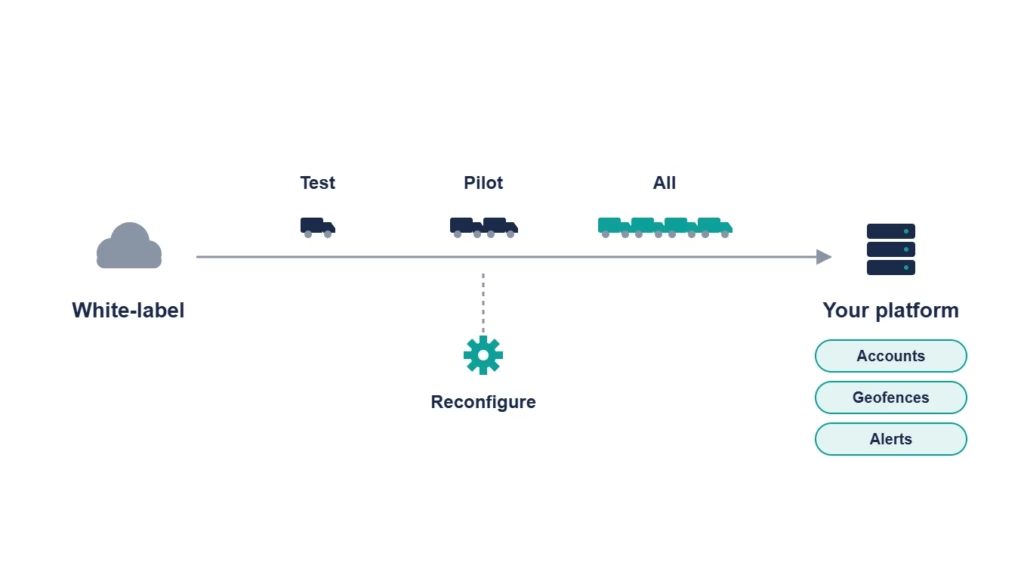
Each tracker is configured with a server address and port. Moving a device usually means changing that setting, either by SMS command, by remote configuration from the manufacturer’s tools, or in person. Before any device moves, your new platform should already have the customer’s account, users, vehicles, geofences and alert rules set up, so the customer notices nothing except the new branding.
We would plan a migration in batches. Start with internal test vehicles, then a small group of friendly customers, then the rest by device model. Check what historical data you can export from the white-label platform and how much your customers actually need. Often a summary of past trips is enough, rather than every raw position.
How the development process works
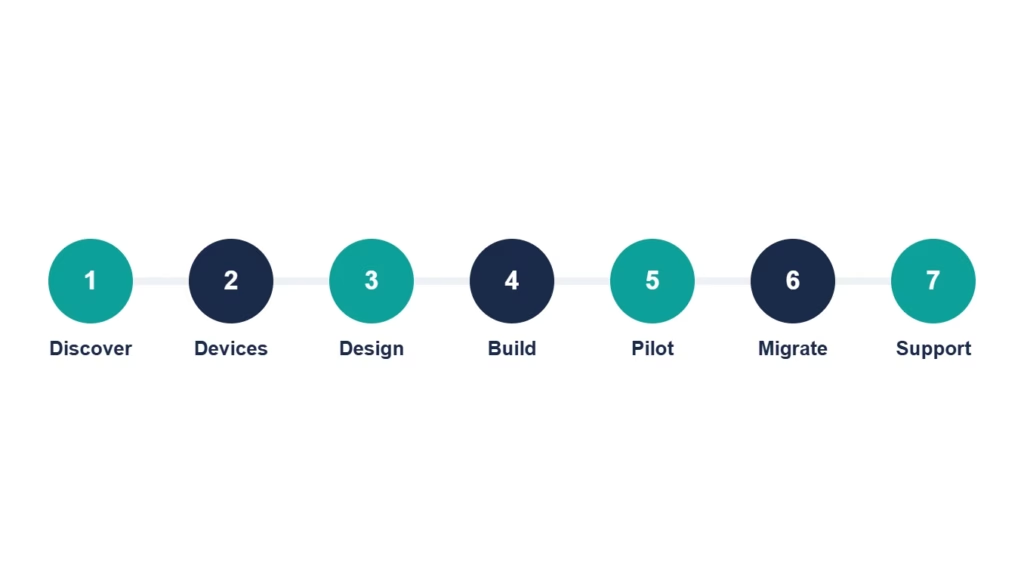
- Discovery.
Your business model, customer segments, device list, current platform limits and the features that will win or keep customers. - Device and data assessment.
The protocols, firmware versions, sensors and commands you need, and your current and expected device count. - Architecture and product design.
Storage, scaling and hosting choices, plus the screens for your operations team, customers and drivers. - First release.
Device gateway for your main device models, live tracking, history, alerts, customer accounts and the core mobile app. - Pilot.
Real devices and a small group of customers, while you watch data accuracy, alert timing and app behaviour on weak networks. - Migration and scale-up.
Customers move in batches, and the next features are added based on what customers ask for. - Ongoing support.
New device models, protocol updates, security patches and monitoring.
The first release should be deliberately small. A GPS company has paying customers from day one of the migration. A stable, narrow platform is better than a feature-rich one that drops packets.
What drives the cost of GPS tracking software development
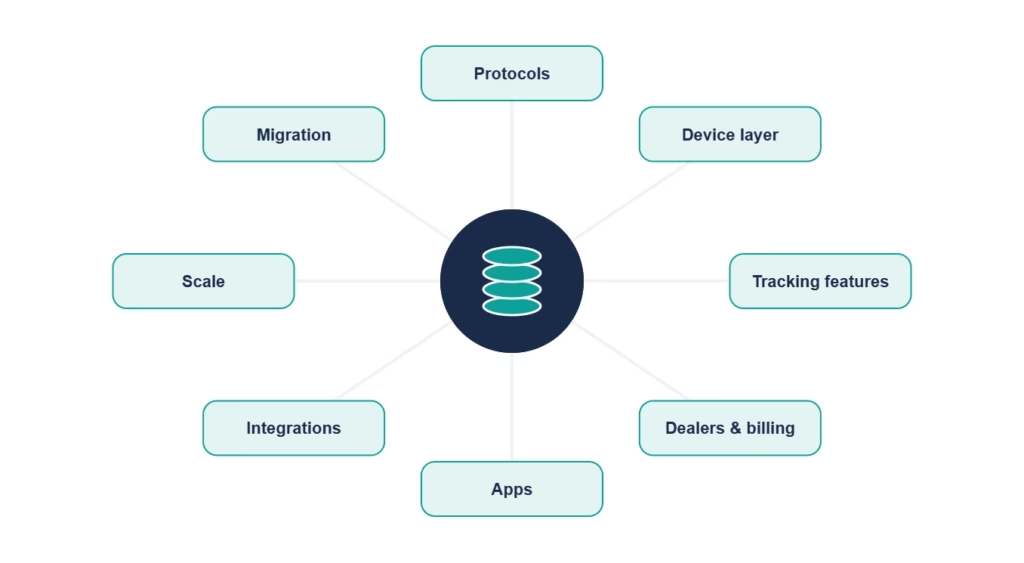
There is no honest single price for a custom GPS tracking platform. Two GPS companies with the same device count can need very different software. What we can do is show what drives the effort, so you can shape the scope around your budget and see where the money goes.
| Cost factor | Lower effort | Higher effort |
|---|---|---|
| Device protocols | One or two manufacturers, already supported by an open-source device layer | Many manufacturers, custom firmware, or protocols with little documentation |
| Device layer | Built on an open-source tracking server | Your own gateway and parsers for every protocol |
| Tracking features | Live map, history, geofences, standard alerts | Fuel and temperature sensors, CAN bus data, video telematics, driver identification |
| Business features | Single company, simple plans | Dealer hierarchy, dealer branding, commissions, customer-level billing, SIM management |
| Apps | Web dashboard and one customer app | Customer app, driver app, parent or passenger app, dealer app |
| Integrations | Email and SMS alerts | Customer ERP, TMS, fuel cards, WhatsApp, payment gateways |
| Scale and uptime | Hundreds of devices, standard hosting | Tens of thousands of devices, high availability, multiple regions |
| Migration | New customers only | Existing customers and history moved from another platform |
A sensible way to control cost is to phase the work. The first release covers your main device models, core tracking, customer accounts and billing. Dealer features, extra apps and integrations follow once the platform is stable and earning.
Running costs matter as much as the build: hosting, map and geocoding APIs, SMS and notification services, app store accounts, and ongoing support. Compare these with your current per-object fees at your expected device count in two or three years. That comparison, not the build price alone, tells you whether owning the platform makes sense. Once we understand your device list and feature priorities, we can give you a scoped estimate for your own project.
Common mistakes GPS companies make
- Choosing a developer who has never handled device protocols.
A good mobile app team can still underestimate binary parsing, acknowledgements and command handling. - Designing for today’s device count.
Storage and processing choices that work for 500 devices may fail at 20,000. - Forgetting the operations side.
Device provisioning, SIM tracking, billing and support tools are what make a GPS business run, yet they are often left out of the first scope. - Not keeping raw packets.
Without them, a parsing error can permanently corrupt customer history. - Rushing migration.
Moving every customer in one weekend turns small bugs into support crises. - Leaving security for later.
Device ports, APIs and apps are exposed to the internet. They need authentication, rate limiting and testing from the start. Our API security testing work exists for this reason.
How Sigosoft approaches GPS tracking platform development
At Sigosoft, we would start by understanding how your GPS business makes money: who your customers are, what they pay for, which devices you sell, and why your current platform is holding you back. The answer decides whether you need a full custom platform, a custom product on top of an open-source device layer, or simply custom apps and integrations around your existing white-label service.
We would normally evaluate your device list and current data volumes before suggesting an architecture. Where possible, we integrate the GPS devices you already own, so your customers do not need new hardware. We design the platform as multi-tenant SaaS from the start, because a GPS company sells software to many customers, not to one. And we plan the migration of your existing customers as part of the project, not as an afterthought.
The technology stack we use for GPS tracking platforms
Our approach would depend on your device count, features and hosting, but this is the stack our team typically works with on tracking platforms, and why each part is there.
| Layer | Technology | Why |
|---|---|---|
| Customer and driver apps | Flutter | One codebase for Android and iOS, so features ship to both at once |
| Web dashboard and admin panels | Vue.js | Fast, map-heavy screens for live tracking, reports and dealer management |
| Business logic and REST API | Laravel | Accounts, dealers, subscriptions, billing, permissions, reports and the public API |
| Accounts, devices and billing data | MySQL | Reliable relational storage for customers, devices, SIMs, plans and invoices |
| Location and sensor history | TimescaleDB (PostgreSQL) with PostGIS | Time-partitioned tables, compression and pre-aggregated summaries for large position histories, plus geofence queries |
| Device gateway | A separate protocol service | Holds thousands of long-lived TCP and UDP device connections and decodes each manufacturer’s protocol |
| Live updates | WebSockets | Pushes new positions and alerts to open dashboards and apps |
The device gateway sits outside the Laravel application on purpose. Trackers keep connections open for long periods and expect fast acknowledgements, which is a different job from serving web requests. Keeping it separate means a spike in device traffic cannot slow down the dashboard, and the gateway can be scaled on its own.
The split between MySQL and TimescaleDB is also deliberate. Account and billing data changes slowly and needs strict relationships. Position history grows every second and is mostly read by time range and vehicle. Using the right store for each keeps reports fast as years of history build up.
Airotrack: a vehicle tracking platform we built
Airotrack is a vehicle tracking platform Sigosoft developed for the Indian market. It runs on web, Android and iOS, built with Flutter, Vue.js and Laravel behind a secure REST API with cloud hosting. Fleet users can see at a glance which vehicles are running, stopped, idle or inactive. Each vehicle shows its location, speed and last update time. A card-based layout with colour-coded statuses lets fleet managers spot problems without reading through tables. The project reflects how we approach tracking software: clear real-time status first, built on a stack that runs the same features across web and mobile.
For GPS companies that also want dispatch, driver apps and proof of delivery on the same platform, our Fleet and Logistics Management System work covers those modules. If you plan to sell the platform to other businesses on subscription, our SaaS product development team designs the tenants, plans and billing.
Frequently asked questions
Who can develop custom GPS tracking software for my company?
A software development company with experience in GPS device protocols, time-series data and multi-tenant SaaS is the best fit. Freelancers can install and brand an open-source server, and white-label providers can rent you a platform, but neither gives you a product designed around your customers.
Should I build my own platform or stay on a white-label GPS platform?
White-label is usually right while you are launching. A custom platform starts to make sense when per-object fees become a large share of your margin, or when customers ask for features and integrations the white-label platform can’t provide.
Can a custom platform work with the GPS devices I already sell?
Usually yes. Most professional trackers use documented protocols. The development team needs your device models and firmware versions to plan parsers and test them on real hardware.
What is Teltonika Codec 8 Extended?
It is one of the binary protocols Teltonika devices use to send data to a server. Compared with Codec 8, it uses 2-byte IO IDs and counts and supports variable-length values, which is useful for CAN bus and advanced sensor data. Commands to the device use a separate protocol, Codec 12.
Can Traccar be used as the base for a custom GPS platform?
Yes. Traccar is open source and supports a large number of device protocols, so it can serve as the device layer. You would still need to build your own customer apps, billing, reseller features, reports and integrations on top of it.
Which database is best for GPS tracking data?
Keep accounts, devices and billing in a relational database such as MySQL or PostgreSQL. Location history behaves like time-series data, and TimescaleDB with PostGIS is a common choice for it at scale.
How long does it take to build a GPS tracking platform?
It depends on the number of device protocols, features and apps. A focused first release with your main device models comes first, followed by a pilot and a gradual migration of customers.
How much does custom GPS tracking software development cost?
It depends mainly on the number of device protocols, features beyond basic tracking, dealer and billing features, the number of apps, integrations, expected scale and whether existing customers must be migrated. A phased plan, starting with your main devices and core features, keeps the first release affordable. A development partner should give you a scoped estimate once they have seen your device list and priorities.
How do I move my customers from my current platform?
Set up each customer’s account on the new platform first, then reconfigure devices to the new server in batches, starting with test vehicles and a small pilot group.
Ready to build or migrate to your own GPS tracking platform?
If you are paying more each month as your device count grows, or turning away customer requests your platform can’t handle, it is worth looking at the numbers properly. The right partner for a GPS tracking company can talk about device protocols, data storage, dealer billing and migration as comfortably as screens and features.
A first conversation with us would cover four things:
- your device models and current device count
- what your current platform costs you and where it falls short
- the features your customers and dealers ask for most
- whether a full custom build, a custom product on an open-source device layer, or a phased migration fits your business best
Running a GPS tracking business and thinking about your own platform? Talk to our team about building or migrating to your own GPS tracking software. Bring your device list, and we will help you work out the most practical route before you commit to a full build.
Sources
- Teltonika Wiki: Codec protocols
- Teltonika Wiki: data sending protocols
- Traccar: open-source GPS tracking server (GitHub)
- Tiger Data (TimescaleDB): storing fleet telemetry at scale
- TimescaleDB on GitHub
- Global Market Insights: fleet management market
Thanks for the feedback!

Jishnu kuttiyadan Sigosoft team
Part of the Sigosoft team building AI automation, custom software and apps for businesses worldwide.
Start the discussion
Questions or experiences to share? Our team reads and replies.