
Accenture alone employs close to 799,000 people and serves roughly 9,000 clients worldwide. The company that’s right for a Fortune 500 rollout is almost never right for a 40-person logistics business trying to replace its Excel sheets. A digital operations platform is custom software that connects a business’s workflows, sales, finance, inventory, and reporting, into one system instead of scattered spreadsheets and disconnected apps. Companies search for this when manual processes start costing them time, accuracy, or visibility, and picking the wrong-sized partner is one of the most expensive mistakes on a project like this.
AI has also changed part of this decision, many of the advantages that used to make only large firms viable, deep engineering benches, dedicated QA teams, expensive tooling, are now available to smaller, specialist teams too.
This list splits the market into real tiers and explains how to weigh company size against project fit now that AI has narrowed that gap.
Quick Answer
- Enterprise rollouts ($10M+, multi-country): Accenture, TCS, IBM, Capgemini
- Mid-market projects ($50K to $2M, regional): Sigosoft, Experion, eSparkBiz, Capital Numbers, MindInventory, Softlabs Group
- Best documented fit for healthcare: Sigosoft, Experion Technologies
- Best documented fit for logistics and distribution: Sigosoft, Softlabs Group, Experion
- Best for SMEs on a lean budget: Sigosoft, eSparkBiz, Capital Numbers
- Certifications (ISO 27001, SOC 2) matter more than company size for compliance-heavy industries
What Is a Digital Operations Platform Development Company?

A digital operations platform development company builds custom software that connects a business’s workflows, such as sales, finance, workforce management, and reporting, into one system instead of scattered spreadsheets and disconnected tools. Unlike off-the-shelf ERPs, these firms design the platform around how a specific business actually works. The market ranges from global consultancies handling billion-dollar transformation programs to small, specialized teams handling single-department automation projects.
What Are the Signs Your Business Needs a Digital Operations Platform?

If more than two or three of these sound familiar, a custom platform is usually cheaper long-term than continuing to patch the current setup.
- Your team still tracks orders, inventory, or approvals in Excel and copies data between sheets manually
- You’re running four or five disconnected tools (a CRM, a spreadsheet, an accounting app, a messaging app) that don’t talk to each other
- Approvals happen over email or WhatsApp with no audit trail
- The same customer or product data gets entered twice because systems don’t sync
- Monthly or weekly reports take days to compile because someone has to pull numbers from multiple places by hand
- Inventory counts in the system don’t match what’s actually on the shelf or in the warehouse
- Leadership can’t see what’s happening across departments without asking three different people
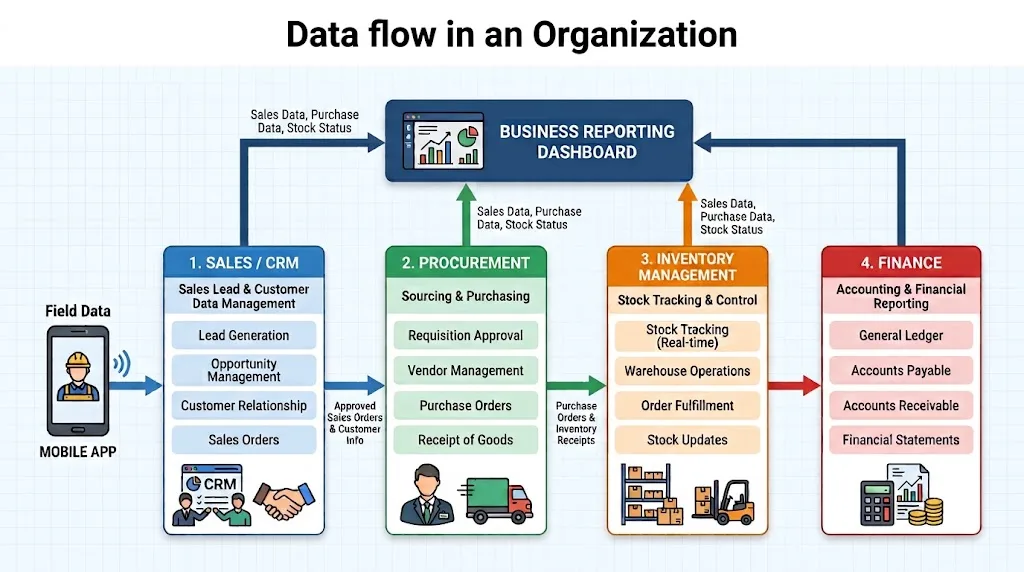
What Does a Digital Operations Platform Actually Include?

Most platforms are built from a combination of these modules, chosen based on which workflows the business actually needs digitized:
- Sales and CRM tracking: lead capture, pipeline stages, customer history
- Procurement and vendor management: purchase orders, approvals, vendor records
- Inventory and warehouse management: stock levels, multi-location tracking, reorder alerts
- Finance and billing: invoicing, payment tracking, reconciliation
- HR and workforce management: attendance, scheduling, payroll triggers
- Document management: contracts, compliance records, version history
- Dashboards and reporting: role-based views for leadership, operations, and finance
- Workflow automation: rules-based approvals and task routing
- Mobile access: field teams, drivers, or warehouse staff updating status from a phone
- API integrations: connecting the platform to existing accounting, CRM, or logistics tools
Who Are the Top Enterprise-Scale Digital Operations Platform Companies?

These four firms operate at a scale suited to Fortune 500 companies, multi-country deployments, and transformation programs with eight or nine-figure budgets.
1. Accenture
Headquartered in Dublin, Accenture reported approximately $69.67 billion in FY25 revenue and had about 799,000 employees as of Q3 FY26, serving clients across 120-plus countries. Best for large enterprises needing end-to-end digital core rebuilds alongside AI deployment at scale.
2. Tata Consultancy Services (TCS)
Founded in 1968 and headquartered in Mumbai, TCS reported consolidated revenue of over $30 billion for the fiscal year ended March 31, 2026, with 584,519 employees. Strong fit for enterprises wanting a single vendor across IT infrastructure, consulting, and operations.
3. IBM
IBM generated $67.5 billion in revenue in 2025, an 8% increase year over year, with consulting and software now making up over 75% of its business mix. A common choice when a digital operations project needs to integrate with existing IBM infrastructure or hybrid cloud systems.
4. Capgemini
The Paris-based firm’s headcount rose to 421,000 employees as of March 2026 following its WNS acquisition, with Q1 2026 revenue growth of 11% at constant currency. Fits large-scale business process transformation, particularly where data and AI integration span multiple regions.
Common thread across Tier 1: minimum engagement sizes typically start in the high six figures, project timelines run 12 months or longer, and procurement processes usually require formal RFPs.
Not sure if you actually need this scale?
Get a free Digital Transformation Assessment from Sigosoft and find out honestly whether your project needs an enterprise consultancy or a leaner team.
Which Companies Fit Mid-Market Digital Transformation Projects?
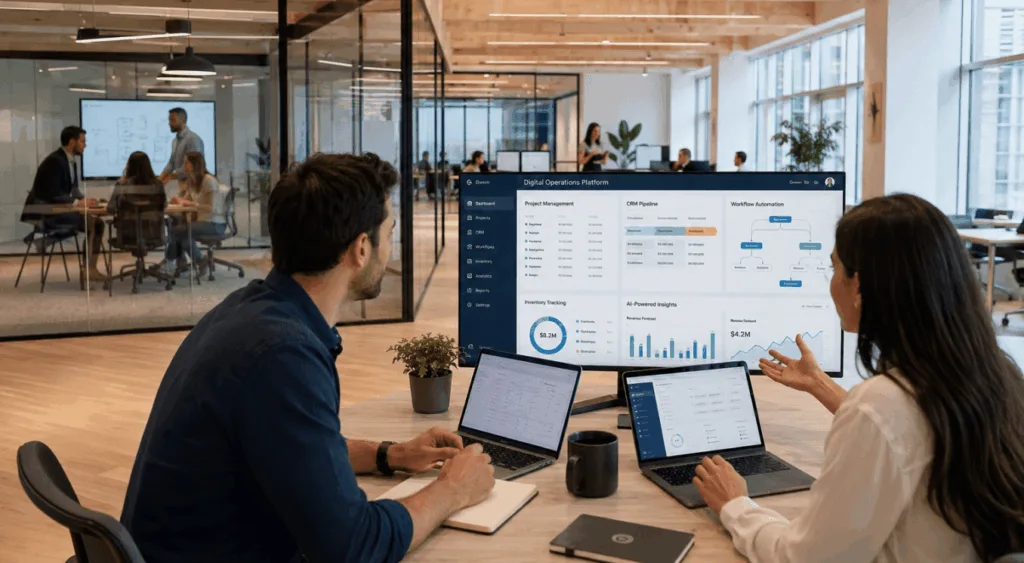
These six firms serve growing companies, single-region businesses, and departments that need a working platform in months, not years, without enterprise-level overhead.
5. Sigosoft
Based in Kerala and led by CEO Praveen Soman, Sigosoft runs a lean team of under 25 people, a deliberate choice that keeps senior developers hands-on rather than handing projects to junior benches. The company states it operates under ISO/IEC 27001:2022-aligned information security practices and describes its SaaS product work as combining cloud frameworks, DevOps-aligned workflows, and AI-assisted architecture planning. Documented delivery work spans healthcare (including telemedicine systems), e-commerce, and logistics, including distribution management software for wholesalers and trading companies replacing manual, Excel-based processes. Khalid Al-Rashid, Head of Operations at StratEdge Group, has credited the team’s post-launch support model. Best fit for founders and operations leaders who want direct access to the people building their platform, not a rotating account team.
6. Experion Technologies
Founded in 2006 and headquartered in Trivandrum, Kerala, Experion runs a team of roughly 1,500 people across offices in the US, UK, and Australia, serving 500-plus clients in 37 countries. The company is ISO 27001:2013 and ISO 9001:2015 certified, and SOC 2 Type II compliant, with delivery work spanning healthcare, retail, logistics, BFSI, and construction. Good fit for mid-size companies wanting enterprise-grade compliance without an enterprise price tag.
7. eSparkBiz
Founded in 2010 in Ahmedabad, Gujarat, team size estimates from third-party data range between roughly 200 and 400 employees depending on the source. The firm holds ISO 9001:2015, ISO 27001:2022, and SOC 2 certifications and reports delivery across healthcare, fintech, e-commerce, and logistics. Suited to SMEs and startups needing a broad service range under one roof.
8. Capital Numbers
Based in Kolkata and established in 2012, Capital Numbers runs a team of 500-plus professionals across three delivery centers and has served over 250 clients. It holds ISO 9001, ISO 27001, and SOC 2 Type II certifications. A solid option for businesses that want an on-demand, scalable team model rather than a fixed-scope contract.
9. MindInventory
Founded in 2011 and headquartered in Ahmedabad, MindInventory operates with a 250-plus person team and holds ISO 27001:2022, ISO 9001:2015, and SOC 2 Type II certifications. Reasonable fit for product-focused digital operations builds, particularly SaaS-adjacent platforms.
10. Softlabs Group
Founded in 2003 and headquartered in Mumbai, Softlabs Group runs a team of roughly 50 to 200 people with additional offices in Sweden, Australia, the US, and the UK. The firm is ISO 27001 and ISO 9001:2015 certified and won a GovTech award at the Aegis Graham Bell Awards, with delivery work spanning fleet management, worker safety, and compliance monitoring for logistics and industrial clients. Fits businesses wanting a long-tenured firm (22-plus years) with a strong senior-to-junior delivery ratio.
Common thread across Tier 2: engagement sizes typically range from $50,000 to $2 million, timelines run 8 to 20 weeks for a first working version, and most offer fixed-scope or dedicated-team pricing.
Digital Operations Platform vs. ERP: What’s the Difference?

A digital operations platform and an ERP solve similar problems but start from opposite directions. An ERP gives you pre-built modules and asks your business to adapt its processes to fit them. A custom digital operations platform starts from your actual workflow and builds software around it.
| Aspect | Digital Operations Platform | Traditional ERP |
| Starting point | Your existing workflow | Pre-built standard modules |
| Customization | Built to order | Configured within vendor limits |
| Implementation time | Weeks to a few months for a first version | Often 6 to 18 months |
| Ongoing cost | Development plus maintenance | Licensing plus configuration fees |
| Best fit | Specific, non-standard workflows | Standardized finance, HR, or supply chain processes |
Choose an ERP when your processes are fairly standard and you want proven, widely-supported software. Choose a custom digital operations platform when your workflow doesn’t fit a standard mold, or when you’re replacing a patchwork of spreadsheets that no off-the-shelf tool covers well.
Digital Operations Platform vs. CRM: What’s the Difference?
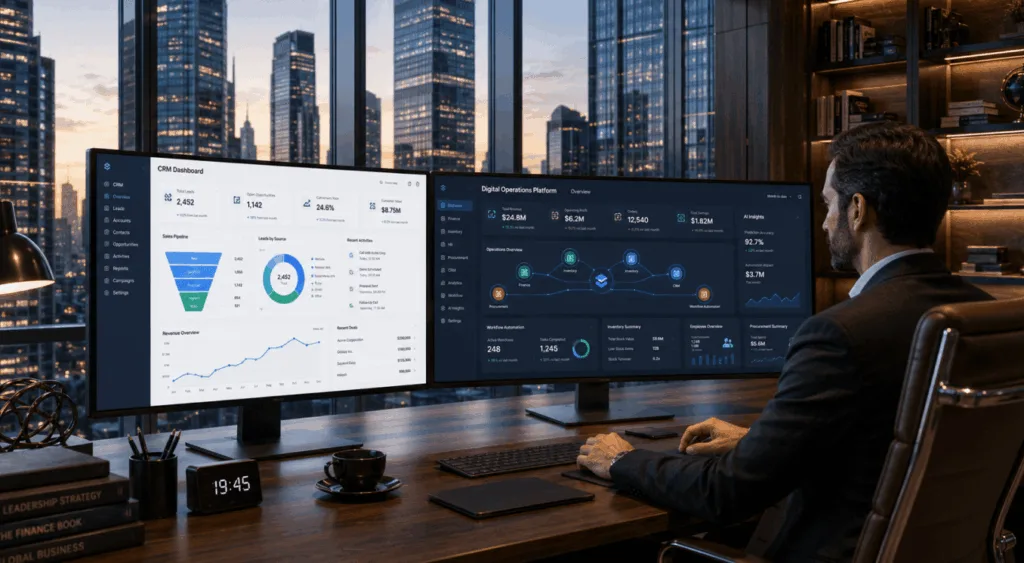
A CRM is one piece of what a digital operations platform can include, not a replacement for it.
| Aspect | Digital Operations Platform | CRM |
| Scope | Entire business workflow (sales, finance, inventory, HR) | Customer and sales relationship data |
| Primary user | Operations, finance, and leadership teams | Sales and marketing teams |
| Data connected | Cross-departmental | Customer-focused only |
| When it’s enough on its own | Rarely, for most operating businesses | When sales tracking is the only real pain point |
If your only problem is disorganized customer data, a CRM alone may solve it. If the problem spans procurement, inventory, finance, and reporting, a CRM becomes one module inside a larger platform rather than the whole solution.
Digital Operations Platform Companies Compared

| Company | HQ | Best For | Certifications |
| Accenture | Dublin | Fortune 500, multi-country | ISO 27001, ISO 27701, SOC 2 Type II (by engagement/business unit)[10] |
| TCS | Mumbai | Single-vendor enterprise IT | ISO 27001:2013 (enterprise-wide), CMMI Level 5, ISO 9001, ISO 22301[11] |
| IBM | Armonk, NY | Hybrid cloud integration | ISO 9001, ISO 27001, ISO 27701, ISO 22301 (corporate and business-unit level)[12] |
| Capgemini | Paris | Large-scale AI and data transformation | ISO 27001, ISO 9001, ISO 22301 (business-unit level)[13] |
| Sigosoft | Bangalore | Direct-access, lean delivery | ISO/IEC 27001:2022-aligned practices |
| Experion Technologies | Trivandrum | Compliance-heavy mid-market | ISO 27001:2013, ISO 9001:2015, SOC 2 Type II |
| eSparkBiz | Ahmedabad | Broad-service SMEs | ISO 9001:2015, ISO 27001:2022, SOC 2 |
| Capital Numbers | Kolkata | On-demand team scaling | ISO 9001, ISO 27001, SOC 2 Type II |
| MindInventory | Ahmedabad | Product/SaaS builds | ISO 27001:2022, ISO 9001:2015, SOC 2 Type II |
| Softlabs Group | Mumbai | Long-tenured, senior-heavy delivery | ISO 27001, ISO 9001:2015 |
A note on how to read the certifications column: the four enterprise firms hold these certifications at the corporate, country, or business-unit level rather than as one single blanket certificate, which is standard practice for organizations their size. The mid-market firms on this list typically hold one company-wide certificate instead. Ask any vendor for the specific certificate and its scope rather than assuming “ISO 27001” means the identical thing across every company on this table.
Which Company Fits Which Need?
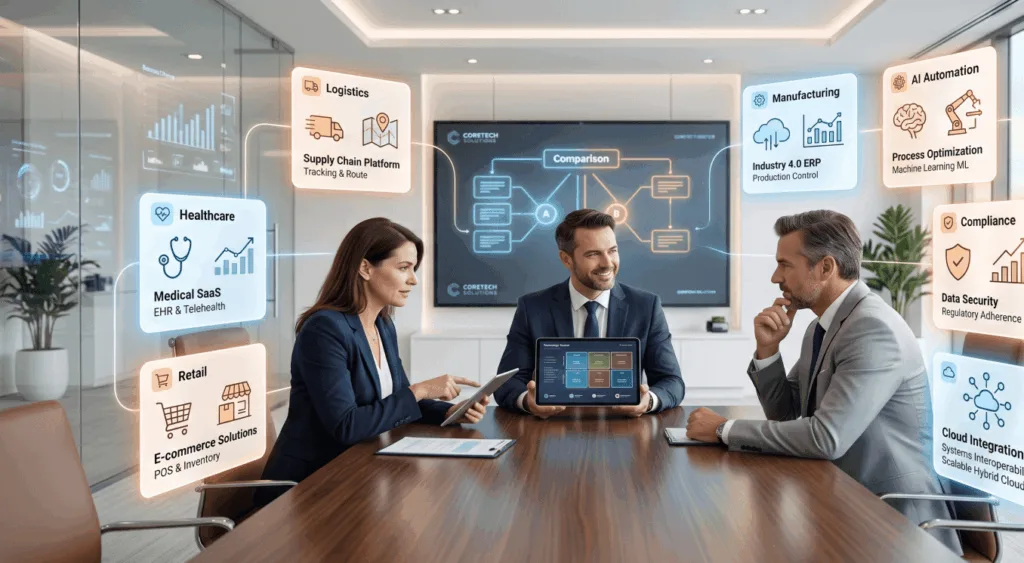
This table maps documented strengths to specific needs, rather than guessing at coverage no source confirms.
| Your Need | Companies With Documented Fit |
| Healthcare or telemedicine workflows | Sigosoft, Experion Technologies |
| Logistics or distribution management | Sigosoft, Softlabs Group, Experion |
| Retail, fintech, or e-commerce | eSparkBiz, Experion |
| Product or SaaS-first builds | Sigosoft, MindInventory |
| Flexible, on-demand team scaling | Capital Numbers |
| Long operating history (20+ years) | Softlabs Group |
| Lean team, direct founder or CEO access | Sigosoft |
Want a straight answer on where your project fits?
Request a Free Cost Estimation from Sigosoft and we’ll tell you which tier and which type of partner actually matches your workflow.
What Does Digital Operations Platform Development Typically Cost?

These are general market ranges to help you budget, not quotes from any single company on this list. Actual pricing depends on scope, integrations, and compliance requirements, so confirm exact numbers directly with a vendor before committing.
- MVP or single-workflow tool: smallest scope, one core workflow digitized (for example, just inventory tracking or just approvals)
- Department-level platform: covers one full department, such as procurement or warehouse operations, with reporting
- Enterprise platform: connects multiple departments with role-based access, integrations, and audit trails
- Global, multi-region platform: adds multi-currency, multi-language, and regional compliance requirements on top of an enterprise build
What actually moves the price: the number of integrations (accounting software, existing CRMs, hardware like barcode scanners), the number of user roles and permission levels, whether the platform needs to work offline in the field, and compliance requirements like HIPAA or GDPR.
What Does a Typical Development Timeline Look Like?

- Discovery: mapping current workflows and defining scope
- UI/UX design: wireframes and interface design for key user roles
- Development: building the core modules and integrations
- Testing: functional testing, user acceptance testing, and security review
- Deployment: rollout, data migration, and user training
- Support: bug fixes, monitoring, and iteration after go-live
For mid-market projects, discovery through deployment typically runs 8 to 20 weeks depending on how many modules are in scope. Enterprise-scale, multi-region builds commonly extend past 12 months once every phase above repeats across regions.
Does Company Size Still Matter in the AI Era?

Company size still matters, but the specific advantages that once made larger firms the automatically safer choice have narrowed. For mid-size digital operations projects, a smaller, experienced specialist team can now compete with much larger firms on quality, not just on price.
For years, size itself was a reasonable proxy for capability. A large enterprise software development company could offer things a small team simply couldn’t: bigger engineering benches to throw at a deadline, dedicated QA departments running full regression cycles, expensive infrastructure most clients couldn’t justify on their own, proprietary internal tooling built up over decades, specialized enterprise architects, and large documentation teams keeping every decision on record. None of that has disappeared. But the gap has closed on several fronts, mainly because of what’s now available to teams of any size.
AI-assisted software development has changed what a small, senior team can produce in a given timeframe. Automated testing frameworks catch regressions that used to require a dedicated QA department. AI code review tools flag security and logic issues before a human ever looks at the pull request. AI-generated documentation keeps a small team’s output as traceable as a large team’s used to be. DevOps automation handles deployment pipelines that once needed a dedicated infrastructure team. Mature open-source frameworks and cloud platforms replace proprietary tooling that used to be a genuine moat. Put together, an experienced specialist team can often deliver work at a standard that used to require far more headcount, and do it on a shorter cycle.
None of this means small is automatically better, that large consultancies are outdated, or that AI replaces the engineers doing the work. It doesn’t mean development has become easy, and it isn’t an argument against hiring firms like Accenture, IBM, TCS, or Capgemini when the project calls for them. Large consultancies remain the right choice for global rollouts, Fortune 500-scale governance, multi-country deployments serving tens of thousands of users, and extensive SAP, Oracle, or legacy system modernization, where the depth of process and compliance infrastructure genuinely earns its cost. Specialist development firms tend to hold their own, and often win on speed and value, for custom software builds, workflow automation, department-level platforms, ERP customization, healthcare platforms, logistics systems, digital operations platforms, and AI-enabled business applications where fast MVP delivery matters more than global governance structure.
| Evaluation Factor | Large Global Consultancy | Specialist Development Company |
| Best project size | Enterprise, multi-country, thousands of users | Department-level to mid-market, single or few regions |
| Communication | Layered, often through account managers | Usually direct with the developers on the project |
| Decision speed | Slower, tied to internal governance | Faster, fewer approval layers |
| Access to senior developers | Variable, depends on account tier | Typically consistent throughout the project |
| Change requests | Formal change-order process | Often handled within the existing engagement |
| Procurement complexity | High, formal RFP processes common | Lower, direct scoping and contracting |
| Personalization | Standardized delivery frameworks | Tailored to the specific business and workflow |
| Delivery flexibility | Structured, harder to pivot mid-project | More adaptable to scope changes |
| Typical timeline | Months to over a year | Weeks to a few months for a first version |
| Cost efficiency (mid-size projects) | Higher overhead relative to project size | Generally better value at this scale |
| Innovation speed | Bound by internal process and legacy systems | Faster to adopt new tools and approaches |
Which Type of Partner Is Right for You?
Choose a large consultancy when your project involves multiple countries, tens of thousands of users, strict enterprise governance requirements, a large digital transformation budget, or extensive SAP, Oracle, or legacy system modernization.
Choose a specialist development firm when your project involves custom software, workflow automation, a department-level platform, ERP customization, a healthcare or logistics system, a digital operations platform, an AI-enabled business application, or when you need a working MVP faster than a formal enterprise engagement would allow.
AI has meaningfully accelerated parts of custom software development, including code generation, automated testing, documentation, security analysis, refactoring, API integration, debugging, and quality assurance. What it hasn’t done is replace the judgment involved in enterprise application development. Sound architecture decisions, an accurate read of business requirements, usable interface design, and close collaboration with the client still depend on experienced software architects, business analysts, UX designers, and senior developers. AI software development tools make the team you hire faster at execution; they don’t substitute for the team’s experience in the first place. The practical takeaway for anyone evaluating a software development partner in 2026 is to match the partner to the project, not to the partner’s name recognition.
How Do You Choose the Right Digital Operations Platform Partner?

Match these factors before comparing feature lists or pricing:
- Budget tier
Under $2 million and regional in scope points to Tier 2. Multi-country with an eight-figure budget points to Tier 1. - Compliance requirements
Healthcare, finance, and government work usually requires a partner with active ISO 27001 or SOC 2 certification, not just “aligned practices.” - Architecture and cloud expertise
Ask what cloud provider they build on and whether the architecture is designed to scale past your current size, not just your current needs. - Team access model
Decide whether you want a dedicated small team you talk to directly, or a large account structure with layered project management. - Communication style
Ask how often you’ll get updates and whether you’ll speak with the people actually writing the code, or only with account managers. - Timeline pressure
If you need a working version in under six months, a boutique mid-market firm will typically move faster than a large consultancy’s procurement and staffing process. - Post-launch support terms
Confirm what’s included after go-live and what counts as a billable change request.
What Common Mistakes Do Businesses Make When Choosing a Digital Operations Partner?

- Hiring for brand name over project fit
A well-known enterprise vendor applying a standard enterprise process to a 20-person company often results in over-engineered software and a bloated timeline. - Skipping the certification check
“ISO certified” and “ISO-aligned” are not the same claim. Ask for the actual certificate and audit date before signing. - Choosing based on price alone
The lowest quote often means the least discovery work upfront, which shows up later as scope changes and rework. - Ignoring integration requirements
A platform that can’t talk to your existing accounting or CRM software creates a second data silo instead of solving the first one. - Accepting poor documentation
If a vendor won’t document the architecture and codebase clearly, replacing them later becomes expensive and risky. - Ignoring post-launch support terms
Many contracts price the build but leave maintenance, bug fixes, and feature updates as a separate, uncapped cost. Get this in writing upfront. - Not asking for a named reference in your industry
A portfolio slide is not proof. Ask to speak with an actual past client in a similar sector. - Overlooking vendor lock-in
Confirm you own the source code and infrastructure access, not just a license to use the finished product.
Where Is Digital Operations Platform Development Heading?

A few shifts are already changing how these platforms get built and used:
- AI agents inside workflows
Instead of just displaying data, platforms are starting to take actions, like flagging anomalies or drafting approval recommendations, rather than only reporting numbers. - Low-code layers for faster iteration
More platforms include a low-code layer so operations teams can adjust simple workflows without a full development cycle. - Process mining
Some platforms now analyze how work actually flows through a business to find bottlenecks the team didn’t know existed. - Predictive analytics over static reporting
Dashboards are shifting from “what happened” to “what’s likely to happen next” for inventory, demand, or staffing. - IoT and digital twins for physical operations
Manufacturing and logistics platforms increasingly pull in sensor data to mirror physical operations digitally in real time.
These trends matter most for businesses planning a platform that needs to still be relevant in three to five years, not just at launch.
Frequently Asked Questions

What does a digital operations platform development company actually build?
It builds custom software connecting a business’s workflows, such as sales, operations, finance, and reporting, into a single system tailored to how that specific business runs, rather than a generic off-the-shelf ERP with unused features.
How much does digital operations platform development cost?
Costs scale with scope, from a single-workflow MVP tool up to a multi-region enterprise build. Mid-market firms on this list typically work in fixed-scope or dedicated-team models; get a scoped quote rather than relying on published ranges.
How long does it take to build a digital operations platform?
Mid-market firms typically deliver a first working version in 8 to 20 weeks. Enterprise-scale programs with multiple integrations and regions commonly run 12 months or longer.
Can a digital operations platform replace an ERP?
For many mid-size businesses, yes, particularly when the workflow is non-standard enough that an ERP would need heavy customization anyway. Large enterprises with standardized global processes often still need an ERP as the system of record.
Can it integrate with SAP, Odoo, or QuickBooks?
Most custom platforms are built with API-based integration in mind, so connecting to accounting or ERP systems like these is generally possible. Ask any vendor for specific examples of integrations they’ve actually built, not just general capability claims.
Can small and mid-size businesses actually afford one?
Yes. That’s the core reason a mid-market tier exists separately from enterprise consultancies. Engagement sizes for firms like the mid-market companies on this list generally start well below what enterprise consultancies quote.
Cloud or on-premise, which is better?
Cloud is the default for most new builds because of lower upfront infrastructure cost and easier scaling. On-premise still gets chosen for specific regulatory, data residency, or legacy-system reasons; ask your vendor which they recommend for your industry.
Is AI included in a digital operations platform?
It can be, but AI should solve a specific problem, like flagging anomalies or forecasting demand, rather than being added as a marketing feature. Ask what specific AI functionality is included and what data it’s trained or configured on.
How secure are these platforms?
Security depends on the vendor’s actual practices, not just marketing language. Look for active ISO 27001 or SOC 2 Type II certification, ask for the audit certificate, and confirm how they handle data encryption and access controls.
Can it automate approvals?
Yes, rules-based approval routing is one of the most common modules requested, particularly for procurement, expense, and vendor onboarding workflows.
What industries benefit most from a custom platform?
Industries with workflows that don’t fit standard software well tend to benefit most, including healthcare, logistics and distribution, manufacturing, and multi-location retail or wholesale operations.
Is a smaller company like Sigosoft safe to hire for a compliance-heavy project?
Team size alone doesn’t determine security posture. Check for active ISO 27001 or SOC 2 certification, ask for the audit certificate, and request references from clients in regulated industries like healthcare or finance before deciding.
What’s the difference between a digital operations platform and an ERP?
An ERP is a pre-built system with standardized modules that a business adapts its processes to fit. A custom digital operations platform is built around the business’s existing workflows instead of forcing the business to change how it operates.
Should I choose a global consultancy or a boutique firm for a mid-size project?
If your budget is under $2 million and the project is regional rather than multi-country, a boutique firm generally offers faster delivery and more direct access to senior developers. Global consultancies are built for larger, longer, multi-region engagements.
Does Sigosoft only work with small businesses?
No. Sigosoft has delivered projects for healthcare, e-commerce, and logistics clients including replacing manual, Excel-based systems with audit-ready platforms, and its distribution management work targets wholesalers and trading companies of varying sizes, not exclusively startups.
What should I ask a vendor before signing a contract?
Ask for their actual ISO or SOC 2 certificate, a named reference client in your industry, what’s included in post-launch support, and who owns the source code once the project is delivered.
Sources
- Accenture Fact Sheet, Fiscal 2026 Q3, Accenture Newsroom
- Tata Consultancy Services, FY26 financial results (TCS Investor Relations); company overview, Wikipedia
- IBM 2025 Annual Report (SEC Form ARS filing)
- Capgemini Q1 2026 investor presentation and full-year 2025 results, Capgemini press releases
- Sigosoft, SaaS Product Development service page, sigosoft.com
- Experion Technologies company profile, LinkedIn; company profile, Crunchbase
- eSparkBiz company profile, LinkedIn; company profile, Tracxn; company review, ITProfiles
- Capital Numbers company profile, as referenced in DEV Community’s roundup of software development companies in India
- Softlabs Group company profile, softlabsgroup.com
- Accenture, “Information Security at Accenture” and Cloud Security Alliance STAR registry listing
- Tata Consultancy Services, TCS MasterCraft Security Policy and CMMI Level 5 announcement, TCS.com
- IBM ISO Management System Certifications page, ibm.com
- Capgemini, Cybersecurity & Data Protection page and Capgemini Technology Services India SOC 3 report, capgemini.com
