
Modern water delivery software connects the driver, the route, and the customer in one system.
Quick Answer: Where water delivery software saves money
- Cuts fuel by fixing backtracking van routes
- Automates recurring subscription orders and billing
- Tracks every jar issued and returned, stopping stock loss
- Optimizes fleets so each van carries more stops
- Flags unpaid invoices and low stock before they cost you
A bottled water supplier serving residential towers in Dubai or offices in Abu Dhabi usually loses more to bad routing and missed refills than to any competitor down the road. The leak is rarely the price of the water itself. It sits inside the daily operation: fuel burned on routes that double back, five gallon bottles that leave the warehouse and never return, and subscription customers tracked on a paper register that nobody updates on a busy Thursday.
Water delivery software closes those gaps. Sigosoft built Sigo Water, an AI assisted platform of seven connected apps, to replace the manual order books, guesswork routing, and separate billing sheets that quietly drain a distributor’s margin. This breakdown walks through exactly where the money goes and how the right system pulls it back.
The global water delivery service market sat at 22.96 billion dollars in 2026 and is projected to reach 30.31 billion by 2032 (Verified Market Reports). Demand is not the problem for most suppliers. The operation behind the delivery is.
What each feature actually does for your business
| Feature | Business benefit |
| AI route optimization | Fewer miles per route, lower fuel and labor cost |
| White-label customer app | Repeat orders and one-tap reorders under your own brand |
| Driver app | GPS navigation and proof of delivery on every drop |
| Warehouse app | Real-time stock and refill alerts, no dispatch against empty shelves |
| Fleet dashboard | Live van status, idling alerts, and pending credit tracking |
| Inventory and jar tracking | Every returnable jar logged in and out, deposits controlled |
| Subscription billing | Recurring orders and invoices generated automatically |
| CRM and customer management | Branch-wise history that supports retention |
| Analytics | Sales, delivery, and VAT reports for faster decisions |
Why do water delivery companies lose money operationally?
Most water businesses do not lose money on a spreadsheet line called “losses.” They bleed it in small, repeated inefficiencies that never get measured.

Paper registers and untracked bottles are where most water distributors quietly lose margin.
Start with the delivery leg itself. Last mile delivery now absorbs around 53 percent of total shipping cost, up from 41 percent in 2018 (GoBolt). For a water distributor, that final stretch between the plant and the customer’s door is the single most expensive part of the business, and it is usually the least controlled. Labor makes up roughly half of last mile expense, with fuel adding another 10 to 25 percent (Go LTL). Both are driven by one thing: how far and how long the vans travel.
Then there is the jar problem. A refillable five gallon jar or cooler that goes out and does not come back is pure loss, and manual logs rarely catch it in time. Deposits get forgotten. Broken and smelly cans get mixed into the count. Multiply a handful of untracked bottles per van across a month and the number stops being small.
Subscriptions are the third leak. Recurring customers are the most valuable accounts a water company has, yet they are often managed by memory. A skipped delivery, a missed payment, or a customer who quietly churned because nobody followed up all show up as revenue that should have been recurring and was not.
Add the everyday friction: a call center taking orders on paper, a supervisor counting vans in and out by hand, an admin chasing pending credits across three notebooks. None of these feels expensive on its own. Together they are the reason a growing water business can add customers and still watch its margin shrink.
Sigosoft has written before on how these problems compound, and how a single connected system resolves them, in Solve All Your Water Delivery Problems With Just One Solution.
How does AI improve water delivery efficiency?
The biggest avoidable cost is inefficient routing, and this is where AI earns its place. Manual planning with a map and a driver’s instinct cannot account for live traffic, delivery windows, van capacity, and stop sequencing at the same time.

AI route optimization trims miles and fuel by sequencing every stop before the van leaves.
Fleets that adopt route optimization software average an 18.7 percent reduction in miles driven and 15.3 percent fuel savings (Go LTL). Most operators land in a 15 to 25 percent fuel saving band once optimized routing is paired with GPS tracking (Mobility Infotech). Sigo Water’s own AI route engine calculates the most efficient path per driver based on traffic, order volume, and proximity, which the platform reports can reduce delivery time by up to 30 percent.
Routing is only the start. The AI layer inside Sigo Water also handles:
- Demand forecasting
It reads historical order patterns to predict high demand days, so you stock and staff for the real curve instead of guessing. - Driver scoring
Delivery speed, delays, and customer feedback roll into an automatic performance score, which surfaces who is efficient and who is costing you time. - Smart assignment
Orders are auto assigned or reassigned to drivers based on live availability and workload, so no van sits half loaded while another runs overtime. - Automated alerts
Low stock, delayed deliveries, unpaid invoices, and complaints trigger real time notifications before they turn into lost revenue.
That combination is why Sigosoft positioned the launch as the UAE’s first AI assisted water delivery management platform. The point is not novelty. It is that intelligence applied to routing, forecasting, and assignment attacks the two costs that hurt most, labor and fuel, at the same time.
See it against your own numbers. Book a live Sigo Water walkthrough, share your current van count and delivery zones, and the Sigosoft team will map your existing routes against an optimized plan so you can see the fuel gap for yourself.
How does subscription delivery automation work?
Water is a repeat purchase. A household orders the same bottles on roughly the same schedule, and a restaurant or office reorders like clockwork. That predictability is the most profitable feature of the business, and manual systems waste it.

Recurring orders scheduled once, then generated, invoiced, and reminded automatically.
Subscription automation turns those repeat orders into a standing schedule the system runs on its own. Inside Sigo Water, a customer sets up a recurring order once through the customer app, available under your own branding on both the Google Play Store and the Apple App Store. From there the platform handles the rest:
- It generates each delivery on schedule without anyone re keying the order.
- It raises the invoice automatically and records the payment method, whether card, wallet, or cash on delivery.
- It sends the customer delivery reminders, driver ETA, and a digital receipt.
- It flags a failed payment or a skipped delivery to the admin instead of letting it slip.
That last point matters more than it looks. A failed delivery costs an average of about 17 dollars per drop in redelivery and labor (Go LTL), and a lapsed subscription costs the entire lifetime value of that account. Automation catches both early.
For the customer, the experience is a clean, repeatable reorder rather than a phone call. For the operator, recurring revenue becomes visible and predictable on the admin dashboard. Sigosoft covered this shift in depth in How Water Delivery Apps Can Actually Save Your Time and Money.
How does fleet optimization help water businesses?
Fleet optimization is about squeezing more delivered bottles out of every van, every mile, and every driver hour. Route density, the number of stops completed per mile driven, is the single highest leverage change most delivery operations can make (GoBolt).
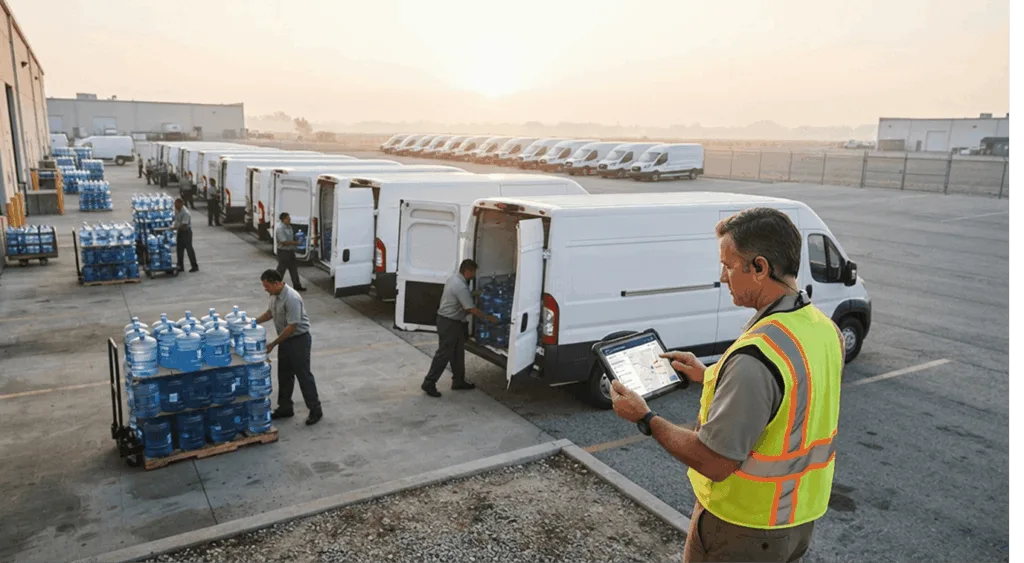
Fleet optimization gets more delivered bottles out of every van, mile, and driver hour.
Sigo Water gives each role the tool to push that density up:
- The driver app provides GPS navigation on AI optimized routes, live check in and check out, and delivery proof by e signature, photo, or OTP, so every drop is confirmed and every route stays tight.
- The supervisor app tracks vans in real time, catches route deviations and idling, and lets a supervisor reassign an order the moment a van falls behind.
- The admin panel runs full fleet and driver management, shows daily, weekly, monthly, and lifetime van status, and tracks pending credits per van so no vehicle quietly runs at a loss.
- The warehouse app keeps stock levels honest with real time inventory and AI based refill alerts, so a van is never dispatched against stock you do not have.
The measurable result across optimized fleets is an 18 to 25 percent reduction in total last mile cost within 90 days of deployment (Go LTL). For a water business, that shows up as fewer vans needed for the same delivery load, lower fuel bills, and drivers who finish routes instead of running overtime.
This is the difference between a fleet you react to and a fleet you run. Sigosoft’s piece on The App Transformation for Your Water Delivery Business walks through what that operational shift looks like day to day.
Manual operations vs water delivery software: what changes?
| Task | Manual operations | Water delivery software |
| Orders | Paper registers, double entry | One shared database, entered once |
| Billing | Manual invoices, delays | Automated invoices and receipts |
| Inventory | Guesswork, jar loss | Real-time stock and jar tracking |
| Route planning | Fixed, habit-based | AI optimized and traffic-aware |
| Customer management | Scattered notes | Branch-wise CRM history |
| Subscriptions | Tracked by memory | Auto-scheduled and billed |

Real time inventory records every jar in and out, closing the deposit and stock loss gap.
What common mistakes drain water delivery profits?
Even operators who invest in software leave money on the table by getting a few basics wrong.
- Planning routes by habit, not data
A route that made sense two years ago is rarely still optimal. Fixed routes ignore new customers, traffic changes, and demand shifts, and they quietly add miles every single day. - Treating jar deposits as an afterthought
If issued and returned bottles are not reconciled automatically, loss hides in plain sight. The system should record every jar out and in, and apply refundable deposits without a human remembering to. - Running the call center and the field on separate systems
When order taking, dispatch, and billing do not share one database, the same order gets entered twice and reconciled never. One connected platform removes the double handling. - Ignoring driver performance data
Without scoring, the difference between your fastest and slowest driver stays invisible, and so does the cost of it. - Buying software you cannot brand or scale
A tool that cannot carry your logo on the app stores, or cannot add a second branch with its own pricing and tax rules, becomes a ceiling within a year.
Avoiding these is less about spending more and more about running one system that sees the whole operation. Sigosoft made that case in A Single App to Simplify Water Delivery.
Frequently Asked Questions
What is water delivery software?
Water delivery software is a digital platform that manages a bottled water business end to end. It handles order placement, delivery scheduling, route planning, jar and inventory tracking, subscription billing, and payments across connected apps for customers, drivers, supervisors, warehouse staff, and admins, replacing manual order books and separate billing sheets.
How much does water delivery software cost?
Pricing depends on fleet size and modules. As a published example, Sigo Water lists a one-time setup fee of AED 7,340 and an annual subscription of AED 11,010 per year, or AED 1,100 monthly, for up to 10 vans, with extra vans at AED 367 per year each. Request a quote for your operation.
Can I launch my own branded white-label water delivery app?
Yes. A white-label water delivery app is published under your own name and logo on the Google Play Store and Apple App Store. Your customers, drivers, and staff use apps that carry your brand, while the platform and its updates run behind the scenes.
How does water delivery software reduce operational costs?
It cuts the two largest costs first, labor and fuel, through AI route optimization that trims miles driven by around 18 percent on average. It also automates subscription billing, tracks returnable bottles to stop stock loss, and flags failed deliveries and unpaid invoices early, so small daily leaks stop compounding into lost margin.
Can water delivery software handle recurring subscription orders?
Yes. Sigo Water lets a customer set a recurring order once, then generates each delivery on schedule, raises the invoice automatically, records the payment, and sends reminders and digital receipts. The admin dashboard shows recurring revenue clearly and flags any skipped delivery or failed payment before the account churns.
How do bottled water companies track returnable bottles?
The software logs every jar and cooler issued and returned, applies refundable deposits, and produces jar-return reports. Warehouse and supervisor apps reconcile full, empty, broken, and defective cans, which prevents the slow inventory loss that manual counting tends to miss.
Does the software optimize delivery routes for water vans?
Yes. The driver app runs AI optimized routes based on live traffic, order volume, and proximity, which Sigo Water reports can reduce delivery time by up to 30 percent. Supervisors track vans in real time, catch idling and deviations, and reassign stops instantly to keep every route tight and dense.
Can it manage multiple branches across the Emirates?
Yes. The platform scales from a single branch to a multi-branch distributor. Each branch runs its own pricing, tax rules, and delivery zones across Dubai, Abu Dhabi, Sharjah, and beyond, while central analytics keep the whole business in one view.
How long does it take to launch water delivery software?
Deployment can be completed in as little as 2 to 3 weeks. Sigosoft’s onboarding covers setup, product import, driver app training, and full technical support. The apps are published under your own branding on the Google Play Store and Apple App Store for a fully white labeled rollout.
Does water delivery software support Arabic, VAT, and GCC business needs?
Yes. Sigo Water offers bilingual English and Arabic interfaces with right to left layouts, AED currency with VAT compliance, local delivery cutoff settings, and GCC compliant cloud hosting. It is ready to integrate with regional payment gateways, making it configurable for UAE, wider Middle East, and international markets.
Book a demo and see the savings on your own numbers
The fastest way to judge water delivery software is against your real operation, not a feature list. Book a Sigo Water demo and you get a clear view of the outcomes: the fuel saved through AI route optimization, the labor hours recovered by subscription automation, the jar losses closed by real-time inventory, and the ROI across your fleet. Share your van count and delivery zones across the Emirates, and you receive a costed rollout plan rather than a sales pitch. Founded in 2017, Sigosoft has delivered over 100 projects across more than 30 countries, and the water platform is live on Android and iOS today.
