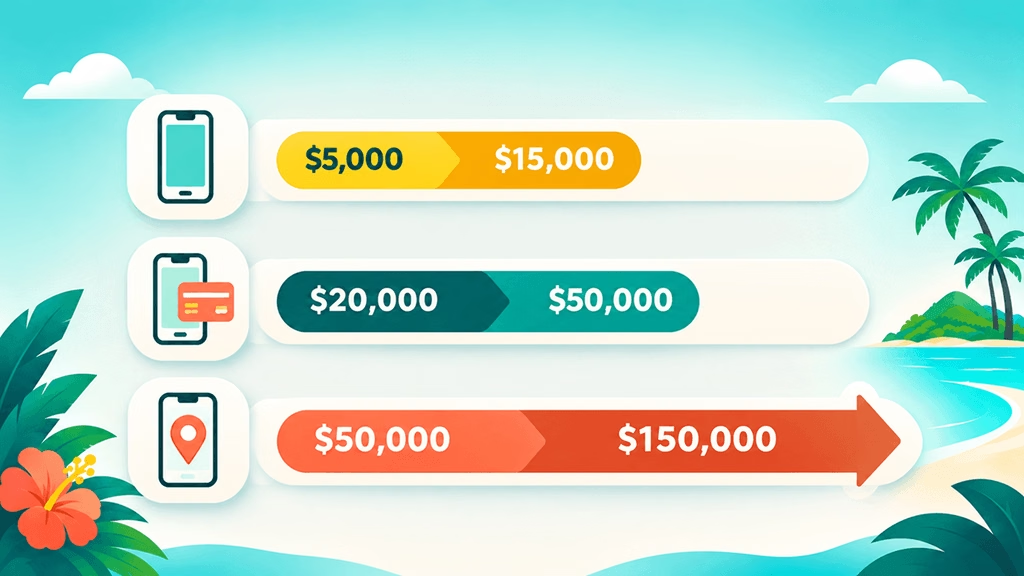
App development cost in Jamaica depends far more on what you build than where you build it. Published estimates for Jamaica put a simple app at roughly US$5,000 to US$15,000, a mid-complexity app with accounts, payments and an admin panel at US$20,000 to US$50,000, and a complex platform such as delivery, marketplace or telemedicine at US$50,000 to US$150,000 or more (PerfectionGeeks). Wider industry research quotes a much broader US$15,000 to US$300,000+ depending on scope, platform and team location (Netguru, 2026).
On top of the build, budget about US$124 for store accounts in year one and roughly 15% to 25% of the build cost per year to keep the app running. These are market figures to help you plan. They are not a quote, and the rest of this guide shows you how to turn them into a number for your own idea.
Why one price never fits
Picture two business owners who both say, “I need an app.”
The first runs a bakery in Kingston and wants customers to order for pickup. The second runs a tour company in Montego Bay and wants guests to book, pay by card, and get a confirmation with a driver’s location. (Both are made-up examples, not clients.)
The bakery needs a handful of screens and a simple order list. The tour company is really building three products: a customer app, a driver or guide app, and an admin panel to manage bookings. Same words, very different budgets.
So the useful question is not “what does an app cost in Jamaica?” It is “what exactly does my app need to do, for whom, and on which phones?”
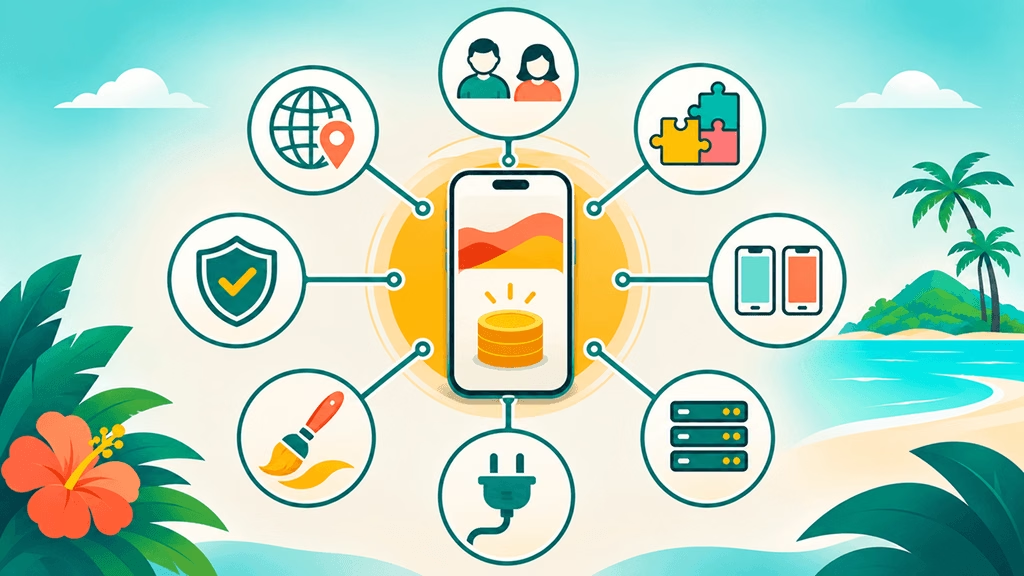
What actually drives the cost
Number of user roles.
A customer, a driver and an admin each need their own screens and permissions. Every extra role adds design, build and testing time.
Features.
Login, push notifications, search, payments, chat, maps and live tracking are each small projects. Real-time features cost more than static ones.
Platforms.
Android only, iOS only, or both. With a cross-platform framework such as Flutter, one codebase can serve both stores, which usually lowers the build and maintenance bill compared with two separate native apps.
Backend and admin panel.
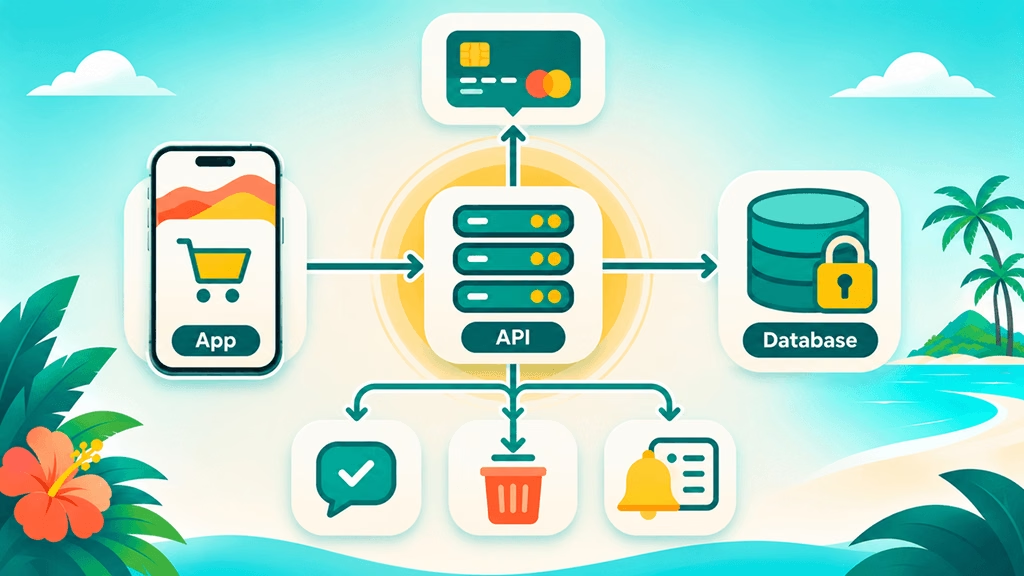
Users see the app. Behind it sit a database, an API and a dashboard where you manage orders, users and content. First-time buyers often forget this half exists.
Integrations.
Payment gateways, SMS, email, WhatsApp, maps and accounting tools all need setup and testing.
Design depth.
A clean template-based interface costs less than a fully custom design system with animations.
Security and compliance.
Health, finance and anything that stores personal data needs extra care. In Jamaica that includes the Data Protection Act, covered below.
Team and location.
Rates differ widely between local agencies, freelancers and offshore teams. We compare them in the next sections.
App development cost in Jamaica: ranges by app type
| App tier | Typical examples | Published range (USD) |
|---|---|---|
| Simple | Informational app, basic booking or ordering, one user role | $5,000 to $15,000 |
| Moderate | Login, payments, push notifications, admin panel, a few integrations | $20,000 to $50,000 |
| Complex | Delivery, marketplace, telemedicine, real-time tracking, multiple user roles | $50,000 to $150,000+ |
Source: PerfectionGeeks’ Jamaica cost guide (updated 2026). It is an agency estimate, so treat it as orientation, not a price list. For comparison, a Canadian agency guide quoting Clutch survey data reported an average project cost of about US$90,780 and an average timeline of 11 months (Space-O, 2026). Averages like that include very large enterprise builds, so most small businesses will sit well below them.
A quick currency note: a March 2026 legal guide from Ramsay & Partners converted JMD 5 million to about US$31,100, which implies roughly JMD 160 per US dollar. Check the Bank of Jamaica rate on the day you budget. At that rate, US$20,000 is about JMD 3.2 million.
How long does it take?
Published Jamaica guides suggest 2 to 4 months for simple apps, 4 to 8 months for medium apps and 8 months or more for complex ones. Our own planning ranges in the Nigeria cost guide are shorter for the same labels: 2 to 6 weeks for a basic app, 6 to 14 weeks for a medium app and 2 to 6 months for an advanced one. The gap comes from different scope assumptions and team sizes, which is why you should always compare quotes against a written scope, not against a label like “medium”.
Local agency, freelancer or offshore partner?
| Option | Where it helps | Watch out for |
|---|---|---|
| Local agency | Same time zone, local market knowledge, easy in-person meetings | Smaller talent pool for specialist skills, and quotes can be high for complex builds |
| Freelancer | Lowest upfront cost for small, well-defined jobs | One person is a single point of failure for design, build, testing and support |
| Offshore partner | Larger team under one roof, often stronger value on bigger projects | Needs a clear written scope, regular demos and agreed overlap hours |
No option is automatically cheaper. A low quote with a vague scope often costs more once change requests start. Ask every provider for an itemised estimate (screens, features, integrations, testing, support) so you can compare like with like.
The costs people forget
- Store accounts.
Apple charges US$99 per year for the Apple Developer Program. Google charges a one-time US$25 for a Play Console account. That is about US$124 in year one for both stores and US$99 a year after that. Apple and Google also take a commission on digital purchases made inside apps, so check their current rates if you sell subscriptions or digital goods. - Maintenance.
Published guides put annual upkeep at roughly 15% to 25% of the build cost for bug fixes, operating system updates, security patches and small improvements. - Payment gateway fees.
These come out of each transaction and vary by provider and card type. - Hosting and third-party services.
Servers, maps, SMS, email and push notification providers are recurring costs. - Compliance.
Registering as a data controller and building consent and data-request features takes time and, sometimes, legal advice. - Marketing.
An app that nobody knows about earns nothing. Budget for launch promotion.
Jamaica-specific things that change your budget
Your customers are on phones
DataReportal’s Digital 2026 report counted 3.18 million cellular mobile connections in Jamaica at the end of 2025, equal to 112% of the population, and 2.54 million internet users in October 2025 (DataReportal). For most Jamaican businesses, a phone-first experience is not optional. Test on mid-range Android devices, not just the newest iPhone.
Payments are a design decision
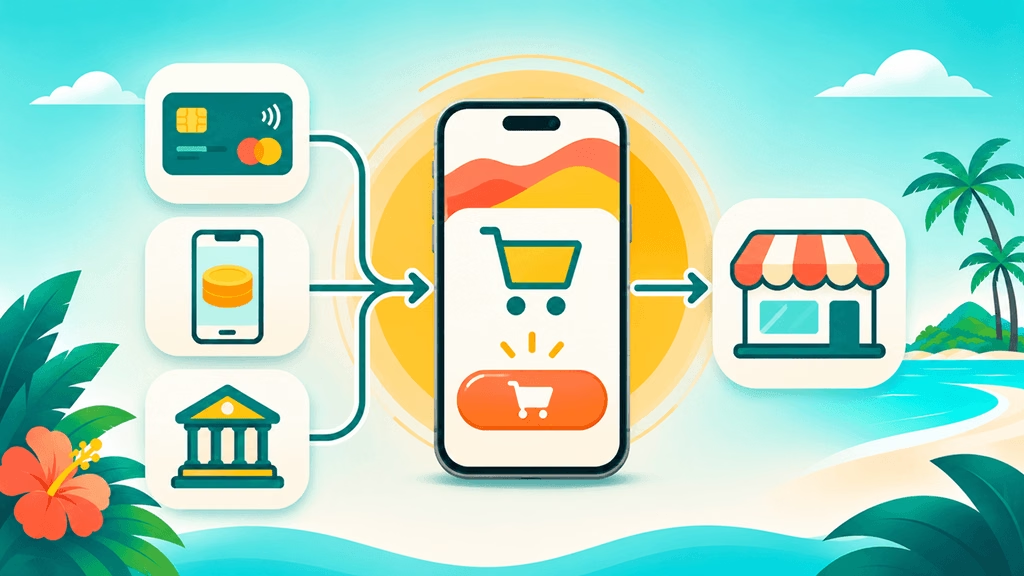
Jamaica’s payment landscape is mixed. Lynk, the wallet from NCB’s fintech arm, and WiPay, which operates across several Caribbean islands, are two names you will hear often, alongside card gateways and bank transfers. WiPay publishes developer integration steps for businesses in its Jamaica FAQ. The Jamaica Observer has reported that wallets can be closed loops, where one wallet only sends to another account on the same wallet (Jamaica Observer). That article is undated in our source, so confirm the current position with each provider.
What this means for your budget: every payment method you support adds integration and testing work. Decide early which two or three your customers truly use, and add the rest later.
The Data Protection Act affects what you build
Jamaica’s Data Protection Act, 2020 is a GDPR-style law. According to Ramsay & Partners’ 2026 practice guide (Chambers, updated March 10, 2026):
- Data controllers must register with the Information Commissioner before processing personal data.
- Certain controllers, including those processing personal data on a large scale or sensitive data, must appoint a data protection officer.
- Security breaches affecting personal data must be reported to the Information Commissioner and to affected people within 72 hours of becoming aware of them.
- The Act can apply to businesses outside Jamaica that offer services to people in Jamaica.
- The guide reports no data localisation rule, but transfers of personal data abroad need adequate protection or a listed exception.
- Fines for companies can reach 4% of annual gross worldwide turnover.
On enforcement, the same guide says the Information Commissioner’s enforcement powers were not yet in effect and no action had been taken for failure to register. A June 2026 Jamaica Gleaner report likewise noted that full enforcement provisions had yet to be activated. That can change, so check with the Office of the Information Commissioner and a Jamaican lawyer. This is general information, not legal advice.
In engineering terms, this means building consent screens, a way to export or delete a user’s data, access controls and breach logging from day one. Adding them later costs more.
Plan for weak signal
Keep screens light, cache key data on the phone and let users finish common tasks when the connection drops. This is cheaper to design in than to retrofit.
How we scope and price an app at Sigosoft
We are a software company with teams in Bangalore and Calicut and a US office in Oak Park, Illinois. We build mobile apps, web platforms and SaaS products for clients in 40+ countries, and we are ISO 27001:2022 certified. A Jamaican morning is an Indian evening, so regular calls fit comfortably.
Here is how we keep budgets honest:
- Roadmap first.
Tell us the idea and we send a roadmap with scope, timeline and cost, so you can compare us with other quotes on a like-for-like basis. - Start from a proven base when it fits.
We offer ready-made foundations that we customise to your brand, including food delivery, e-commerce and telemedicine apps. Reusing a tested base can cut the amount of new work you pay for, though the saving depends on how far your needs differ from the base. - One codebase where it makes sense.
We build with Flutter and React Native for iOS and Android, and with Laravel and Vue.js for backends and web apps. - NDA first, and the code is yours.
We sign an NDA before you share details, and the IP is yours by contract. - Phased delivery.
We would rather help you launch a focused first version and grow it than sell you a giant build up front. You can see how our custom mobile app development process works, and browse our case studies.
If you want a worked example of how we explain pricing for another market, our app development cost in Nigeria guide follows the same logic.
Five ways to keep your first version affordable
- Build a minimum viable product.
Launch with the few features that prove people want the app, then add more using real feedback. - Choose one codebase.
A cross-platform build usually costs less to create and to maintain than two native apps. - Start with the platform your customers use.
Check your website analytics or ask customers before paying for both. - Reuse proven components.
Login, payments and notifications are solved problems. Do not pay for custom versions unless you need them. - Phase your integrations.
Launch with your two main payment methods and add others once there is demand.
Common mistakes to avoid
- Choosing on price alone.
The cheapest quote often leaves out testing, the admin panel or support. - No written scope.
Without it, every new idea becomes a change request. - Forgetting the admin panel.
You need a way to manage orders, users and content. - Ignoring the Data Protection Act.
Registration and privacy features are easier to plan early. - Budgeting nothing for maintenance.
Phones and operating systems change every year. - Not owning your accounts.
Register the Apple and Google developer accounts in your company’s name and make sure you receive the source code. - Building everything at once.
Android, iOS, web and an admin panel on day one is how budgets double.
Questions to ask any developer before you sign
- Can I see an itemised estimate by feature and screen?
- Who owns the source code and the store accounts?
- What is included in testing, and what happens if you find bugs after launch?
- What does support cost after launch, and how fast do you respond?
- How will you handle consent, data requests and breach reporting under Jamaican law?
- Which payment providers have you integrated before?
Frequently asked questions
How much does it cost to build an app in Jamaica?
Published estimates range from about US$5,000 to US$15,000 for a simple app, US$20,000 to US$50,000 for a moderate one and US$50,000 to US$150,000 or more for a complex platform. Your cost depends on features, platforms, integrations and the team you choose.
Is it cheaper to hire a local developer in Jamaica?
Not always. A local freelancer can be cheaper for a small, well-defined job. For larger projects, an offshore team can offer more capacity for the money. Compare itemised quotes against the same written scope.
How long does it take to build an app?
Simple apps can take weeks to a few months. Complex apps with real-time features or several user roles usually take several months. Published Jamaica guides and our own planning ranges differ, so confirm the timeline against your scope.
Do I need to register under Jamaica’s Data Protection Act?
According to a 2026 practice guide, data controllers must register with the Information Commissioner before processing personal data. Whether and how it applies to you depends on your situation, so check with the Office of the Information Commissioner and a Jamaican lawyer.
What does it cost to publish on the App Store and Google Play?
Apple charges US$99 per year and Google charges a one-time US$25, so about US$124 in the first year for both stores.
How much does app maintenance cost?
Published guides suggest roughly 15% to 25% of the original build cost per year. Apps with many integrations or heavy usage sit at the higher end.
Get a realistic number for your app
If you have an idea and want to know what it would take in budget and time, talk to our team. Tell us what you want to build and who it is for, and we will send a roadmap with scope, timeline and cost.
Thanks for the feedback!

Praveen Soman CEO, Sigosoft
Technology entrepreneur and digital product strategist with a passion for building scalable software products and solving real-world business challenges. Enjoys exploring AI, emerging technologies, startups, and the ideas shaping the future of technology.
Connect on LinkedIn →Start the discussion
Questions or experiences to share? Our team reads and replies.