
In Nouakchott, a grocery delivery order placed at 6:15 PM rarely comes with a street address. It comes with a rider’s phone number, a WhatsApp pin drop, and a landmark: “next to the Tevragh Zeina mosque, blue gate.” That single detail, more than any framework or programming language, is what determines whether a delivery app in this region survives contact with real users. We learned that the hard way while building a food and grocery delivery platform for a client in Mauritania, and this blog guides you through the key things to consider for delivery app development in West Africa.
The Quick Answer
- Cost range: $10,000 to $18,000 for an MVP, $35,000 to $70,000+ for a full two-sided platform with admin dashboard.
- Timeline: 10 to 16 weeks for an MVP, 5 to 9 months for a full platform with multi-country payment logic.
- Payment priorities: Wave and Orange Money cover the most ground across UEMOA countries; a payment aggregator (PayDunya, CinetPay, or similar) is the fastest path to launch.
- Biggest technical constraint: streets without usable names or numbers. Dispatch has to run on GPS pins, landmarks, and phone calls, not postal addresses.
Why This Market Doesn’t Behave Like a Generic Playbook
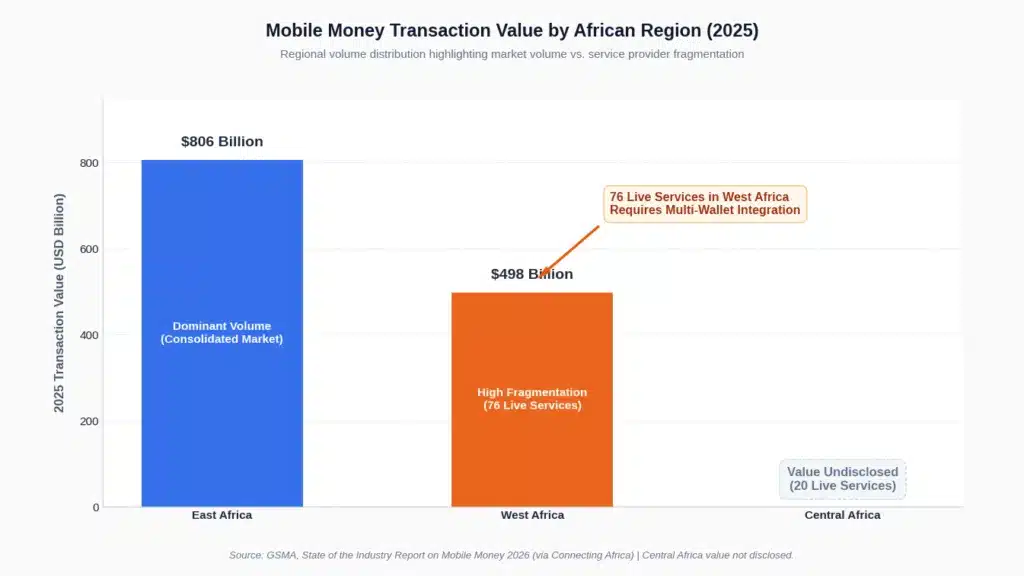
Mobile money in Sub-Saharan Africa is not a secondary payment method bolted onto a card-first checkout. It is the checkout. Globally, mobile money processed more than $2 trillion in transactions in 2025, a 23% jump over 2024, and registered accounts reached 2.3 billion, up 268 million in a single year. West Africa alone accounted for $498 billion of that transaction value and hosts 76 live mobile money services, more than any other African region. Merchant payments, the category a delivery app lives in, grew almost 50% to $155 billion in 2025, making it the fastest-growing use case in the entire industry. [GSMA, State of the Industry Report on Mobile Money 2026].
That growth is exactly why three agencies will quote a founder three different prices and three different payment strategies. Most of them are pricing a generic Uber Eats clone and swapping in a payment SDK at the end. The apps that actually retain users here are engineered around the region’s constraints from day one, not patched afterward.
How Delivery Apps Work, Country by Country
How Does Senegal’s Delivery Market Work?

Senegal is the market where Wave rewired the entire payment conversation. Wave launched in Senegal in 2018, won a full Electronic Money Institution license from the BCEAO in April 2022, becoming the first non-bank structure to hold one, and built its model on a flat 1% transfer fee with free cash-in and cash-out at agents. That pricing forced Orange Money, the previously dominant operator, to cut its own fees, and by 2025 Wave held a majority share of Senegal’s mobile money market. Free Money and Wizall remain smaller but real alternatives, mainly for bill payment and remittance-adjacent use cases. Senegal’s mobile internet penetration reached 125.78% of the population (multiple SIMs per user included) by the end of 2025, with 23.38 million mobile internet subscribers recorded by the ARTP. The local quirk that breaks a standard build: Dakar’s motorcycle-taxi culture (jakartaman) means your rider-assignment logic needs to account for informal, high-density traffic patterns that a Google Maps ETA will consistently underestimate.
Why Is Côte d’Ivoire Different From Senegal?
Abidjan runs on a similar wallet mix, Wave, Orange Money, MTN Mobile Money, and Moov Money, but the operational reality is different. Mobile money penetration in Côte d’Ivoire sits around 86%, and the country’s cellular penetration rate was measured at 164.5% by ARTCI, reflecting widespread multi-SIM ownership. Internet penetration is projected at 67% for 2025. The quirk that catches new entrants: rainy season in Abidjan (roughly June through October) regularly floods Cocody and Adjamé access roads, and a motorcycle-first fleet needs a dispatch layer that can reroute or pause zones without killing the whole platform’s SLA.
What Makes Mali’s Delivery Logistics Harder?
Orange Money is the default wallet across Mali, with Wave and Moov Money present but smaller. Bamako’s ACI 2000 district has relatively usable addressing; older neighborhoods do not. Security conditions in parts of the country beyond the capital also mean a delivery app here needs a hard geofence in its dispatch logic from day one, not as a later patch, since expanding delivery zones without local operational input can put riders at real risk.
Why Does Guinea Run on Cash More Than Its Neighbors?
Guinea uses its own currency, the Guinean franc (GNF), not the CFA franc, which trips up multi-country builds that assume a single currency zone. Orange Money and MTN Mobile Money are present, but cash on delivery remains the dominant payment method for most delivery categories. Conakry’s peninsula geography, one main road in and out of the city center, means route planning has far less flexibility than a grid-based city, and a single accident or market-day congestion event can back up deliveries citywide.
How Do You Handle Payments in Burkina Faso?
Orange Money and Moov Money lead in Burkina Faso, with Wave also operating in the market. LigdiCash is a commonly used local aggregator for merchants who don’t want to negotiate directly with each operator. The defining constraint here is security-driven: delivery zones in Ouagadougou need to be reviewed regularly against current conditions, and a platform’s admin dashboard should make it fast to suspend a zone, not require a code deployment to do it.
What’s Different About Cameroon’s Payment Landscape?
Cameroon sits in the CEMAC zone, using the XAF franc under the BEAC central bank, not the XOF franc under the BCEAO. This is the single most common mistake in multi-country builds: teams assume “franc CFA” is one currency and hardcode assumptions that break the moment a Cameroon order tries to settle against a Senegal-configured payment flow. MTN Mobile Money and Orange Money dominate, and Wave entered the Cameroonian market in 2025, one of four new mobile money services to launch across Africa that year. Douala’s rainy season disrupts motorcycle delivery similarly to Abidjan, and the country’s bilingual French and English administrative split (Anglophone regions in the Northwest and Southwest) matters if your customer support flow is French-only.
Why Does Morocco Need a Different Payment Stack Entirely?
Morocco is the outlier in this list. Card acquiring through CMI is far more viable here than anywhere else on this page, and cash networks like CashPlus and Wafacash still handle significant volume alongside wallet apps. Morocco’s internet penetration is estimated at 92.2%, among the highest in the region, with roughly 35.3 million internet users. Glovo has a genuinely strong footprint in Morocco’s food delivery market, which changes the competitive question for a new entrant from “should we build” to “what segment or city does Glovo not serve well.” Darija and, in some regions, Amazigh matter more than standard French for customer-facing copy.

What Should You Know Before Building for Mauritania?
Mauritania is the market with the widest gap between phone ownership and internet access anywhere on this list: mobile connections reached 119% of the population, but only 37.4% of the population used the internet by the end of 2025. That gap is the reason a Mauritania-facing app cannot assume a Stripe-style checkout experience; Bankily, Masrvi, and Sadad Mauritanie are how people already pay for electricity and phone credit, and a delivery app needs to meet them there. Masrvi has no public developer sandbox; integration is arranged directly as a merchant relationship with BMCI, the bank behind the product. Hassaniya Arabic and Pulaar matter for voice-note and WhatsApp ordering flows aimed at users with lower French literacy.
How Do You Choose Between Wave, Orange Money, and the Rest?

Two decisions sit underneath every payment integration in this region: which wallets to support, and whether to integrate directly with operators or go through an aggregator.
Wallets that matter most, by scale: Wave has the lowest fees and the fastest-growing user base across Senegal, Côte d’Ivoire, Mali, Burkina Faso, The Gambia, and Uganda, and entered Cameroon in 2025. Orange Money has the broadest footprint of any single operator across Francophone Africa, spanning nearly every country covered in this guide. MTN Mobile Money leads in Cameroon and is a strong second option in Côte d’Ivoire and Guinea. Moov Money matters most in Côte d’Ivoire, Burkina Faso, and Mali.
Direct integration versus an aggregator: integrating directly with an operator’s API gets you a lower per-transaction fee and full control over the payment experience, but it means separate technical and compliance work for every wallet, in every country, and separate commercial negotiations with each operator. An aggregator like PayDunya, CinetPay, Bizao, or InTouch bundles several wallets behind a single integration and gets you to launch faster, in exchange for a higher cut per transaction and less control over edge cases like failed reversals.
Our rule of thumb: if you’re launching in one or two cities and need to validate demand, start with an aggregator. If you’re already processing meaningful volume and expanding across three or more countries, the economics usually justify moving your top one or two wallets to direct integration while keeping an aggregator as a fallback for everything else.
On the regulatory side, the question we get asked most often, and the one most agencies get wrong, is whether a delivery platform needs its own electronic money issuer license under BCEAO rules to hold customer funds, or whether operating on top of a licensed aggregator is enough. The honest answer is that this depends on how your platform actually moves and holds money, and it changes as regulation evolves. Confirm your specific flow directly with your chosen aggregator’s compliance team and, where relevant, your national central bank before you build your settlement logic. We are not going to state a general rule here because getting it wrong has real legal consequences, and a blog post is the wrong place to find out.

Want a payment integration plan specific to your city?
Send us your delivery flow, cash-on-delivery share, and target country, and we’ll send back a written payment integration plan naming the exact wallets, aggregator, and fallback logic we’d build for your market. No generic proposal, just the plan.
Talk to the Sigosoft mobile team
What Technical Constraints Actually Shape a Build Here?

Network: 2G and 3G still carry real traffic outside major city centers across all eight markets. Design every screen for retry, not for a stable connection: assume a request will time out mid-transaction and build idempotent order creation from the start.
Devices: Transsion brands, Tecno, Infinix, and itel, dominate the low and mid-range Android market. App size directly affects whether installation completes on a budget device with limited storage. Test on an actual low-end Android phone, not an emulator; emulators hide the RAM and storage pressure that causes real crashes.
Data cost: Users on prepaid bundles ration data deliberately. A fashion catalogue with unoptimized product images can cost a shopper real money just to browse, before they’ve bought anything. Compress aggressively and lazy-load below the fold.
Addressing: Most streets have no usable name or number. The practical fix is a combination: pinned GPS location plus a free-text landmark field, saved locations for repeat customers, in-app call and WhatsApp handoff between rider and customer, and zone-based rather than address-based dispatch logic.
Cash on delivery: Still dominant across several of these markets, especially Guinea and parts of Mali and Burkina Faso. It changes rider float management, reconciliation, and fraud exposure in ways a card-first platform never has to think about. Build a rider cash settlement flow, with daily float caps and end-of-shift reconciliation, as a first-class feature, not an afterthought.
Languages: French is the safe interface default, but real usability improvements come from supporting Wolof in Senegal, Bambara and Dioula in Mali, Côte d’Ivoire, and Burkina Faso, Pulaar and Hassaniya Arabic in Mauritania, and Darija in Morocco. For users with lower French literacy, voice notes and WhatsApp ordering often outperform a polished app interface.
WhatsApp: Frequently the real customer service channel, regardless of what your app’s in-app chat looks like. WhatsApp Business API integration for order status updates is close to mandatory, not a nice-to-have.
Fleet: Motorcycle-first dispatch in most markets, which changes route estimation and makes rainy-season disruption in Abidjan and Douala a recurring operational event your platform needs to handle gracefully, not an outage.
Seasonality: Ramadan produces a sharp iftar-hour demand spike that breaks naive capacity planning; plan surge staffing and rider incentives around it well in advance.
Power: Load shedding affects merchant tablets and rider phone battery life. Offline-first order capture, where a merchant can accept and queue an order without a live connection, is a reliability feature, not a luxury.
Beyond Food: What Changes for Other Delivery Verticals?
Fashion ecommerce
The technical shift is almost entirely about image weight and catalogue browsing on rationed data. A fashion storefront needs aggressive image compression, a low-data browsing mode, and a checkout that doesn’t assume the shopper will re-enter card details from memory. Our ecommerce app development work for this region is built around exactly this constraint.
Pharmacy and medicine delivery
Verification matters more than speed here: prescription upload and pharmacist confirmation need to happen before dispatch, not after, and cash-on-delivery reconciliation needs tighter controls given the sensitivity of the product category.
Gas cylinder and water delivery
These verticals run on recurring, predictable orders rather than impulse demand, which favors a subscription or standing-order model over a marketplace browse experience. Route planning also needs to account for weight and vehicle capacity in a way food delivery doesn’t. Field sales teams selling these categories door to door often need the same order-capture tooling as delivery riders; our van sales app development covers that overlap directly.
Meat and butcher delivery
Cold chain and same-day delivery windows are the constraint here, not payment or addressing. See our dedicated meat delivery app solutions for how we handle that.
How Much Does a Delivery App Actually Cost?
| Feature scope | MVP (single city) | Full platform (multi-country, admin dashboard) |
| Customer app (order, track, pay) | 3,200,000 – 5,500,000 FCFA (~4,900 – 8,400 EUR / 5,300 – 9,100 USD) | 8,000,000 – 14,000,000 FCFA (~12,200 – 21,300 EUR / 13,200 – 23,000 USD) |
| Merchant/vendor panel | 1,800,000 – 3,000,000 FCFA (~2,700 – 4,600 EUR / 3,000 – 4,900 USD) | 4,500,000 – 8,000,000 FCFA (~6,900 – 12,200 EUR / 7,400 – 13,100 USD) |
| Rider app + dispatch logic | 2,500,000 – 4,200,000 FCFA (~3,800 – 6,400 EUR / 4,100 – 6,900 USD) | 6,000,000 – 11,000,000 FCFA (~9,100 – 16,800 EUR / 9,800 – 18,000 USD) |
| Payment integration (1-2 wallets or aggregator) | 900,000 – 1,800,000 FCFA (~1,400 – 2,700 EUR / 1,500 – 2,900 USD) | 2,500,000 – 5,000,000 FCFA (~3,800 – 7,600 EUR / 4,100 – 8,200 USD) |
| Admin dashboard and reporting | Not included in MVP scope | 4,000,000 – 7,500,000 FCFA (~6,100 – 11,400 EUR / 6,600 – 12,300 USD) |
| Total estimated range | ~6,500,000 – 11,800,000 FCFA (~10,000 – 18,000 EUR/USD) | ~23,000,000 – 45,500,000 FCFA (~35,000 – 70,000+ EUR/USD) |
These are Sigosoft’s own commercial estimates based on delivered projects in the region, not third-party market data, and they move with feature scope, country count, and how many payment integrations you need on day one.
Common Mistakes We See Repeatedly
- Hardcoding “franc CFA” as one currency
XOF (UEMOA) and XAF (CEMAC) are not interchangeable, and a Cameroon order routed through Senegal-configured settlement logic will fail or misreport. - Designing for card checkout first, wallet checkout second
In this market, that ordering is backwards and it shows in conversion rates within the first week of launch. - Assuming addresses exist
Teams that ship a standard address form instead of a pin-plus-landmark flow see a spike in failed deliveries and angry WhatsApp messages within days. - Underbuilding rider cash reconciliation
Cash on delivery without a proper float and settlement system turns into a bookkeeping crisis by week three. - Ignoring low-end Android in QA
An app that runs smoothly on a test iPhone can crash or fail to install entirely on a budget Tecno device with limited storage. - Treating WhatsApp as optional
Customers will message your business WhatsApp number regardless of what your app supports; not integrating it means duplicate, disconnected support conversations. - Skipping the regulatory conversation
Launching payment flows before confirming with your aggregator or central bank whether you need your own money-holding license is a compliance risk that surfaces only after you’ve scaled. - Building one dispatch model for every city
Dakar’s motorcycle-taxi density, Abidjan’s rainy-season flooding, and Conakry’s single-road geography all need different routing assumptions, not one global default.
Case Study: Building a Delivery App in Nouakchott, Mauritania

We built a food and grocery delivery application for a client operating in Nouakchott. The build’s core constraint was connectivity: only 37.4% of Mauritania’s population was online, even though mobile connections reached 119% of the population. That gap ruled out an always-connected, card-first checkout, so payment integration ran through Masrvi and Bankily instead, set up as direct merchant relationships since neither offers a public developer sandbox. What we can say is that the addressing and connectivity constraints behind this build apply to every delivery operator working in Nouakchott, not just this one, which is why we’ve written about the Masrvi integration path in more depth separately.
Frequently Asked Questions
How much does it cost to build a delivery app in West Africa?
Expect $10,000 to $18,000 for a single-city MVP with basic payment integration, and $35,000 to $70,000 or more for a full two-sided platform with a merchant dashboard, rider app, and multi-country payment logic.
How do I integrate Wave and Orange Money into a delivery app?
You either integrate directly with each operator’s API, which takes longer but lowers your per-transaction fee, or you go through an aggregator like PayDunya or CinetPay, which bundles both wallets behind one integration and gets you to launch faster.
What is the best payment method to support first in Senegal?
Wave, given its low fees and market share, followed by Orange Money. Most Dakar-based platforms support both from day one rather than choosing one.
How long does it take to build a delivery app for this region?
A single-city MVP typically takes 6 to 10 weeks. A full multi-country platform with admin tooling and several payment integrations usually takes 2 to 4 months.
Can a delivery app work well with cash on delivery as the main payment method?
Yes, but it requires a proper rider float and settlement system built in from the start. Skipping this is one of the most common and costly mistakes we see.
What’s the biggest technical challenge building for Francophone West Africa?
Addressing. Most streets don’t have usable names or numbers, so dispatch has to run on GPS pins, landmark text fields, and rider phone calls instead of standard address forms.
Do I need a license to hold customer payments in a UEMOA country?
This depends on how your platform moves and holds funds, and the rules are specific and evolving. Confirm directly with your payment aggregator and, where relevant, the BCEAO, rather than relying on general guidance.
Is Jumia Food still operating in West Africa?
No. Jumia shut down its food delivery business across seven countries, including Côte d’Ivoire and Morocco, by the end of December 2023, after the segment never turned a profit since its 2012 launch.
Ready to Scope Your Build?

If you’ve read this far, you already know more about payment integration in this region than most agencies pitching you. The next step is turning that into a real technical plan: features, timeline, and a payment stack matched to your country and cash-on-delivery share. Our team has shipped delivery, grocery, and ecommerce platforms across these markets, and we’ll scope yours the same way. Start a project conversation with Sigosoft, or see how we approach the category more broadly in our food delivery app development wider guide to food delivery apps in Africa.
