If your phones ring in Dubai, Riyadh or Doha, you already know the problem. One caller speaks Emirati Arabic, the next speaks English with a South Asian accent, and the third starts in Arabic and finishes the sentence in English. Your team handles this every day. Most off-the-shelf voice bots do not.
The right team for Arabic AI voice agent development is one that treats Arabic as a design requirement, not a translation step. It should test Gulf dialects and mixed Arabic-English calls before launch, connect the agent to your own CRM and booking systems, and handle call recording and data the way UAE and Saudi law expects. A platform subscription can work for simple English calls. A bilingual agent that books, qualifies and hands over properly usually needs custom development around the platform.
This guide is for business owners and operations heads in the UAE and wider GCC who are evaluating that work. It explains what makes Arabic voice agents hard, what a good one needs, how it is built, what drives cost and how to choose a partner.
What is a bilingual AI voice agent?
A bilingual AI voice agent answers or makes phone calls and holds a natural conversation in two languages, here Arabic and English. It understands what the caller says, works out what they want, takes an action in your systems and replies in a spoken voice.
It is different from an IVR menu, where callers press 1 or 2, and from a chatbot, which only handles text. The agent listens and talks, and it can change language when the caller does.
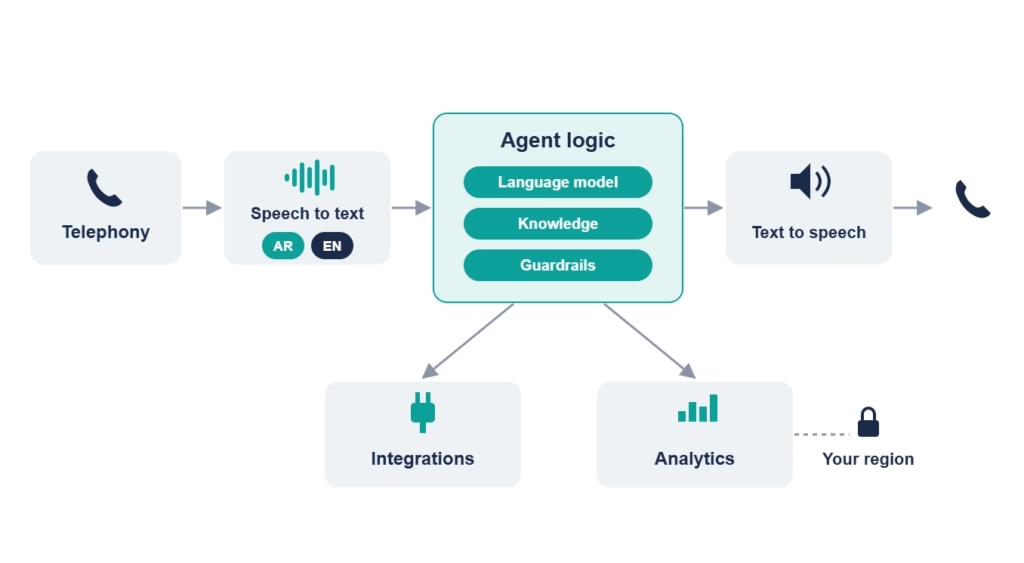
Under the hood, most voice agents run the same loop on every turn of the conversation:
- Speech-to-text (STT). It converts the caller’s speech into text.
- Language model. It works out the intent and decides what to say or do.
- Tools and integrations. It checks a calendar, looks up an order or saves a lead.
- Text-to-speech (TTS). It speaks the reply back in a natural voice.
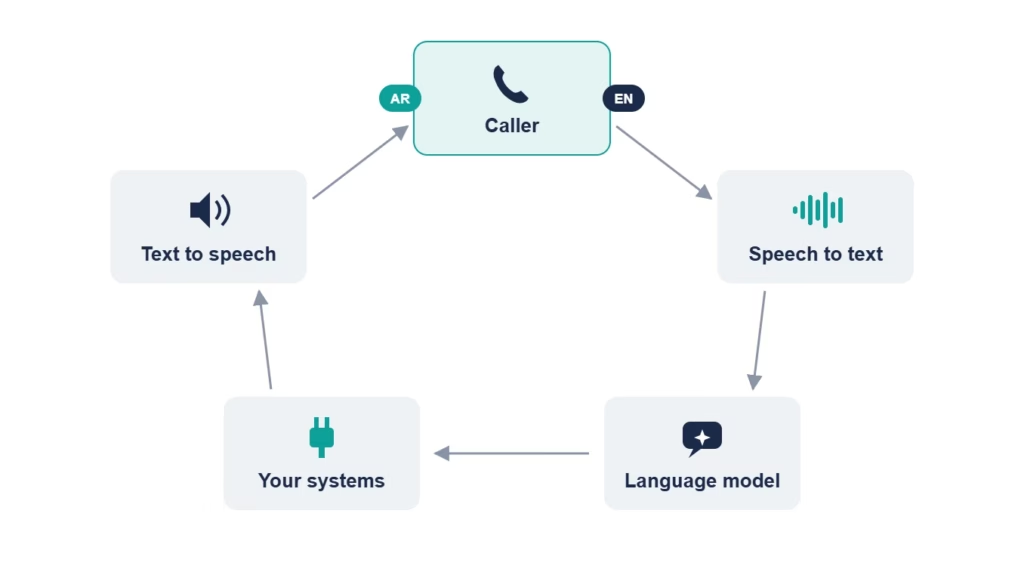
The quality of a bilingual agent depends on how well each step handles Arabic, not just on how good the language model is.
Why businesses in the UAE and GCC need Arabic and English voice support
The region’s callers are mixed by default. Telnyx notes that the Gulf is home to about 31 million foreign nationals, close to 55 percent of the population, and that the UAE has residents from more than 200 nationalities. It adds that most Gulf contact centres operate in two languages (Telnyx).
For a clinic, a property developer or a car service centre, that means an English-only agent leaves out many local callers. An Arabic-only agent struggles with expatriate customers. Supporting both is the baseline in this market, not a premium feature.
There is also a trust factor. Callers are more patient with an automated agent that sounds like it belongs in the region. Formal Arabic read in a foreign accent can sound off-putting.
Gulf Arabic dialects versus Modern Standard Arabic (MSA)
This is the question that separates serious vendors from the rest.
Modern Standard Arabic is the formal Arabic of news, documents and official speech. People rarely speak it on the phone. Callers use their own dialect: Gulf (Khaleeji), Egyptian, Levantine and others. Each has its own vocabulary, pronunciation and rhythm, and dialects vary even inside a single country. MBZUAI researchers note that dialect varies from one emirate to another within the UAE (MBZUAI).
Many speech models are trained mostly on MSA. MBZUAI’s speech team, describing its Arabic speech work, pointed to the limited pool of open Gulf dialect data. It also noted that open models tend to slip back into MSA instead of keeping the requested dialect (The National).
For your agent, this affects two directions:
- Understanding. Can it accurately transcribe a Gulf caller who says a date, a car model or a medication name in dialect?
- Speaking. Does the agent reply in a voice and wording that suits your callers? Formal MSA is often acceptable for confirmations, but a Gulf-sounding voice usually lands better for a UAE or Saudi brand.
Our recommendation would be to decide early which dialects your callers actually use, based on real call recordings if you have them, rather than assuming “Arabic” covers it.
Speech-to-text, LLMs and text-to-speech: what matters for Arabic
Speech-to-text (STT)
The agent can only respond well to what it hears correctly. Three choices decide this.
- Arabic locale and model. Major cloud speech services list separate Arabic locales for Gulf countries. Microsoft’s Azure Speech, for example, lists the UAE (ar-AE), Saudi Arabia (ar-SA), Qatar, Kuwait, Bahrain and Oman (Microsoft Learn). Specialist Arabic models from regional and international providers are also available. A locale label does not tell you how well a model handles your callers, so test with your own audio.
- Phone audio. Phone calls carry lower-quality audio than a mobile app or a recording studio. Some providers offer models tuned for it. Google, for example, documents phone-call models that recognise speech from phone audio more accurately than its default models (Google Cloud). Check whether the Arabic option you choose has such a model.
- Streaming and vocabulary. The STT should transcribe while the caller is still speaking, so the agent can respond quickly. It should also accept a list of your own terms, such as branch names, product names, doctor names and area names, which general models often get wrong.
The language model (LLM)
The language model decides what the caller wants and what to do next. For a business voice agent, it should not improvise freely. Our approach would be to:
- Answer from your content. Use only your approved prices, policies and FAQs, retrieved from your own knowledge base at the moment it is needed.
- Call defined tools. Use named actions such as “check availability”, “create booking” or “find order” to work with your systems, rather than generating free text about them.
- Follow written rules. Have clear limits on what the agent must not say or do, such as quoting unapproved discounts, giving medical advice or sharing another customer’s details.
- Keep replies short. Spoken replies need to be shorter than chat replies, and the agent should confirm key details such as dates and phone numbers back to the caller.
Text-to-speech (TTS)
The reply voice must pronounce Arabic names, numbers, times and places correctly, and English product and brand names too. Azure, for example, offers Emirati Arabic neural voices under the ar-AE locale (Microsoft Learn). Test how each candidate voice reads your real content, including phone numbers and prices. The choice of voice is a brand decision as much as a technical one.
Latency: keeping the conversation natural
Latency is the gap between the caller finishing a sentence and the agent starting to reply. Long gaps make callers repeat themselves, talk over the agent or hang up. Telnyx’s October 2026 comparison of five voice AI platforms on real phone calls found median response gaps of about 1.3 to 1.7 seconds (Telnyx).
Every step adds to the delay:
- the phone network
- detecting that the caller has stopped speaking
- transcription
- the language model
- any system lookup
- generating the voice
Practical ways to keep it low:
- host the components close to each other and to your callers
- stream the voice reply as soon as the first words are ready
- use short filler phrases while a slow lookup runs
- let callers interrupt, so the agent stops speaking and listens
The end-of-turn setting needs care in Arabic and English. If it is too short, the agent cuts in while a caller pauses to think. If it is too long, every reply feels slow.
Handling Arabic-English code-switching
Code-switching means changing language within a conversation, or within a sentence. In the Gulf it is normal: “Abgha appointment yom al khamees, after 4 pm” mixes Gulf Arabic and English in one request.
Speechmatics, which publishes Arabic speech models, describes this as the scenario that matters most in the region and the one where many systems fall short (Speechmatics). MBZUAI’s research found that multilingual pre-training improved results across its code-switching tests (MBZUAI).
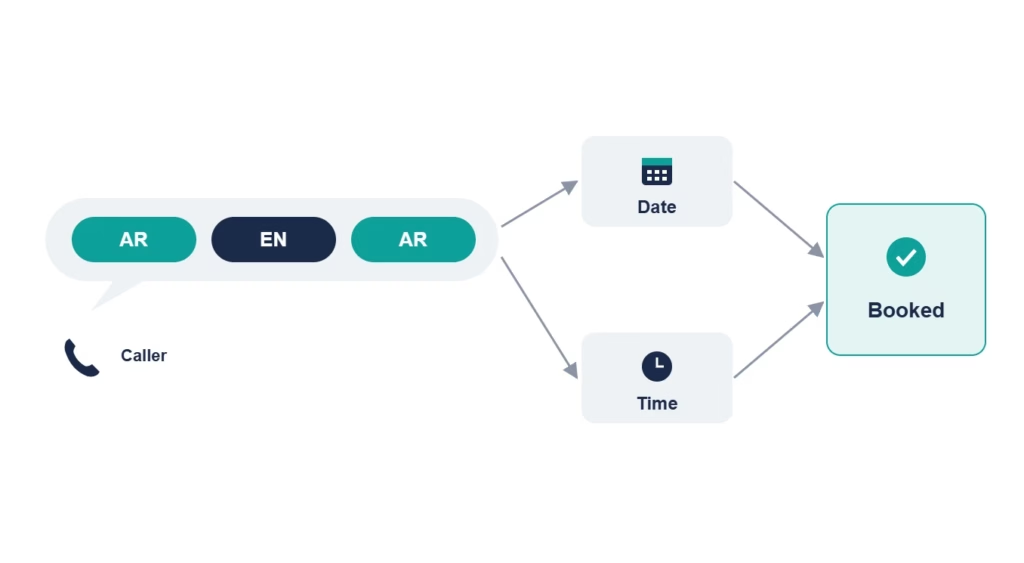
For a business, handling code-switching well means:
- Transcription. It handles both languages in one utterance, without forcing the caller to pick a language at the start.
- Entity capture. It picks up names, dates, times and numbers correctly, whichever language they are spoken in.
- Reply language. The agent answers in the language the caller is most comfortable with, and keeps a consistent language unless the caller switches.
- Records. Transcripts are stored in a form your team can read and search.
The practical test is simple. Before you sign with any developer, ask for a demo using recordings of your own callers, including mixed-language ones, and check what the agent understood.
Features a bilingual voice agent should have
These are the capabilities worth asking about. Not every business needs all of them on day one.
| Capability | Why it matters |
|---|---|
| Inbound and outbound calls | Answer every incoming call, and make reminder, confirmation or follow-up calls |
| Language detection and switching | Respond in Arabic or English based on the caller, and switch when the caller switches |
| Dialect-aware recognition | Understand Gulf and other dialects your callers use, not only formal Arabic |
| Actions in your systems | Book, reschedule, look up orders, create leads and update records during the call |
| Answers from your own content | Use your approved prices, policies and FAQs, not general internet knowledge |
| Human hand-over | Transfer to staff with a summary when the caller needs a person, or take a message |
| AI disclosure and consent | Tell callers they are speaking to an AI agent and capture recording consent at the start |
| Transcripts and analytics | Searchable call records, outcomes, hand-over reasons and failed intents |
| Guardrails | Refuse off-topic requests, avoid sharing data with the wrong caller, and resist manipulation |
The last two rows are often missing from demos and matter most after launch. Our AI and LLM security testing work looks specifically at how agents can be manipulated into saying or doing things they should not.
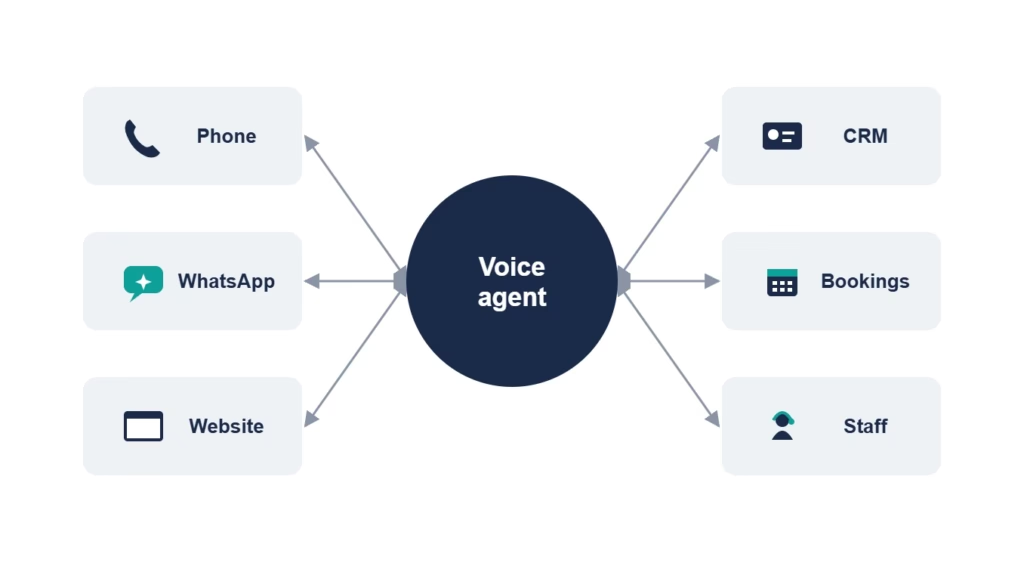
CRM, WhatsApp, website and telephony integrations
A voice agent that cannot touch your systems is a talking FAQ page. The value comes from integrations.
Telephony. Calls reach the agent through a cloud telephony provider or a SIP connection from your existing phone system. Calls can usually be forwarded from your current number. In the UAE, telecom and VoIP services are regulated, so confirm early which numbers and routes your provider can legally offer for your use case.
WhatsApp. Meta launched the WhatsApp Business Calling API in July 2025, adding voice calls inside WhatsApp business conversations (PPC Land). In markets where customers live on WhatsApp, the same agent can answer voice calls there as well as on a phone number. Feature availability varies by country, so check Meta’s current terms for your market. Our WhatsApp Business API integration team works on the messaging side of this channel.
CRM and booking systems. The agent should read and write to your CRM, calendar, booking or clinic system, so that a booked appointment or a qualified lead appears where your team works. Our AI CRM automation work covers lead capture and follow-up logic.
Website and app. A voice button on your website or mobile app can start a browser-based voice session with the same agent, useful for support pages and order tracking.
One brain for all channels. If you already run a WhatsApp or web chatbot, the voice agent should use the same knowledge base and business rules. Otherwise callers get different answers on different channels. Our AI chatbot development and voice work are designed to share that content.
Industry use cases in the UAE and GCC
These examples describe common fits, not Sigosoft client projects.
- Clinics and hospitals. The agent books, confirms and reschedules appointments and answers questions on timings, insurance acceptance and location. Health data has its own rules in the UAE, separate from the general data protection law, so medical details need extra care.
- Real estate. It qualifies enquiries from property portals and adverts at any hour: budget, area, ready or off-plan, and timeline. Hot leads pass to an agent with a summary.
- Automotive service centres. It books service slots, confirms pick-up times and gives repair status from the workshop system.
- Restaurants, retail and delivery. It answers “where is my order?” from live data, takes simple orders and handles opening-hours questions.
- Hospitality and travel. It handles booking changes, check-in questions and concierge requests in the guest’s language.
- Education and training. It answers admissions enquiries, books campus visits and sends fee reminders to parents.
In each case, the agent is strongest on high-volume, predictable calls. Complaints, negotiations and sensitive conversations should reach a person quickly.

How a custom Arabic-English voice agent is built: technology considerations
There are three broad ways to build one:
| Approach | What it means | Suits |
|---|---|---|
| Voice agent platform, configured | A hosted platform where you set prompts, voices and integrations | Simple, mostly English calls with standard integrations |
| Custom pipeline | Your own orchestration, choosing each STT, language model and TTS component | Strict data, dialect or latency needs, or high call volumes where per-minute platform fees add up |
| Hybrid | A platform for call handling, with custom code for Arabic handling, integrations, guardrails and analytics | Most GCC businesses starting out |
The main technical decisions are:
- STT per language and dialect. The provider and model are tested on your callers’ audio, not on a demo clip.
- Language model and prompts. These are designed to answer from your approved content, with clear rules for what the agent must not do. For knowledge-heavy agents, retrieval from your own documents keeps answers accurate.
- TTS voice. A voice that suits your brand and pronounces Arabic and English names correctly.
- Data location. Where audio, transcripts and logs are stored and processed. For sensitive sectors, private or on-premise AI can keep data under your control.
- Latency budget. How much delay each layer adds, and how to keep the total low on real phone lines.
Testing accuracy, handover and call analytics before launch
Most voice agent problems show up in the first week of real calls. Good testing moves them to before launch.
Measuring accuracy
Accuracy should be measured on a test set built from your own calls, or realistic recordings made by people who speak like your customers. That means Gulf and other dialects, mixed Arabic and English, background noise and mobile connections. Useful measures include:
- Transcription accuracy. Word error rate, the share of words transcribed wrongly, reported separately for Arabic, English and mixed calls.
- Entity accuracy. Whether names, dates, times, phone numbers and booking references were captured correctly. These matter more than overall word accuracy.
- Task completion. The share of test calls where the agent completed the job correctly, such as a correct booking.
- Safe failure. What the agent does when it does not understand: does it ask again, confirm, or hand over, instead of guessing?
Vendors publish their own benchmark results. Speechmatics, for example, has published comparisons on colloquial Arabic and Arabic-English code-switching (Speechmatics). Treat these as a starting point, and rely on results from your own test set.
Human-agent handover
The handover is where callers decide whether they trust the system. The agent should hand over when:
- the caller asks for a person
- it fails to understand twice
- the topic is outside its rules, such as a complaint, a refund dispute or a medical concern
- the caller is upset
A good handover transfers the call to the right team or person and passes a short summary with the caller’s name, number, request and what has been done so far. That way the caller does not repeat everything. Outside working hours, the agent should take a message and create a follow-up task instead.
Call analytics
After launch, the dashboard should show:
- calls handled
- calls completed without staff
- handover reasons
- the questions the agent could not answer
- calls by language
- average response delay
Review a sample of transcripts every week, especially failed and handed-over calls. That review is where most improvements come from.
Recording, consent and data protection
Voice calls carry personal data, and recording them is regulated in both the UAE and Saudi Arabia. These are the main points, with sources.
UAE
- Data protection law. The federal data protection law (Federal Decree-Law No. 45 of 2021) defines personal data to include identifiers such as a person’s name, voice and image. Its definition of sensitive personal data includes biometric and health data (UAE Legislation).
- Where it does not apply. The same law does not apply to personal health data that has its own legislation, or to free zone companies with their own data protection rules, such as the DIFC and ADGM.
- Criminal law on recording. Separately, the UAE’s cybercrimes law (Federal Decree-Law No. 34 of 2021, Article 44) and Penal Code (Federal Decree-Law No. 31 of 2021, Article 431) treat recording conversations without consent as a privacy offence (Chambers).
Saudi Arabia
- Criminal law on interception. The Anti-Cyber Crime Law (Royal Decree No. M/17) lists interception of data transmitted through an information network without legitimate authorisation as an offence (MCIT).
- Data protection law. The Personal Data Protection Law is enforced by SDAIA, which consulted on amendments to its implementing regulations in October and November 2026 (Akin).
Our recommendations for the call flow, which are planning guidance and not legal requirements quoted from the laws above:
- tell callers at the start that they are speaking to an AI agent, and that the call may be recorded
- capture consent, or offer a way to speak to a person instead
- store recordings and transcripts in a region and for a period you have agreed with your legal advisers
- keep customer data out of public model training
This is a summary for planning, not legal advice. Confirm the rules for your sector and free zone with your legal team before launch.
The development process and a realistic timeline
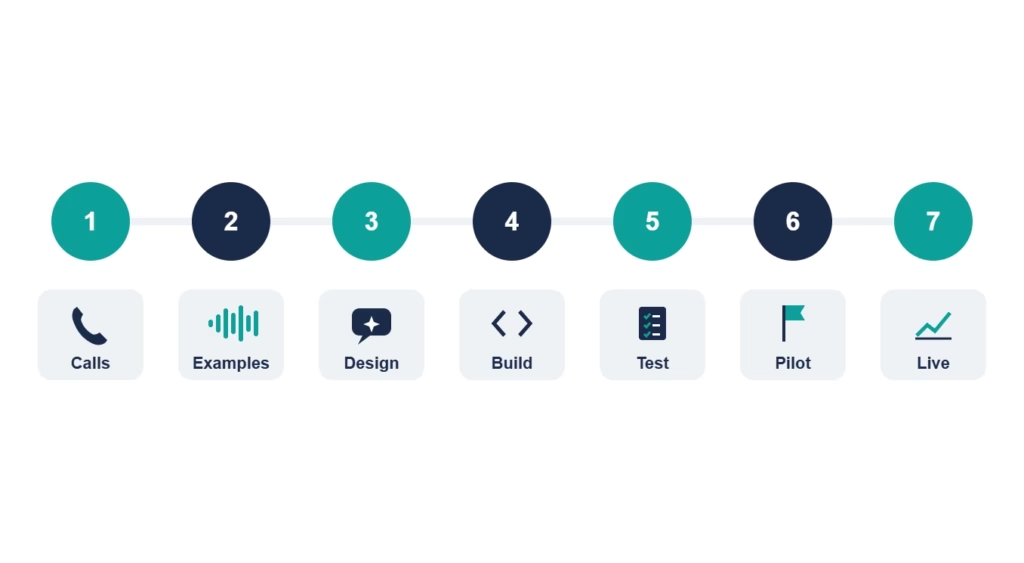
- Choose the calls to automate. List your call types by volume, and pick one or two that are frequent and predictable, such as appointment booking or order status. Agree what success looks like.
- Collect real examples. Gather sample recordings or transcripts, your common questions, your dialect mix, and the systems the agent must use.
- Design the conversation. Write the opening, the consent script, the questions, the hand-over rules and what the agent must refuse.
- Build and connect. Set up telephony, STT, language model, TTS and integrations, plus the dashboard for transcripts and outcomes.
- Test with your callers’ language. Run dialect, code-switching, interruption, background-noise and wrong-information tests, plus security tests.
- Pilot on a test number. Your staff and a small group of real callers try it, and you review every call.
- Go live and improve. Connect the main line, monitor results, and add call types once the first ones work well.
On our AI voice agent projects, the published plan is to agree the call types in the first week and run a pilot on a test number in weeks two and three, then go live with monitoring. Larger scopes take longer: more call types, several integrations, outbound campaigns or strict data requirements.
What drives the cost of an Arabic-English voice agent
There is no fixed price, because two businesses can need very different agents. These are the factors that move the effort and the running cost.
| Cost factor | Lower effort | Higher effort |
|---|---|---|
| Call types | One predictable call type, such as booking | Many call types, complaints triage, outbound campaigns |
| Language scope | Arabic and English with one main dialect | Several dialects, heavy code-switching, extra languages |
| Integrations | One calendar or CRM with a standard API | Several systems, legacy software without APIs |
| Channels | One phone number | Phone, WhatsApp voice, website and app |
| Data requirements | Standard cloud hosting in an agreed region | Private or on-premise models, strict sector rules |
| Quality and safety | Standard testing | Extended dialect testing, security testing, human review workflows |
| Call volume | Low monthly minutes | High volumes, where per-minute costs drive architecture |
Running costs matter as much as the build: telephony minutes, speech-to-text, the language model, text-to-speech, hosting and support. At high volumes, these per-minute costs can outweigh the build cost, which is one reason some businesses move from a pure platform subscription to a custom or hybrid setup. Once the call types and integrations are clear, a development partner should give you a scoped estimate covering both the build and the expected running cost per minute.
How to choose the right AI voice agent development company
The answer to “who can develop this?” is any team that can show, not just say, that it handles Arabic properly. These are the questions worth asking:
- Will you test the agent on recordings of our callers, including mixed Arabic-English calls, before we commit?
- Which dialects will it understand well, and how will you measure that?
- How does the agent hand over to staff, and what does the summary contain?
- Which of our systems will it read and write to, and how?
- Where will audio and transcripts be stored, for how long, and who can access them?
- How will you test for wrong answers, manipulation and data leaks before launch?
- What is the expected cost per minute at our call volume, and which parts can we change later?
- Who supports the agent after launch, and how are improvements made?
Be careful with vendors who only demo in English, quote one price before seeing your calls, or cannot explain where your data goes.
How Sigosoft approaches Arabic-English voice agent projects
At Sigosoft, we would start with your calls, not the technology. Which calls come in most, which ones staff spend the most time on, and which ones are lost after hours? That tells us what the agent should do first.
Our approach would be to pick one or two call types, test the Arabic and English handling on your own callers’ language, and connect the agent to the system those calls depend on. We recommend the agent tells callers it is an AI at the start, and that every call has a clear route to a person. On our voice agent service, recordings and transcripts are stored in the client’s chosen region with access controls, and are not used to train public AI models.
We build voice agents alongside WhatsApp and web chat assistants, so one set of approved answers can serve every channel. A voice project usually connects to the work our other teams already do:
- AI Voice Agents. The phone agent itself.
- AI chatbot development. Text conversations on the web and in apps.
- WhatsApp Business API integration. Messaging and notifications on WhatsApp.
- AI CRM automation. Leads and follow-ups landing in your CRM.
One example of our practical AI work is SAIMPEX, a food and grocery delivery platform for Mauritania. The app supports English, French and Arabic, and has AI voice search and an AI chatbot built into its ordering and delivery flow.
The voice search works inside the app: the customer taps and speaks instead of calling a phone number. A phone-based voice agent involves further work that SAIMPEX did not need, such as phone-line audio, live call handling, transfers to staff and recording consent. What carries over is the groundwork: supporting Arabic alongside other languages, understanding spoken requests, and connecting AI features to a live ordering and delivery system.
Planning an AI voice agent that speaks Arabic and English?
If your team is missing calls, or your callers switch between Arabic and English faster than your current system can follow, start small. Pick your most common call type and gather a handful of real recordings. That is enough for a useful first conversation.
When you contact us, it helps to share:
- the call types you want to automate and your rough monthly call volume
- the languages and dialects your callers use
- the systems the agent must work with, such as your CRM, booking system or WhatsApp number
- any data or recording requirements from your sector
Get a voice agent plan for your business or talk to our team. We will review your calls, dialects and systems, and recommend a practical first step, whether that is a focused pilot on one call type or a fully custom Arabic-English voice agent.
Frequently asked questions
Who can develop an AI voice agent with Arabic and English support?
A software development company that can show working Arabic dialect handling, Arabic-English code-switching, integration with your business systems, and a clear approach to call recording consent and data storage. Ask to see a demo on your own callers’ recordings.
What is the difference between Gulf Arabic and Modern Standard Arabic for a voice agent?
Modern Standard Arabic is formal Arabic used in writing and official speech. Most callers speak a dialect such as Gulf, Egyptian or Levantine. A voice agent needs to understand the dialects your callers use, and its spoken replies should suit your audience.
Can an AI voice agent handle callers who mix Arabic and English?
Yes, if it is designed and tested for code-switching. The speech recognition, entity capture and reply logic all need to handle both languages in one conversation. Test this with real mixed-language recordings before launch.
Can the voice agent work on WhatsApp?
The WhatsApp Business Calling API, launched by Meta in July 2025, lets businesses make and receive voice calls inside WhatsApp. A voice agent can be connected to it where the feature is available in your market.
Can it work with our existing phone number?
Usually yes. Calls can be forwarded from your current number or routed through a cloud telephony provider or SIP connection. Confirm with your provider which routes are allowed in your country.
Will callers know they are speaking to AI?
They should. We recommend the agent says so at the start of the call, together with any recording notice. Callers tend to be more patient when they know.
Do we need consent to record AI voice calls in the UAE or Saudi Arabia?
You should plan for it. UAE law treats voice as personal data, and both the UAE and Saudi Arabia treat recording or intercepting communications without consent or authorisation as an offence. Build a clear AI and recording notice into the call opening, offer a way to reach a person, and confirm the exact requirements for your sector and free zone with your legal advisers.
How accurate is Arabic speech recognition for voice agents?
It depends on the model, the dialect, phone audio quality and your vocabulary. Vendor benchmarks are a starting point only. Measure transcription accuracy, entity accuracy and task completion on a test set built from your own callers before launch.
How long does it take to build an Arabic-English voice agent?
A focused first phase, one or two call types with a pilot on a test number, can run in a few weeks. More call types, integrations, outbound campaigns or strict data requirements extend the timeline.
How much does an AI voice agent cost?
It depends on the number of call types, dialect and language scope, integrations, channels, data requirements, testing depth and call volume. Running costs per minute matter as much as the build cost. Ask for an estimate that covers both.
Should we use a voice agent platform or build a custom agent?
A platform can be enough for simple, mostly English calls. Custom or hybrid builds make sense when you need strong dialect handling, several integrations, strict data control or high call volumes.
Thanks for the feedback!

Jishnu kuttiyadan Sigosoft team
Part of the Sigosoft team building AI automation, custom software and apps for businesses worldwide.
Start the discussion
Questions or experiences to share? Our team reads and replies.