For a distributor or wholesaler, automating order to cash costs far less to run than to build. The running costs are small. Meta charges ₹0.115 for each WhatsApp utility message to an Indian number, so two order updates on 3,000 orders a month come to ₹690 before GST. Automation tools start at about $9 to $20 a month. The real cost is connecting Tally or your ERP to everything else, and published benchmarks put a custom ERP integration at $10,000 to $20,000. Whether you need that depends on where your orders come from and which accounting system you run.
If you run a distribution business in Kochi, Kozhikode or Sharjah, the pattern is familiar. Retailers send orders on WhatsApp at all hours. The salesperson on the van route writes orders in a notebook. Someone in the office types it all into Tally or ERPNext the next morning, invoices go out late, and collections depend on who remembers to call. This guide prices fixing each of those steps, with a source for every number.
Quick answer
| Cost line | What it costs | Source |
|---|---|---|
| WhatsApp order and delivery updates (India) | ₹0.115 per utility message, plus 18% GST | Meta rate card |
| WhatsApp offers and broadcasts (India) | ₹0.8631 per marketing message, plus GST | Meta rate card |
| No-code automation tool | Free tiers, then about $9 to $50 a month at small volumes | Vendor pricing pages |
| Custom ERP or Tally integration | $10,000 to $20,000 | Published Clutch and GoodFirms benchmarks |
| Full SME automation project | About €8,000 to €40,000 | Kolonell agency benchmark, September 2026 |
| Maintenance | 15% to 30% of the build each year | Published 2026 pricing guides |
The distribution processes worth automating first
Roughly in order of how much office time they take:
- Order capture
WhatsApp messages, calls and rep notes become sales orders without anyone retyping them. - Stock confirmation
The retailer hears whether the items are available before the van is loaded. - Invoicing
The order becomes a GST invoice in Tally, ERPNext or Odoo, and the retailer gets a copy. - Dispatch and delivery updates
“Out for delivery” and “delivered” messages, with the route planned from the day’s orders. - Collections
Payment reminders based on the real outstanding in your accounts, not a separate spreadsheet. - Van sales and returns
Reps book orders, record returns and collect cash on a phone app that syncs with the office.
Start with the step that eats the most hours. For most distributors that’s order capture, because every later step depends on clean orders.
Distribution business automation cost by process
| Process | What it needs | Main cost line |
|---|---|---|
| Order capture from WhatsApp | WhatsApp Business Platform, an order form or parser, ERP connection | The ERP connection; messages are cheap |
| Stock confirmation | Read access to ERP stock | The ERP connection |
| Invoicing | Write access to Tally or the ERP | The ERP connection |
| Delivery updates | Approved utility templates | ₹0.115 per message in India |
| Collections | Outstanding balances from accounts, reminder templates | ₹0.115 per reminder, plus the accounts connection |
| Van sales and returns | A mobile app that works offline and syncs | A custom app build |
The ERP connection shows up in almost every row. Build it once, properly, and every later automation costs less.
WhatsApp costs for distributors
Retailers already order on WhatsApp, so this is where most distribution automation runs. Meta charges per delivered message, by category and by the customer’s country.
| Message type | Rate for Indian numbers (before 18% GST) |
|---|---|
| Marketing template (offers, new stock) | ₹0.8631 |
| Utility template (order confirmed, invoice, out for delivery, payment due) | ₹0.115 |
| Authentication (OTP for a retailer app login) | ₹0.115 |
| Service reply to a retailer’s message, inside 24 hours | First 1,000 free per number per month, then ₹0.115 |
What changed on 1 October 2026
Service replies and in-window utility messages used to be free. Meta now charges for them, with 1,000 free service messages per business number each month. If your team answers 2,000 retailer chats a month, you pay for 1,000 of them: ₹115 before GST.
A worked example
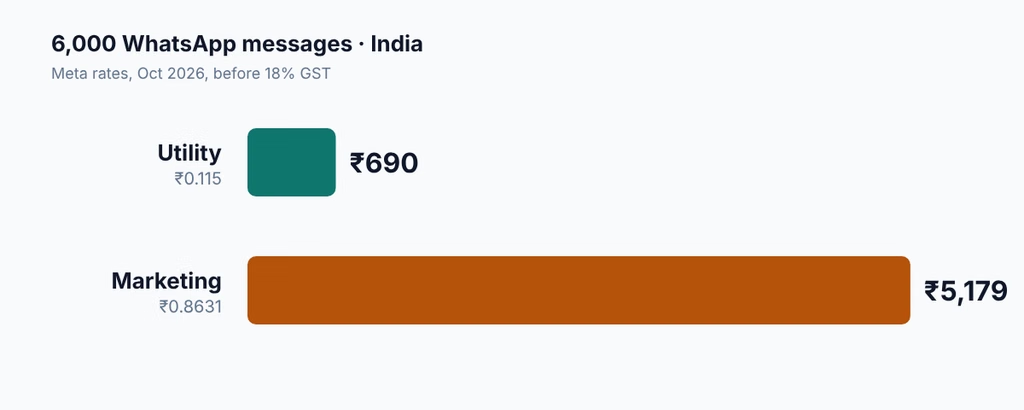
A distributor sends “order confirmed” and “out for delivery” on 3,000 orders a month. That’s 6,000 utility messages × ₹0.115 = ₹690, or about ₹814 with GST. Adding 500 payment reminders costs another ₹57.50 before GST. Sending the same 6,000 order updates as marketing messages would cost ₹5,179 before GST, so get your templates categorised correctly.
These are Meta’s fees only. WhatsApp platform providers add their own subscription or markup on top.
Automation tools: where they work for distributors and where they stop
| Tool | Free tier | Entry paid plan (October 2026) | How it bills |
|---|---|---|---|
| Zapier | 100 tasks a month | Professional from $19.99 a month billed yearly ($29.99 monthly) for 750 tasks | Per task, so every action step counts |
| Make | 1,000 credits a month | Core at $9 a month billed yearly ($10.59 monthly) for 10,000 credits | Per credit, roughly one per module run |
| n8n Cloud | Self-hosted edition is free | Starter at €20 a month billed yearly for 2,500 executions; Pro at €50 for 10,000 | Per workflow run, however many steps |
| Microsoft Power Automate | Basic flows included with Microsoft 365 | Premium at $15 per user a month; Process at $150 per bot a month | Per user or per bot |

Order volume changes the bill
Put 3,000 orders a month through a four-step Zapier workflow and you use 12,000 tasks, because each action step is a task. On n8n the same 3,000 runs count as 3,000 executions, which needs the €50 Pro plan because Starter stops at 2,500. On Make, four modules per order uses about 12,000 credits, just over the 10,000 in Core. When n8n Cloud runs out of executions, workflows stop until the next month.
Where tools stop
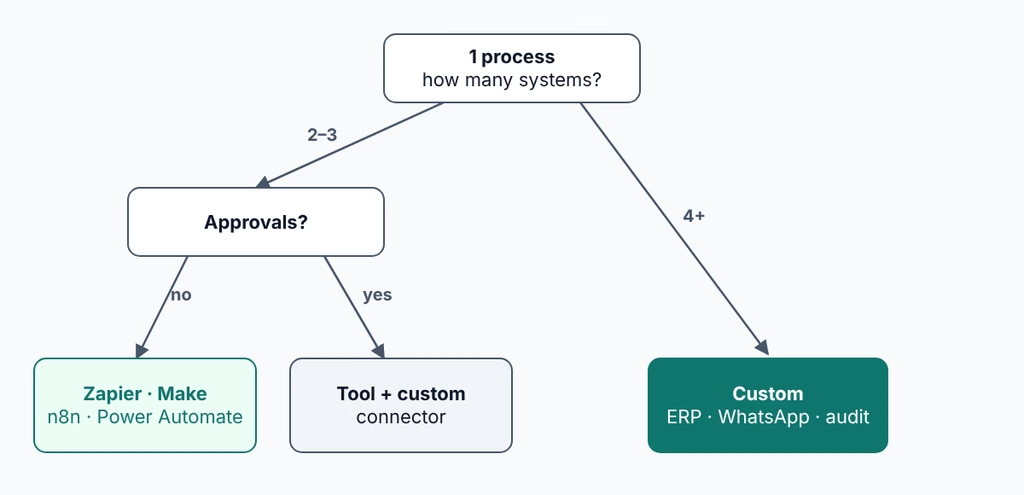
Cloud tools work well with ERPNext and Odoo, which both have APIs, though customised setups need their fields mapped carefully. Tally is different. It usually runs on an office PC, so a cloud tool can’t reach it without a connector running on your network. Approvals, credit limits per retailer and audit trails also push beyond what a simple workflow handles.
Connecting Tally, ERPNext or Odoo
This is the line that decides your budget. Published benchmarks, collected in our AI chatbot development cost guide from Clutch and GoodFirms data, put a custom ERP integration at $10,000 to $20,000 and a CRM integration at $3,000 to $10,000. The same sources put Indian development rates at about $20 to $70 an hour, against $100 to $250 in the US.
Three things move you up or down that range:
- Which system
ERPNext and Odoo expose APIs. Tally needs a connector on your network. - How customised it is
Custom item codes, price lists per retailer and scheme discounts all need mapping. - Which direction data flows
Reading stock is simpler than writing invoices back.
If you’re on ERPNext, see our ERPNext mobile apps for how we connect sales apps to it.
Van sales and field sales apps
No-code tools don’t help the rep standing in a shop with one bar of signal. A van sales app has to book orders offline, record returns and cash, and sync when the connection comes back. That makes it a custom mobile build, priced by screens, offline needs and integrations rather than a list price.
We built Grain n Grace Sales Spark, a Flutter sales app connected to ERPNext, for a business in India. For SAIMPEX in Mauritania we built AI route optimisation that assigns orders to drivers, and an offline POS that syncs when the internet returns.
Distributors and traders in the UAE
The processes are the same: quotes, orders, invoices and collections, often in English and Arabic. Two things change the budget.
- WhatsApp rates depend on the customer’s country
The Indian rates above don’t apply to UAE numbers, so check Meta’s current rate card for the UAE before you budget. - Data location
Check the UAE’s data protection rules on where customer data may be stored before choosing a tool that hosts it abroad.
How to work out your payback
You don’t need anyone’s ROI statistic. Use four numbers from your own business:
- Hours the process takes each month. For example, 2 people × 2 hours of order entry a day × 22 days = 88 hours.
- The loaded cost of an hour of those people’s time.
- The monthly running cost of the automation: tools, messages and hosting.
- The build cost.
Monthly saving = hours saved × hourly cost − monthly running cost. Payback in months = build cost ÷ monthly saving.
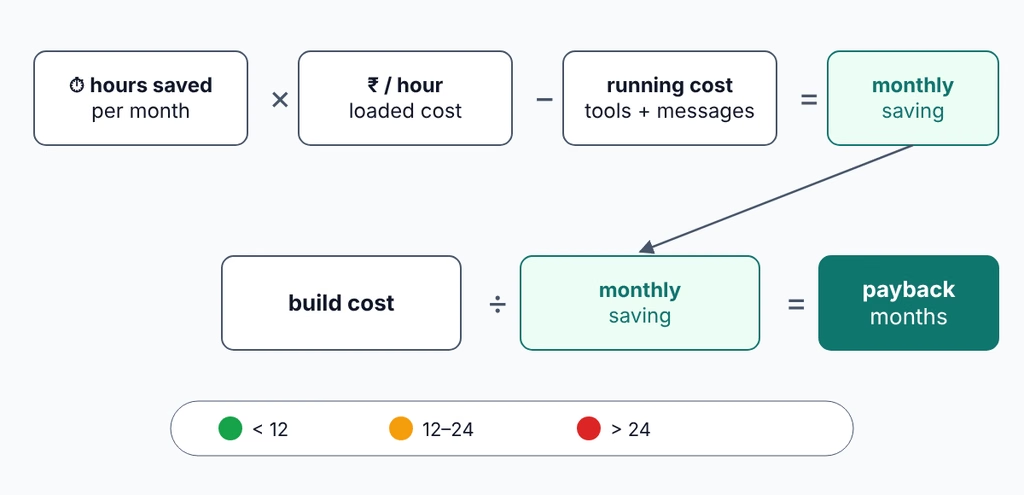
If the payback is under 12 months, the automation is usually worth doing. If it’s over 24 months, start with a cheaper tool or a smaller first step.
Tool or custom: how to decide
A no-code tool is enough when:
- your ERP is ERPNext or Odoo and the flow touches two or three systems
- order volume stays inside an entry plan
- nobody has to approve anything
- you are fine with the vendor hosting the data
Custom automation pays off when:
- you run Tally or a heavily customised ERP
- you have retailer credit limits, scheme discounts or approvals
- reps need an offline van sales app
- tool bills grow with every order
What Sigosoft charges, and how we price
We don’t bill by the hour. We price the task together with a stated period during which we stay responsible for it, or a monthly retainer for systems that keep running. Our CEO explains why in why we stopped billing by the hour.
[SIGOSOFT TO CONFIRM: typical price range for a first distribution automation, such as WhatsApp orders into ERPNext or Tally] [SIGOSOFT TO CONFIRM: typical range for a van sales app with ERP sync] [SIGOSOFT TO CONFIRM: typical monthly retainer for support and monitoring]
What we can say for certain: on our business process automation services, the first process usually goes live in 1 to 2 weeks. We spend days 1 to 2 on discovery, build a working prototype in days 3 to 5, and release in weeks 1 to 2. Every automation has human approvals where they matter, and our setup runs under an ISO 27001:2022 certified security system.
Distribution projects we’ve built
- Grain n Grace Sales Spark, India: a Flutter sales app integrated with ERPNext.
- SAIMPEX, Mauritania: AI order-to-driver routing, a chatbot for order status questions, an offline vendor POS, and a POS, ERP and CRM business suite.
- Business Connect, Mauritania: a Windows desktop SaaS combining offline POS, billing, inventory, CRM, ERP and HRM.
Common mistakes distributors make with automation
- Automating invoices before order capture is clean
Bad orders become bad invoices faster. - Sending order updates as marketing templates
Utility messages cost ₹0.115 in India; marketing costs ₹0.8631, more than seven times as much. - Budgeting on free service replies
Since 1 October 2026, replies beyond 1,000 a month per number are charged. - Choosing a cloud tool that can’t reach Tally
Check how the tool will connect before you subscribe. - Building the rep app without offline mode
Rural routes have patchy coverage, and lost orders cost more than the app. - Pricing by plan, not by order volume
Multiply orders by workflow steps before you pick a plan. - Leaving maintenance out
Plan 15% to 30% of the build cost each year from day one.
FAQ
How much does it cost to automate a distribution business in India?
Running costs are small: WhatsApp order updates cost ₹0.115 each plus GST, and tool plans start around $9 to $20 a month. The main cost is connecting Tally or your ERP, which published benchmarks put at $10,000 to $20,000 for a custom integration.
How much do WhatsApp order updates cost for 3,000 orders a month?
Two utility messages per order is 6,000 messages, which costs ₹690 before GST, or about ₹814 with GST, at Meta’s October 2026 rate for Indian numbers.
Can Zapier or n8n connect to Tally?
Not out of the box in most setups, because Tally usually runs on an office PC. You need a connector on the same network or a custom integration. ERPNext and Odoo are easier, because both have APIs.
How long does it take to automate order processing?
A single, well-defined process can go live in 1 to 2 weeks. Connecting several systems, or adding a van sales app, takes longer.
Do I need a van sales app?
If your reps book orders in shops, yes. A phone app that works offline removes the notebook and the next-day retyping.
What does automation cost after launch?
Published industry ranges put maintenance at 15% to 30% of the build cost a year, plus tool subscriptions and message fees.
Get a cost estimate for your distribution business
Tell us how orders reach you, roughly how many you handle a month, and whether you run Tally, ERPNext, Odoo or something else. We’ll reply with a roadmap covering scope, timeline and cost. If an off-the-shelf tool serves you better, we’ll say so. Email [email protected], WhatsApp +91 98462 37384, or get a free roadmap.
Related reading: Business process automation guide
Thanks for the feedback!

Praveen Soman CEO, Sigosoft
Technology entrepreneur and digital product strategist with a passion for building scalable software products and solving real-world business challenges. Enjoys exploring AI, emerging technologies, startups, and the ideas shaping the future of technology.
Connect on LinkedIn →Start the discussion
Questions or experiences to share? Our team reads and replies.