
At a Glance
- Mobile app development in Dubai costs between AED 25,000 and AED 500,000+ depending on scope, platform, and compliance requirements (Riseup Labs, 2026)
- Labour accounts for 60 to 70 percent of the total bill. Every other cost combined rarely exceeds 15 percent (Innovatrix Infotech, 2026)
- Flutter development cuts build cost by 20 to 40 percent versus separate native iOS and Android builds (GoodFirms, 2026)
- Hidden costs add 45 to 70 percent on top of the quoted build price in year one when maintenance, hosting, and compliance are included (Decipherzone, 2026)
- UAE PDPL compliance built in from sprint one costs 15 to 20 percent of total build. Retrofitted after development, it costs three to five times more (Decipherzone, 2026)
- Dubai directed all government entities to integrate services into a single unified digital platform in April 2026. Apps serving regulated sectors, government-connected workflows, or identity-sensitive use cases may increasingly benefit from UAE PASS and government integration readiness (Dubai Media Office, April 2026)
Key Takeaways
- The most common mid-level business app investment in the UAE is AED 92,000 to AED 294,000 (roughly $25,000 to $80,000)
- Local Dubai agency rates run AED 400 to AED 600 per senior developer hour. Offshore rates run AED 90 to AED 180 per hour for comparable senior work
- Flutter is the right default for most UAE business apps in 2026. Over 60 percent of new Dubai apps are built cross-platform (Riseup Labs, 2026)
- AI features add cost when they require custom model training. They reduce cost and time-to-market when built using existing APIs (OpenAI, Claude, Gemini)
- PDPL, DHA, and Arabic RTL are non-negotiable UAE requirements that cost significantly more if left to the end of a project
- Annual maintenance costs 15 to 20 percent of the original build per year (Riseup Labs / ZeeBrains, 2026)
- A quote 40 percent below the ranges in this article is cutting scope or deferring costs you will pay after launch
How Much Does Mobile App Development Cost in Dubai?

Mobile app development in Dubai costs between AED 25,000 and AED 500,000+ depending on scope. The most common mid-level business app sits between AED 92,000 and AED 294,000. A basic MVP on a single platform starts from AED 25,000 to AED 80,000. A standard business app with payments and integrations runs AED 80,000 to AED 200,000. A mid-complexity app covering telemedicine, ecommerce, or field service runs AED 200,000 to AED 400,000. Enterprise apps with AI, custom backend, and full compliance exceed AED 400,000.
Mobile App Development Cost by Business Type
| Business Type | Typical UAE Cost Range (AED) | USD Equivalent |
| Ecommerce App | AED 100,000 to AED 250,000 | $27,200 to $68,000 |
| Telemedicine App | AED 150,000 to AED 350,000 | $40,800 to $95,200 |
| GPS Tracking App | AED 100,000 to AED 250,000 | $27,200 to $68,000 |
| Delivery App | AED 120,000 to AED 300,000 | $32,600 to $81,600 |
| Voice Chat App | AED 150,000 to AED 400,000 | $40,800 to $108,800 |
| Enterprise Operations App | AED 150,000 to AED 500,000+ | $40,800 to $136,000+ |
Sources: Riseup Labs, Decipherzone, GoodFirms, Netguru, 2026. AED/USD at AED 1 = USD 0.272 (Innovatrix Infotech, May 2026).
These ranges reflect full builds with UAE compliance, Arabic RTL, and at least one payment gateway integration. A stripped MVP in each category will sit at the lower end of the complexity table above.
Building an app in Dubai is not cheap relative to most other markets, and for good reason. The UAE has near-total smartphone penetration, a multilingual user base expecting Arabic and English interfaces, an active data protection law with enforcement teeth, and a consumer market where quality expectations are high across every category. You get what you pay for here more predictably than almost anywhere else in the region.
The ranges in the market run from AED 18,000 to AED 5 million. Both are technically accurate. Neither is useful without context. This guide breaks down exactly what you pay for, what drives cost up, what the hidden expenses are, where AI features sit in the equation, and how Dubai’s accelerating government digital transformation is reshaping what apps need to do from day one.
Real UAE project examples from Sigosoft’s mobile application development work follow throughout, including Convergint UAE, healthcare app deployments, and GPS operations tools for UAE utility companies.
What Does Mobile App Development in Dubai Actually Cost in 2026?

The table below reflects what UAE businesses are actually investing in 2026, not theoretical minimums.
Cost by App Type and Complexity
| App Type | Scope | UAE Cost (AED) | USD Equivalent |
| Basic MVP | 3 to 5 screens, single platform, minimal backend | AED 25,000 to AED 80,000 | $6,800 to $21,800 |
| Standard business app | 10 to 20 screens, payments, user roles, one integration | AED 80,000 to AED 200,000 | $21,800 to $54,500 |
| Mid-complexity app | Telemedicine, ecommerce, field service, GPS, multi-role | AED 200,000 to AED 400,000 | $54,500 to $108,900 |
| Enterprise / AI app | Custom backend, AI features, multi-platform, compliance layer | AED 400,000 and above | $108,900 and above |
Sources: Riseup Labs, Decipherzone, GoodFirms, ZeeBrains, Netguru, 2026.
The most common business app investment in the UAE sits between AED 92,000 and AED 294,000. That is the real market for mid-complexity apps with payments, user authentication, a basic backend, and one or two integrations (Decipherzone, 2026).
How Long Does Mobile App Development Take in Dubai?
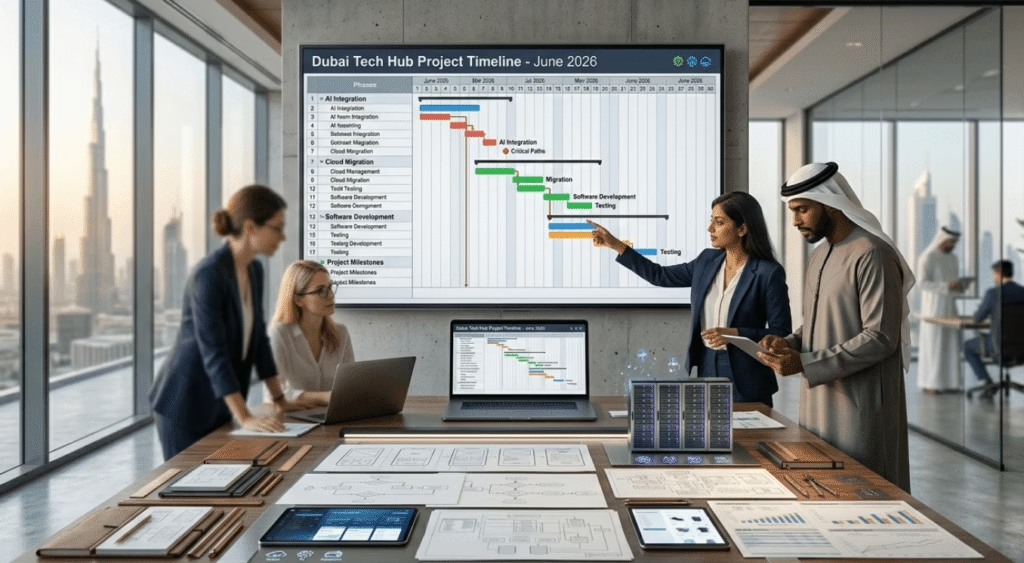
Cost and timeline are always evaluated together. Here is what to expect for each project tier.
App Development Timeline by Type
| App Type | Typical Timeline | What Drives It |
| Basic MVP | 6 to 10 weeks | Simple scope, single platform, minimal integrations |
| Standard business app | 3 to 5 months | Payment integration, user roles, basic backend |
| Mid-complexity app | 5 to 8 months | GPS, video, EHR, multi-role, compliance architecture |
| Enterprise app | 9 to 15 months | AI features, multi-platform, full UAE compliance, custom backend |
Sources: Codingclave, ZeeBrains, Riseup Labs, 2026.
What extends timelines in UAE projects specifically:
Payment gateway certification for UAE processors including Telr, PayFort, and Network International adds two to four weeks independently of engineering time. Arabic RTL testing across device configurations adds one to two weeks if not planned from the design phase. PDPL compliance architecture review and DHA approvals for healthcare apps add two to four weeks depending on the regulatory pathway. Scope changes after development starts are the single biggest timeline risk on any project, regardless of type. For enterprise apps requiring UAE PASS integration or Smart Dubai API connections, factor in government API access approval timelines that are outside the development team’s control.
A well-scoped custom app development engagement in Dubai, where requirements are fully defined before work starts, typically delivers within the ranges above. Projects that begin without defined scope consistently run longer and cost more.
What Is Changing Mobile App Development Costs in the UAE in 2026?

Four forces are actively reshaping what UAE apps cost, what they need to do, and what happens if you do not plan for them from the start.
AI-First Applications: When AI Adds Cost and When It Reduces It
Businesses in Dubai and Abu Dhabi are increasingly expecting AI features as standard: AI chat assistants for customer service, AI-powered search and recommendations, automated workflows, and personalized experiences. The cost impact depends on which kind of AI you are building.
When AI increases cost:
- Custom model training on your proprietary data requires a data pipeline, model infrastructure, and ongoing retraining. This is an expensive path and is rarely necessary for most UAE business apps.
- Real-time computer vision, Arabic voice recognition, and deep learning features require specialised engineers and significantly more infrastructure.
- Building a multi-agent AI system orchestrating actions across multiple business systems is enterprise-grade work.
When AI reduces cost:
- AI coding tools (GitHub Copilot, Cursor) reduce development timelines by 25 to 35 percent on applicable projects (Deorwine Infotech, 2026). This is a development efficiency gain your engineering team captures, not an AI feature in the app itself.
- Using existing LLM APIs (OpenAI, Claude, Gemini) instead of training custom models means an AI chatbot or assistant can be integrated for AED 44,000 to AED 128,000 rather than the AED 300,000+ cost of a custom model (Medium / Primocys, 2026).
Practical AI cost reference for UAE apps:
| AI Feature | Typical UAE Cost Range (AED) | Notes |
| AI chatbot using LLM API (basic) | AED 44,000 to AED 92,000 | Customer support, FAQ bot, using OpenAI or similar API |
| AI search and smart filtering | AED 22,000 to AED 55,000 | Product/service search with intelligent ranking |
| AI recommendation engine (basic) | AED 37,000 to AED 110,000 | Collaborative filtering, personalised content feeds |
| AI recommendation engine (real-time) | AED 110,000 to AED 220,000 | Real-time personalisation with behaviour analysis |
| Arabic NLP / voice recognition | AED 55,000 to AED 183,000 | Multi-language, accuracy-grade voice input |
| On-device AI / edge inference | AED 183,000 and above | Privacy-first AI that processes data on the device |
Sources: Medium AI breakdown, Primocys, MSM Core Tech, 2026. Converted to AED at 0.272.
The UAE National AI Strategy 2031 targets AED 335 billion in AI-driven economic growth (TekRevol, 2026). Dubai Internet City and Dubai Silicon Oasis offer R&D tax credits of up to AED 250,000 from 2026 to offset AI development costs for qualifying projects (Techugo, 2026).
UAE Government Digital Transformation: Why Integration Readiness Now Costs Less Than Unpreparedness Later
In April 2026, His Highness Sheikh Hamdan bin Mohammed directed all Dubai government entities to integrate individual and business services into a single unified digital platform within one year. The initiative is projected to contribute more than AED 10 billion to Dubai’s GDP within two years of operation (Dubai Media Office, April 2026). Dubai’s government services digitisation rate stands at 99.5 percent, with 87 percent of transactions completed digitally (Digital Dubai, 2026).
UAE PASS surpassed 11 million users in 2025 and processed 2.6 billion transactions across 322 public and private services (TekRevol, 2026). The Dubai Cashless Strategy targets 90 percent cashless transactions across government and private sectors by 2026 (Dubai.ae). Apps serving regulated sectors, government-connected workflows, or identity-sensitive use cases may increasingly benefit from UAE PASS and government API integration capabilities as the unified platform matures.
Planning for UAE PASS integration from sprint one adds AED 22,000 to AED 55,000 to an app build. Retrofitting it after launch adds that cost plus rework to existing authentication flows.
Privacy by Design: Why Compliance Architecture Decisions Happen in Sprint One, Not Sprint Ten
The UAE PDPL (Federal Decree-Law No. 45 of 2021) is fully enforced. The UAE Data Office is operational. Non-compliance penalties for data localisation breaches reach AED 500,000 to AED 700,000 (Recording Law, 2026). Criminal liability for unlawful data disclosure carries fines from AED 20,000 and up to one year in prison under the Cybercrime Law (Rounak Computers, 2026).
Privacy by design is an architecture decision that affects data storage location, encryption implementation, user consent flows, data minimisation choices, and audit logging from the first sprint. Specific cost implications:
- Data residency: UAE-hosted data requires AWS, Google Cloud, or Azure UAE availability zones. The cost difference versus non-UAE hosting is typically AED 500 to AED 2,000 per month.
- Consent management: Building PDPL-compliant consent capture, opt-out mechanics, and data subject access request (DSAR) handling adds AED 11,000 to AED 22,000 to a standard app build.
- Healthcare data: Apps handling clinical or health data fall under Federal Law No. 2 of 2019 rather than the PDPL, adding DHA compliance architecture on top. Dubai Healthcare City operates under additional regulatory oversight.
- Children’s data: Federal Decree-Law No. 26 of 2025 on Child Digital Safety is in force from January 2026, with full enforcement from January 2027. Apps with under-18 users require mandatory age verification, content filters, and parental controls designed in from version 1.
PDPL compliance designed from sprint one costs AED 7,000 to AED 37,000 depending on app type. Retrofitted after development, the same work costs three to five times more (Decipherzone, 2026).
The Super App Trend: What It Means for How You Budget Version 1
More than half of UAE residents prefer consolidated digital platforms that handle multiple needs (Rest of World, August 2025). Careem, which started as a ride-hailing service, now handles food delivery, grocery, payments, bike rentals, and home services within a single platform. Talabat has expanded from food delivery into groceries, health, and dining deals. Parkin, Dubai’s official parking app launched in February 2025, integrates parking payment, fine management, and mobility services for residents across the emirate (Mobiiworld, 2026). The global super app market was valued at $75.5 billion in 2023 and is projected to reach $706.2 billion by 2032 at a 28.2 percent CAGR (SNS Insider, 2024).
A super app architecture is fundamentally different from a single-service app. Building a modular backend that can host additional services, support third-party integrations via APIs, and maintain a unified identity and payment layer from day one costs more upfront than a single-service build but costs dramatically less than rebuilding a monolithic app into a multi-service platform later. If you intend to expand to multiple services within three years, the incremental cost of a service-oriented architecture from the start is AED 30,000 to AED 80,000. Rebuilding later costs 40 to 60 percent of the original build.
Estimate Your Mobile App Cost in Dubai: Feature-by-Feature Reference

Use this table to estimate the cost impact of individual features before your scoping conversation. Add the ranges that apply to your app to build a rough budget floor.
Feature Cost Calculator
| Feature | Typical UAE Cost Impact (AED) | Notes |
| User registration and login | AED 7,000 to AED 18,000 | Email, phone, social login. Add biometrics: AED 7,000 to AED 15,000 |
| UAE PASS integration | AED 22,000 to AED 55,000 | Government identity verification for UAE users |
| Arabic language and RTL support | AED 15,000 to AED 30,000 | Full layout mirroring, font rendering, RTL testing. Scoped from design phase. |
| Push notifications | AED 4,000 to AED 11,000 | Firebase Cloud Messaging or APNs. Segmentation and scheduling adds cost. |
| Payment gateway (Telr, PayFort, Stripe) | AED 11,000 to AED 29,000 per gateway | Includes sandbox testing and certification. BNPL (Tabby/Tamara) is a separate integration. |
| GPS tracking and maps | AED 18,000 to AED 55,000 | Real-time tracking, route optimisation, and geofencing at the higher end. |
| Offline mode | AED 15,000 to AED 35,000 | Local data caching, sync logic, conflict resolution. Essential for field apps. |
| Video consultation | AED 22,000 to AED 55,000 | Agora.io or WebRTC integration. Group video adds cost. |
| Admin dashboard and reporting | AED 18,000 to AED 55,000 | Scope depends on the number of metrics, user roles, and export requirements. |
| AI chatbot (LLM API) | AED 44,000 to AED 92,000 | Using OpenAI, Claude, or Gemini API. Custom training adds significant cost. |
| AI recommendation engine | AED 37,000 to AED 110,000 | Basic collaborative filtering at lower end. Real-time personalisation at the higher end. |
| EHR integration | AED 30,000 to AED 80,000 | Depends on target EHR system and data standards (HL7 FHIR, local UAE formats). |
| KYC and age verification | AED 18,000 to AED 44,000 | Third-party verification service integration plus UI flow. |
| Multi-currency support | AED 11,000 to AED 22,000 | Currency conversion, display logic, and payment routing. |
| In-app wallet | AED 22,000 to AED 55,000 | Balance management, top-up, P2P transfer. Regulatory considerations apply. |
| Social features (follow, feed, chat) | AED 37,000 to AED 110,000 | Real-time chat at the higher end using Firebase or a dedicated messaging SDK. |
| PDPL compliance architecture | AED 7,000 to AED 37,000 | Consent management, data residency, DSAR handling. Higher for healthcare and fintech. |
| DHA healthcare compliance | Add AED 20,000 to AED 50,000 | Dubai Healthcare City and DHA-regulated apps. On top of PDPL. |
All figures are UAE market indicative ranges. Final cost depends on scope depth, integration complexity, and team structure. Use these to build a budget floor before your scoping conversation.
Already know your features? Send your feature list to the Sigosoft team and receive a detailed cost estimate within 24 hours. No back-and-forth, no generic ranges.
What Is Actually Driving Your App Development Cost?

Labour is 60 to 70 percent of the bill. Every other line item, Apple Developer fees, push notification SDKs, cloud hosting, App Store Optimisation, combined rarely exceeds 15 percent of the total (Innovatrix Infotech, 2026). When you compare two quotes from any app development company in Dubai or elsewhere, you are comparing two things: how many developer hours go into the project, and what those hours cost.
The Six Biggest Cost Drivers in UAE App Projects
1. App complexity and feature count The single largest variable. A five-screen MVP with login and a basic catalog is structurally different from a telemedicine app with video consultation, EHR integration, e-prescription, and a payment gateway. Each feature is developer hours. Each integration requires testing, error handling, and documentation.
2. Platform choice: iOS, Android, or cross-platform Flutter Building separate native iOS and Android apps means two codebases, two timelines, and two maintenance obligations. Flutter runs from a single codebase across iOS, Android, web, and desktop. Over 60 percent of new Dubai apps in 2026 are built cross-platform to control costs (Riseup Labs, 2026). Mobile app development services in Dubai that offer Flutter as a default deliver faster and at lower total cost than teams building native in parallel.
3. UAE-specific compliance The UAE PDPL (Federal Decree-Law No. 45 of 2021) is actively enforced, with non-compliance penalties for data localisation breaches reaching AED 500,000 to AED 700,000 (Recording Law, 2026). Healthcare apps fall under Federal Law No. 2 of 2019 and DHA standards for deployments in Dubai Healthcare City. Apps with under-18 users must comply with Federal Decree-Law No. 26 of 2025 from January 2026.
4. Arabic RTL design and localisation A production-ready UAE app supports Arabic and English with right-to-left layout rendering. RTL is not a translation pass applied at the end of development. Scoped from the design phase, it costs AED 15,000 to AED 30,000. Retrofitted after building, it costs significantly more.
5. Payment gateway integration UAE gateway options include Telr, PayFort, Stripe, and Network International. Each integration adds AED 11,000 to AED 29,000 in engineering cost plus two to four weeks of sandbox testing and certification (Decipherzone, 2026). BNPL integrations like Tabby or Tamara are each a separate integration and certification process.
6. Backend infrastructure and data residency UAE data residency requirements mean the hosting decision is an architecture decision, not a deployment detail. AWS, Google Cloud, and Azure all have UAE availability zones. Choosing the right configuration for your data category and compliance obligation must happen before the backend is built.
Dubai Agency vs Offshore Team vs Hybrid Model: Which One Fits Your Project?

This is the most consequential financial decision in any UAE app project. The rate gap is significant. The risk profiles are different. The right answer depends on what you are building.
Developer Hourly Rate Comparison
| Model | Senior Developer Rate | Best For | Key Risk |
| Pure local Dubai agency | AED 400 to AED 600 per hour | DHA/PDPL-intensive apps, UAE government integrations, Arabic-first UX research | Cost. A six-month build costs AED 200,000 to AED 400,000 more than an equivalent offshore build. |
| Hybrid (UAE product and compliance lead, offshore engineering) | AED 90 to AED 300 blended per hour | Most mid-complexity UAE business apps. Best cost-to-quality ratio for the majority of projects. | Requires structured handoff, clear documentation, and a strong UAE-side product owner. |
| Pure offshore agency | AED 90 to AED 180 per hour | Cost-sensitive MVPs where UAE-specific compliance is limited and the team is well-briefed. | Without UAE market knowledge, PDPL architecture, Arabic RTL, and local gateway integration are common gap areas. |
Sources: Innovatrix Infotech, GoodFirms, Decipherzone, Cynoteck, 2026.
Why UAE Businesses Choose Hybrid Development Teams
The hybrid model is where most serious UAE projects land in 2026. It is not a compromise. It is the most commercially rational structure for the majority of mid-complexity UAE app builds.
UAE-based product ownership means the regulatory requirements, localisation decisions, market context, and user research are managed by someone embedded in the UAE ecosystem. PDPL architecture, DHA compliance discussions, Arabic UX decisions, and UAE payment gateway relationships all benefit from local knowledge that cannot be fully briefed into an offshore team.
Offshore engineering execution means the build cost is AED 90 to AED 180 per hour rather than AED 400 to AED 600. On a six-month mid-complexity project, the saving is AED 200,000 to AED 400,000 versus a fully local build (Innovatrix Infotech, 2026).
Timezone overlap between UAE and South Asian engineering hubs (India, Pakistan, Sri Lanka) is typically four to five hours of working overlap daily. For well-scoped projects with clear sprint planning, this is sufficient. Video standup culture and async documentation tools (Notion, Linear, Jira) have made hybrid execution reliable for UAE app projects of all sizes.
Compliance support in a hybrid model means a UAE-side lead who has navigated PDPL data architecture, DHA approvals, and Child Digital Safety Law requirements hands this knowledge directly to the offshore engineering team as architecture briefs, not as vague requirements. The result is a compliant build without the cost of a fully local engineering team.
Arabic and English delivery requires design review by someone who reads Arabic natively. In a hybrid model, the UAE product lead handles Arabic UX review, RTL testing, and content validation. Offshore teams handle implementation. This division works consistently across telemedicine, ecommerce, and enterprise operations projects.
Pure local Dubai agency makes the most sense for apps requiring direct DHA licensing discussions, ongoing PDPL legal advice during development, Arabic UX research with Emirati users, or direct integration with UAE government platforms where the API access process benefits from in-person relationship management. Businesses in DIFC, Dubai Healthcare City, and Business Bay operating under specific regulatory frameworks often find the compliance premium of a local agency justifiable.
What Does It Cost by App Category in the UAE?

Telemedicine and Healthcare Apps
Healthcare apps in the UAE fall under both Federal Law No. 2 of 2019 and DHA standards for Dubai-based deployments. Apps serving clients in Dubai Healthcare City face additional regulatory considerations. Compliance architecture must be scoped from the start of the project.
Sigosoft has built telemedicine apps for markets including the UAE and Nigeria, covering video consultation via Agora.io, e-prescription workflows, EHR integration, bilingual Arabic-English interfaces, and DHA-compliant data handling from sprint one. These apps were built to give clinicians mobile access to patient records, appointment schedules, and consultation histories that previously required desktop access, while reducing administrative overhead on scheduling and follow-up communication.
| Feature Layer | Indicative Cost Range (AED) |
| Core telemedicine (video, booking, e-prescription) | AED 150,000 to AED 280,000 |
| EHR integration | Add AED 30,000 to AED 80,000 |
| DHA compliance and data architecture | Add AED 20,000 to AED 50,000 |
| Arabic/English bilingual interface | Add AED 15,000 to AED 30,000 |
| In-app payments (Telr or Stripe) | Add AED 11,000 to AED 29,000 |
Ecommerce Apps
| Feature Layer | Indicative Cost Range (AED) |
| Core ecommerce (catalog, cart, checkout, order tracking) | AED 100,000 to AED 220,000 |
| Payment gateway (Telr, PayFort, or Stripe) | Add AED 11,000 to AED 29,000 |
| Arabic RTL interface | Add AED 15,000 to AED 30,000 |
| Loyalty programme and push notifications | Add AED 20,000 to AED 40,000 |
| Admin dashboard and inventory management | Add AED 30,000 to AED 70,000 |
Field Service and Business Operations Apps
Sigosoft developed a custom Android field operations app for Convergint UAE (previously MVP Tech), a global security and technology integrator operating from offices in Dubai, Abu Dhabi, and Iraq. Convergint’s UAE field teams manage installations, inspections, and service calls across access control, video surveillance, and fire safety systems for government, critical infrastructure, and commercial clients.
Before the app, jobs required manual logging, phone-based status updates, and paper work orders that were re-entered into back-office systems. The Sigosoft app consolidated field dispatch, real-time GPS tracking, digital work orders, offline sync for environments with limited site connectivity, and supervisor dashboards into a single Android interface. Operations managers gained live visibility across all active jobs without calls to the field. Work orders became auditable and reportable without manual data entry, removing a compliance risk for a company operating in regulated environments across Dubai and Abu Dhabi.
Sigosoft has also built GPS-enabled Android operations apps for UAE utility and water management companies. These apps track technician routes in real time, log inspection checkpoints with timestamps and geolocation, trigger alerts when monitored assets show anomalies, and generate compliance-ready reports automatically. The business impact: inspection records that previously required manual compilation at the end of each shift became automated audit trails, reducing reporting overhead and improving the accuracy of regulatory submissions across distributed infrastructure in Dubai and Abu Dhabi.
| Feature Layer | Indicative Cost Range (AED) |
| Core field ops (dispatch, job tracking, digital work orders) | AED 80,000 to AED 180,000 |
| Real-time GPS tracking and route optimisation | Add AED 25,000 to AED 55,000 |
| Offline sync for low-connectivity environments | Add AED 15,000 to AED 35,000 |
| Supervisor dashboards and reporting | Add AED 20,000 to AED 45,000 |
| PDPL-compliant data architecture | Add AED 15,000 to AED 30,000 |
Business Operations and Enterprise Apps
Lottery and Gaming Apps
Lottery app development in the UAE requires compliance with local gaming regulations from version 1. KYC verification, age checks, and responsible gaming features are built-in requirements, not post-launch additions. In-app wallet functionality, real-time draw results, multi-currency support, and referral mechanics complete the standard feature set.
| Feature Layer | Indicative Cost Range (AED) |
| Core lottery (ticket purchase, draw results, wallet) | AED 120,000 to AED 250,000 |
| KYC and age verification | Add AED 20,000 to AED 45,000 |
| Referral programme and leaderboard | Add AED 15,000 to AED 30,000 |
| Multi-currency and payment integration | Add AED 20,000 to AED 40,000 |
Should You Build for iOS or Android First in the UAE?

iOS is the fastest-growing mobile OS segment in the Middle East, driven by rising incomes and strong brand preference among high-income households in Dubai and Abu Dhabi (Market Data Forecast, 2026). iOS captures a disproportionately high share of UAE consumer app revenue despite Android leading raw web traffic volume (Statista / DataReportal, 2024).
For most UAE consumer apps targeting high-value users, launching on both platforms simultaneously via Flutter is the most commercially sound and cost-efficient approach. For B2B field operations apps and enterprise tools used by diverse multinational workforces, Android remains the practical first platform for field-facing roles.
iOS vs Android vs Flutter for UAE Projects
| Factor | iOS Native | Android Native | Flutter Cross-Platform |
| UAE consumer app revenue share | Higher per user | Lower per user | Captures both markets |
| Build cost | Base cost | Base cost | 20 to 40 percent lower than two native builds |
| Arabic RTL support | Strong | Strong | Strong in Flutter 3.x+ |
| Best for UAE consumer apps | Premium consumer, fintech, healthcare | Field teams, enterprise B2B | Most mid-complexity UAE business apps |
| Developer Account fee | USD 99 per year | USD 25 one-time | Both required for dual platform |
| AI feature support | Strong (Core ML, on-device) | Strong (TensorFlow Lite) | Strong via platform channels |
What Are the Hidden Costs That Blow UAE App Budgets?
The number your development partner quotes is the build cost. Total cost of ownership in year one is typically 1.5 to 2 times that number (Decipherzone, 2026). Hidden costs consistently consume 45 to 70 percent of the initial development budget when maintenance, marketing, compliance, and hosting are included.
Year-One Total Cost of Ownership
| Cost Category | Typical Range | Notes |
| App development (build) | AED 80,000 to AED 400,000+ | Quoted by your development partner |
| Annual maintenance | 15 to 20 percent of build cost per year | OS updates, security patches, bug fixes (Riseup Labs, 2026) |
| Cloud hosting (AWS, Google Cloud, Azure UAE zone) | AED 500 to AED 5,000 per month | Depends on traffic and data volume |
| PDPL compliance architecture | AED 7,000 to AED 37,000 | Higher for healthcare and fintech (Netguru, 2026) |
| Apple Developer Program | USD 99 per year (AED 365) | Mandatory for App Store distribution |
| Google Play Developer | USD 25 one-time (AED 92) | One-time fee |
| Arabic localisation and RTL testing | AED 15,000 to AED 30,000 | If not scoped into main build |
| UAE PASS integration | AED 22,000 to AED 55,000 | If required for government service connection |
| App Store Optimisation (ASO) | AED 3,000 to AED 10,000 initial | Ongoing if targeting UAE App Store rankings |
| User acquisition and marketing | 30 to 50 percent of build cost in year one | Dubai’s digital market is competitive (Netguru, 2026) |
What Are the Most Expensive Mistakes in UAE App Projects?

Building without scoping compliance first. PDPL applies to any app processing personal data of UAE residents regardless of where the company is headquartered. Healthcare apps have additional DHA obligations. Retrofitting compliance costs three to five times more than designing it in (Decipherzone, 2026).
Choosing the lowest quote. A quote 40 percent below market is cutting scope, using junior developers on complex components, or deferring costs to post-launch maintenance. The invoice might be lower. The total project cost is not.
Skipping Arabic RTL from the design phase. Arabic localisation added after the interface is built requires layout rework at the component level, not a translation pass. Scoping it from sprint one is materially cheaper.
Ignoring payment gateway certification timelines. UAE gateway integrations (Telr, PayFort, Network International) require sandbox testing, certification, and in some cases merchant account approvals that take two to four weeks independent of engineering time. This is a timeline risk, not just a cost line.
Treating maintenance as optional. Apple and Google release major OS updates annually. Each can break existing functionality silently. Apps without active maintenance break within 12 to 18 months (Skyline Advanced Technology, 2026). Budget 15 to 20 percent of the build cost per year from day one.
Ignoring UAE PASS and government API integration readiness. Apps serving regulated sectors or government-connected workflows may benefit from planning UAE PASS integration readiness from version 1. Retrofitting later adds both engineering cost and disruption to existing authentication flows.
Forgetting offline mode for field apps. Any app used by a technician or inspector in UAE industrial or infrastructure environments must work without consistent connectivity. Apps requiring live network access to log a job fail at the moment they are most needed.
How Much Does Sigosoft Charge for App Development in the UAE?

Sigosoft does not publish a fixed rate card because every project is different. What we can tell you is how to get an accurate number quickly.
The ranges throughout this article are market references. Sigosoft quotes are scoped to your specific feature list, your platform choice, your compliance requirements, and your market. The consistent finding from Sigosoft’s custom app development work in the UAE is that clients who invest 30 minutes in a scoping conversation at the start get a more accurate budget, a shorter build, and fewer surprises after launch.
Sigosoft handles App Store and Google Play submission as part of the development package, covering submission preparation, metadata writing, screenshot production, and review management. You provide your own Apple Developer Account and Google Play Developer Account. Both are quick to set up and Sigosoft guides you through the process.
Get a cost estimate for your specific app. 30-minute scoping call, no obligation
What Information Do You Need to Get an Accurate App Cost Estimate?
Before contacting any app development company in Dubai, having clear answers to these questions will get you to an accurate estimate faster and remove the back-and-forth that delays most scoping conversations.
- Target users: Who uses the app, how many, and where are they? UAE residents only, or multiple markets?
- Platforms: iOS, Android, or both? Web version required?
- Core features: What are the five to seven things the app must do in version 1?
- Integrations: Which external systems must the app connect to? Payment gateways, EHR, ERP, government APIs, UAE PASS?
- Compliance needs: Does your sector require PDPL, DHA, DIFC, or other regulatory compliance? Are any users under 18?
- AI features: Do you need AI? If so, what problem does it solve and do you have proprietary data to train on?
- Timeline: When does version 1 need to launch? Is there a regulatory deadline or market event driving the date?
Having these answers before your first call with app developers in Dubai typically cuts the scoping process from three or four meetings down to one.
Book your scoping call. Come with your answers and leave with a real cost estimate
Frequently Asked Questions: App Development Cost in Dubai and the UAE

How much does mobile app development cost in Dubai in 2026? Between AED 25,000 for a minimal single-platform MVP and AED 500,000 or more for an enterprise app with full UAE compliance. The most common mid-level business app investment runs AED 92,000 to AED 294,000. These figures reflect what UAE businesses are actually paying in 2026, not theoretical minimums (Riseup Labs, Decipherzone, 2026).
Is app development more expensive in Dubai than in other markets? Yes, for local agency work. Dubai senior developer rates run AED 400 to AED 600 per hour versus AED 90 to AED 180 per hour for offshore senior developers. However, UAE-specific requirements including PDPL compliance, Arabic RTL design, UAE PASS integration, and local payment gateway certification require either local expertise or a well-briefed offshore team with a UAE product owner.
How does Flutter reduce app development costs in the UAE? Flutter uses a single codebase for iOS, Android, web, and desktop. Versus building separate native apps, Flutter cuts build cost by 20 to 40 percent and reduces the maintenance obligation to one codebase rather than two. Over 60 percent of new Dubai apps in 2026 are built cross-platform (Riseup Labs, 2026).
What does UAE PDPL compliance add to the development cost? Between AED 7,000 and AED 37,000 when designed from the start of the project, depending on app type and data handling complexity (Netguru, 2026). Healthcare apps face additional DHA requirements. PDPL compliance retrofitted after development costs three to five times more. Penalties for non-compliance with data localisation requirements reach AED 500,000 to AED 700,000 (Recording Law, 2026).
How much does UAE PASS integration cost? Between AED 22,000 and AED 55,000 depending on the depth of integration, whether it covers identity verification only or extends to government service transactions. Apps serving regulated sectors or government-connected workflows may find this increasingly beneficial as Dubai’s unified digital platform matures.
Do I need to add AI features to my app in 2026? Only if they solve a real user or business problem. An AI chatbot built on an LLM API costs AED 44,000 to AED 92,000 and makes sense for apps with high-volume customer queries. An AI recommendation engine costs AED 37,000 to AED 110,000 and justifies its cost for ecommerce or content apps with large catalogs. Custom AI model training rarely makes financial sense for most business apps when pre-built APIs deliver 80 percent of the outcome at 20 percent of the cost.
Should I build for iOS or Android first in the UAE? For consumer apps targeting high-value users in Dubai and Abu Dhabi, Flutter cross-platform simultaneous launch is the most cost-efficient approach. iOS captures a disproportionately high share of UAE consumer app revenue. For B2B field operations apps and enterprise tools, Android is the practical first platform for most field teams.
What ongoing costs should I budget for after launch? Annual maintenance at 15 to 20 percent of the original build cost. Cloud hosting on AWS, Google Cloud, or Azure UAE zones at AED 500 to AED 5,000 per month. Apple Developer Program renewal at USD 99 per year. PDPL compliance reviews as the UAE Data Office issues updated guidance. User acquisition marketing at 30 to 50 percent of build cost in year one for consumer apps (Netguru, 2026).
How long does it take to build an app in the UAE? A basic MVP takes 6 to 10 weeks. A standard business app with payments and integrations takes 3 to 5 months. A mid-complexity app takes 5 to 8 months. An enterprise app with AI features and full UAE compliance takes 9 to 15 months. Timeline risk comes from scope changes after development starts, not engineering speed.
Does Sigosoft work with businesses outside Dubai? Yes. Sigosoft has built apps for clients in Nigeria, the UAE, and international markets. For UAE projects, PDPL compliance, Arabic RTL support, UAE payment gateway integration, and UAE PASS readiness are part of every scoping conversation. For non-UAE projects, the relevant regulatory framework is scoped at the start.
What is the difference between a fixed-price and time-and-materials contract? Fixed-price works when scope is fully defined before development begins. Time-and-materials work when requirements are likely to evolve. UAE development projects with undefined scope that start as fixed-price routinely end in scope change disputes. A proper scoping session before signing any contract is worth the time regardless of contract type.
How do I get a realistic quote for my app idea? Map your core features to the cost calculator table in this article. Review the “What information do you need” checklist above. Then book a 30-minute scoping call with a development team. The combination of market context and a specific conversation about your requirements gets you within 20 percent of the real number before any proposal is written.
The Number That Matters Is the One Scoped to Your Project
Market ranges give you a framework. Your actual cost depends on your feature list, your platform choice, your compliance requirements, and your team structure. Every one of those variables is answerable in 30 minutes with the right conversation.
Sigosoft has built field operations apps for Convergint UAE, telemedicine apps for healthcare providers in Nigeria and the UAE, GPS operations tools for UAE utility companies, and ecommerce, lottery, and voice chat apps across multiple markets. The team knows what drives cost up in UAE mobile application development projects, what Dubai’s government digital transformation means for integration requirements from 2026 forward, and how to scope version 1 to get to market without overbuilding.
Portfolio and Case Studies Does Your Business Need a Custom Mobile App in 2026?
