
$377 billion. That is the size of the global mobile app market in 2026. Users spend an average of 4.2 hours per day inside apps. Eight of the top ten most-downloaded apps worldwide are payment or commerce tools.
The conversation about whether to build a custom mobile app has shifted. The question used to be whether it was technically feasible. It is. The question after that was whether the cost was manageable. For most serious business applications in 2026, it is. The real question now is whether your business can afford to keep operating without one while your competitors build their audience, automate their field operations, and own your customers’ screens.
This guide covers the actual cost of custom mobile app development in 2026, what AI has changed, proven examples across five verticals, and a practical framework for deciding whether you need to build now.
Ready to find out what your app would actually cost? Book a free 30-minute scoping call with Sigosoft. Walk away with a feature list, platform recommendation, and a realistic cost estimate for your idea.
At a Glance
- A custom mobile app is worth building when manual processes are costing you customers, accuracy, or operational time every week
- Flutter app development cuts build cost by up to 50 percent versus separate native iOS and Android builds
- Custom mobile app development MVPs now start from around $30,000 for tightly scoped single-platform builds
- AI tools cut development timelines by 2 to 4 weeks on real projects in 2026, not the 50 to 80 percent vendor marketing claims
- The global mobile app market exceeds $377 billion in 2026 (Mordor Intelligence)
- Healthcare, ecommerce, enterprise operations, and gaming remain the highest-growth verticals
Key Takeaways
- Build a custom app when off-the-shelf software forces your team into daily workarounds
- Flutter reduces mobile app development cost by up to 50 percent versus separate native builds
- AI shortens build timelines but does not replace experienced developers on complex projects
- Most tightly scoped MVPs ship within 8 to 12 weeks on a single platform
- Healthcare, ecommerce, field service, and lottery apps are the highest-growth categories in 2026
- 60 percent of enterprises reported productivity gains within 6 months of deploying a custom app (WorldMetrics, 2026)
- Budget 15 to 20 percent of the original build cost each year for maintenance
What Has AI Actually Changed About Mobile App Development?

The honest picture is a real but measured improvement, not the revolution vendor marketing describes.
| What Changed | Real Impact | Source |
| AI coding tools (GitHub Copilot, Cursor) | 25 to 35 percent faster development timelines | Deorwine Infotech, 2026 |
| Speed to market | 2 to 4 weeks faster per project | Chop Dawg, April 2026 |
| AI cost savings on real projects | 10 to 25 percent, not 50 to 80 percent as marketed | Chop Dawg, April 2026 |
| Flutter cross-platform share | Over 40 percent of the cross-platform market | Deorwine Infotech, 2026 |
| Cross-platform vs separate native builds | Up to 50 percent cost reduction | Netguru / Toptal |
| Low-code platform growth | 65 percent CAGR. Gartner: 75 percent of all new dev by 2026 | Gartner via Lovable |
| Enterprise Mobility Management Market | $22.80B in 2025, rising to $24.87B in 2026 | MarketResearch.com |
A $100,000 project with a team using AI tooling well now costs $75,000 to $90,000 and arrives 2 to 4 weeks earlier. That speed advantage is frequently worth more than the cost saving. In a competitive vertical, being first to market by three weeks can determine which product customers find and stay with.
What did not change: complex projects still require experienced engineers. AI does not replace architecture decisions, security design, compliance scoping, or quality assurance on healthcare or enterprise apps. It handles repetitive scaffolding faster. The expertise still determines the outcome.
Does Your Business Need a Custom Mobile App?

You need one when a manual process is actively costing you customers, accuracy, or hours every single week.
Run these against your own operation:
- Your field team fills paper forms that someone re-enters into a system back at the office. That double-entry costs hours and introduces errors that compound weekly
- A competitor in your sector launched an app in the last 24 months and is reaching customers you cannot access through a website alone
- You have repeat customers but no owned engagement channel. Push notifications, loyalty programmes, and in-app communication all require a native app
- You are processing manual approvals, daily reports, or job assignments that could be automated and logged in real time
- You operate in a regulated vertical where compliance documentation and audit trails are mandatory, and your team produces those records by hand
- Every off-the-shelf SaaS tool you have tried requires workarounds because none of them match your actual workflow
What the data shows: 67 percent of distributed workforce teams already manage business workflows through custom apps. 58 percent still rely on manual processes (SOTI Mobility Mandate, 2025). Among enterprises that deployed custom mobile apps, 60 percent reported measurable productivity gains within 6 months and 45 percent reported a 20 percent or more reduction in operational costs (WorldMetrics, 2026).
Custom App vs Off-the-Shelf Software
| Factor | Custom App | Off-the-Shelf SaaS |
| Workflow fit | Built exactly for your process | Requires workarounds |
| Upfront cost | Higher ($30K to $200K+) | Lower (monthly subscription) |
| Long-term cost | Predictable (15 to 20 percent annual maintenance) | Scales with users and vendor pricing |
| Data ownership | You own all data | Vendor holds your data |
| Integration | Custom to your existing systems | Limited to vendor integrations |
| Competitive edge | High (competitors cannot replicate your tool) | None (competitors use the same tool) |
| Compliance control | Full control over data handling | Dependent on vendor compliance posture |
| Scalability | Scales to your exact requirements | Scales within vendor limits |
The crossover point: when your team spends more than 5 hours a week navigating SaaS workarounds, a custom app pays back faster than most businesses expect.
Not sure whether custom development or an off-the-shelf tool is the right call for your situation? The Sigosoft team can answer that in 30 minutes. No obligation.
What Does a Business Operations App Actually Do? Real Examples

Three real operational contexts where custom Android apps built by Sigosoft changed how work gets done.
Convergint UAE (previously MVP Tech): Security and Technology Field Operations
Convergint is a global security and technology solutions integrator with established offices in Dubai, Abu Dhabi, and Iraq, serving government, critical infrastructure, healthcare, and commercial clients. Their UAE operations cover access control, video surveillance, fire safety systems, and security operations centres. A field workforce managing installations, inspections, and service calls across dozens of active sites cannot run on spreadsheets and phone-based status updates.
Sigosoft developed a custom Android business operations app that consolidated field dispatch, technician job tracking, digital work orders, real-time GPS location, and completion reporting into a single mobile interface. Jobs that previously required manual logging and follow-up calls became trackable, auditable, and reportable from any location. The app operates with offline sync for environments where site connectivity is inconsistent, and supervisor dashboards give operations managers live visibility across all active jobs without a single call to the field.
Healthcare and Clinical Operations: Africa and GCC
Sigosoft has built healthcare apps across markets including Afric and the GCC, covering telemedicine delivery, patient management, appointment scheduling, and clinical operations. These apps handle video consultation via Agora.io, e-prescription workflows, EHR integration, in-app payments through Paystack or Stripe depending on the market, and bilingual Arabic-English interfaces for UAE deployments.
Compliance is scoped at the start of every project, not added at the end: HIPAA for US-aligned deployments, Dubai Health Authority (DHA) standards for UAE, NDPR for Nigeria, and ISO 27001 as the data security baseline across all environments. Infrastructure runs on Flutter for cross-platform iOS and Android delivery from a single codebase, and Firebase for real-time data sync between patient and clinician.
GPS and Operational Optimisation: UAE Water and Utilities
Water and utility management in the UAE involves distributed infrastructure across Dubai and Abu Dhabi, field inspection teams, asset monitoring, and mandatory regulatory reporting. Sigosoft has built GPS-enabled Android operations apps for this sector. These apps track technician routes in real time, log inspection checkpoints with timestamps and geolocation, trigger alerts when monitored assets show anomalies, and generate compliance-ready reports automatically at the end of each shift.
Built for field environments: offline mode for limited-connectivity sites, route optimisation, digital inspection checklists, asset tagging, and supervisor dashboards. The UAE government’s smart city programmes create sustained demand for this type of operational tooling across utilities, facilities management, and infrastructure maintenance.
Why Are Telemedicine and Healthcare Apps Growing Faster Than Any Other Vertical?

- Telemedicine app downloads growing 28 percent annually through 2026 (CMARIX / Sensor Tower)
- Remote consultations up 600 percent since 2020 (AppVerticals)
- AI-driven symptom checkers improve patient engagement by over 40 percent (CMARIX)
- 18 percent of health apps now use some form of machine learning (SQ Magazine, 2025)
Core Features for a Production-Ready Telemedicine App
| Feature | Purpose |
| Video consultation | Live patient-clinician sessions via Agora.io or WebRTC |
| Appointment booking | Self-service scheduling with automated reminders |
| E-prescription | Digital prescription generation tied to the consultation record |
| EHR integration | Sync with existing electronic health records systems |
| In-app payments | Paystack (Nigeria), Stripe (international), Flutterwave (West Africa) |
| Multi-language interface | Arabic and English for UAE, additional languages per market |
| Push notifications | Appointment reminders, test results, prescription alerts |
| Compliance audit trail | Automated logging for regulatory reporting |
Compliance requirements by market:
- UAE: Dubai Health Authority (DHA) standards
- US deployments: HIPAA
- Nigeria: NDPR and Federal Ministry of Health guidelines
- All markets: ISO 27001 as the data security baseline
What Makes a Dedicated E-commerce App Worth Building in 2026?
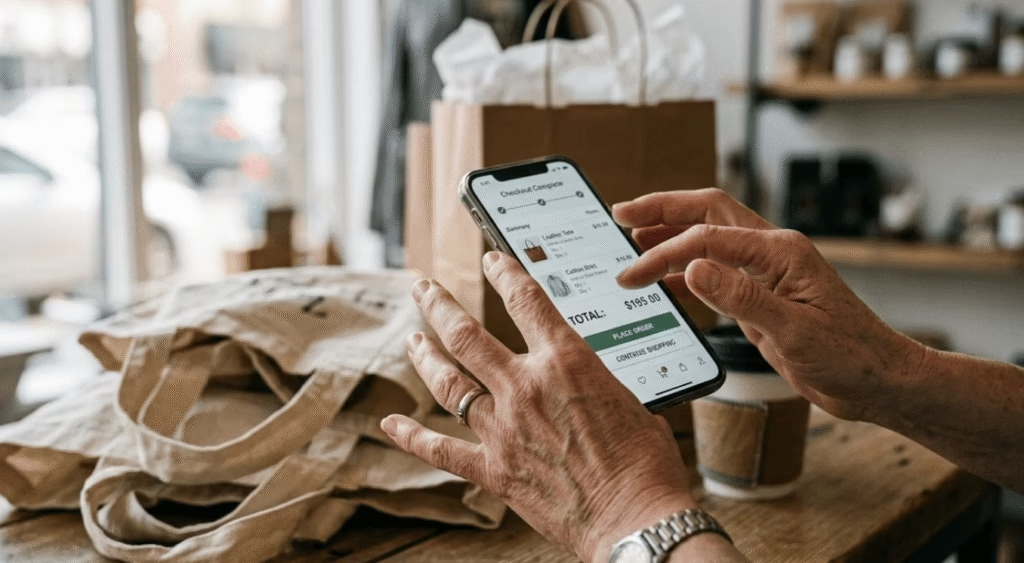
Global ecommerce app revenue is projected at $3.89 trillion in 2026 (Statista). Shopping app marketing spend jumped 70 percent overall and 123 percent on iOS in 2025, following mobile-native commerce rather than mobile websites (AppsFlyer, February 2026).
Mobile App vs Mobile Website
| Factor | Native Mobile App | Mobile Website |
| Load speed | Faster (native rendering) | Slower (browser overhead) |
| Offline access | Yes, catalog browsing and saved items | No |
| Checkout speed | Biometric one-tap checkout | Card details re-entered each time |
| Push notifications | Yes, 4 to 6 percent higher CTR than email (CMARIX) | No |
| Personalisation | Deep, AI-driven home screen and purchase history | Shallow |
| Camera product search | Yes | No |
| App Store discoverability | Yes | No |
| Data ownership | Full, you own all customer data | Full |
| Build cost | Higher | Lower |
| Maintenance | Required annually for OS compatibility | Standard web maintenance |
Social commerce through TikTok and Instagram is growing fast but does not replace an owned app channel. When a customer buys through a social platform, that platform owns the transaction data and the relationship. Your app keeps both.
Core ecommerce app features for 2026: product catalog with search and filter, cart and checkout, payment integration (Paystack, Flutterwave, Stripe), order tracking with real-time status, loyalty points, push notifications, and a review system.
Why Are Lottery and Gaming App Developers Moving Faster Than Before?

In-app purchase revenue from AI-enhanced apps reached $1.3 billion in 2024, up 180 percent year-on-year (Sensor Tower via Droids on Roids, March 2026). Non-gaming interactive apps including lottery, fantasy sports, and social gaming saw marketing spend rise 18 percent in 2025 (AppsFlyer). Regional market gaps in West Africa and the Gulf remain wide.
The critical variable in lottery app development is compliance. In Nigeria, the National Lottery Regulatory Commission (NLRC) governs operations. KYC verification, age checks, and responsible gaming prompts are built-in requirements from version 1, not retrofitted after a regulatory review flags their absence.
Retention-driving features for a lottery app:
- Instant ticket purchase with in-app wallet
- Real-time draw results pushed via notification
- Multi-currency support
- Referral programme with tracked incentives
- Leaderboard and jackpot alerts
- Promotional notifications for special draws
Infrastructure: Kotlin for Android-native builds, Flutter for cross-platform where iOS distribution is also in scope, secure payment APIs with audit-ready transaction logs.
How Does a Voice Chat App Generate Sustainable Revenue in 2026?

Social apps hold 32 percent of all global mobile screen time (SQ Magazine). Voice-first interfaces rank among the top mobile development trends for 2026, replacing traditional tap-based navigation in community and professional contexts (Deorwine Infotech, 2026).
The opportunity is not in building another general social platform. It is in building a voice-first community around a specific vertical: professional networking in a niche industry, language learning with native speaker matching, regional community audio for audiences existing platforms do not serve, or gaming coordination for a specific title.
Revenue models that work in production:
- Subscription tiers gating room size or recording features
- Virtual gifting between users during live audio sessions
- Paid private rooms and hosted events
- Creator monetisation splits
- Sponsored audio events
Core features: real-time audio rooms, push-to-talk, user profiles with follow and discovery, moderation tools, session recording, subscription billing, in-app gifting with virtual currency.
Infrastructure: WebRTC for real-time audio delivery, Agora.io or Twilio for the voice layer depending on latency requirements, Firebase for user state and presence, Kotlin or Flutter for the client build.
You Know Which Vertical Fits. Here Is What Comes Next.

Five verticals. Real builds. Named clients. If any of those descriptions matched your business, the next step is not a proposal document. It is a 30-minute scoping call with the Sigosoft team. Walk away with a feature list, a platform recommendation (iOS first, Android first, or cross-platform Flutter), and a cost range scoped to your specific requirements.
Get your app scoped in 30 minutes. No sales script, no obligation.
What Are the Most Common Mistakes Founders Make Before Building an App?

Most avoidable costs in custom mobile app development are locked in before a single line of code is written.
Mistake 1: Building for both iOS and Android from day one. An MVP on one platform tests the concept at roughly half the cost. The second platform launches after the first proves the idea. Android first for Nigeria and most of Africa. iOS first where the target user is a high-value consumer in the UAE, UK, or US.
Mistake 2: Version 1 built with every feature imaginable. Launch with 5 to 7 core features. Real users tell you which ones they use within 60 days. Add the rest based on that evidence, not pre-launch assumptions. Features built without evidence are the most expensive line in any development budget.
Mistake 3: Choosing the lowest quote. A quote 40 percent below market either omits scope, assigns junior developers to complex components, or defers costs to post-launch maintenance. The invoice might be lower. The total cost never is.
Mistake 4: Skipping user research. Five to ten interviews with real potential users and a competitor audit on the App Store and Google Play take two weeks and cost nothing. They frequently change what version 1 looks like in ways that prevent months of rework later.
Mistake 5: Ignoring maintenance costs. Budget 15 to 20 percent of the original build cost per year. Apple and Google both release major OS updates annually. Each one can break existing functionality if maintenance is deferred (Netguru, 2026).
Mistake 6: No offline mode for field apps. A business operations app used by a security technician in a building basement or a utility inspector at a remote site must work without consistent connectivity. Apps that require live network access to log a job fail at exactly the moment they are needed most.
How Much Does Custom Mobile App Development Cost in 2026?

App Cost by Type and Complexity
| App Type | Typical Scope | Market Cost Range (USD) | UAE Cost Range (AED) |
| Simple MVP | 5 to 7 features, single platform | $30,000 to $80,000 | AED 110,000 to AED 295,000 |
| Mid-complexity app | Payments, GPS, multi-user roles, integrations | $80,000 to $200,000 | AED 295,000 to AED 735,000 |
| Enterprise app with AI | Custom backend, compliance, multi-platform | $200,000 and above | AED 735,000 and above |
Sources: Sketchflow AI, Medium, PixelBrainy, Netguru, 2026.
Flutter vs Native Development
| Factor | Flutter (Cross-Platform) | Native (iOS and Android Separate) |
| Codebase | Single codebase for iOS, Android, web, desktop | Separate codebase per platform |
| Development cost | 25 to 40 percent lower (Netguru) | Higher (two separate teams or builds) |
| Timeline | Faster (one build cycle) | Longer (parallel or sequential builds) |
| Performance | Near-native for most use cases | Maximum native performance |
| Best for | Business apps, ecommerce, telemedicine, operations | Advanced graphics, AR/VR, device-intensive apps |
| Market share | Over 40 percent of cross-platform market (Deorwine Infotech, 2026) | Declining share in new projects |
MVP vs Full Product
| Factor | MVP | Full Product |
| Features | 5 to 7 core features | Full feature set |
| Timeline | 8 to 12 weeks | 4 to 12 months |
| Cost | $30,000 to $80,000 | $80,000 to $500,000+ |
| Purpose | Validate the concept with real users | Scale a proven, validated concept |
| Risk level | Low | Higher (more invested before validation) |
| Recommended approach | Start here | Build here after MVP proves the idea |
Build Now vs Wait Another Year
| Factor | Build Now | Wait Another Year |
| AI development savings available | 10 to 25 percent today | Marginal further improvement projected |
| Flutter maturity | Production-ready, 40 percent market share | No significant change projected |
| Competitor activity | Growing rapidly in most verticals | Your gap widens each month |
| Market size | $377 billion in 2026, 18 percent CAGR | Higher competition as market matures |
| Cost trend | Stable to slightly declining for MVPs | No meaningful price drop projected |
| First-mover advantage | Available in most regional verticals now | Erodes monthly |
All cost figures above are market reference ranges. Sigosoft quotes are scoped to your specific requirements, your platform choice, and your target market.
Frequently Asked Questions: Custom Mobile App Development in 2026

How much does custom mobile app development cost in 2026?
A simple MVP typically costs $30,000 to $80,000. Mid-complexity apps with payment integrations, GPS, and multi-user roles run $80,000 to $200,000. Enterprise-grade apps with AI features and a compliance layer exceed $200,000. In the UAE, budgets start from AED 110,000 for basic builds. Cross-platform Flutter builds cost 25 to 40 percent less than separate native apps (Netguru, 2026).
How long does it take to build a mobile app?
Most apps take 3 to 9 months from kickoff to App Store submission. A tightly scoped MVP on a single platform can ship in 8 to 12 weeks. AI-assisted development is cutting timelines by 2 to 4 weeks compared to traditional builds, depending on the complexity and degree of custom engineering required (Chop Dawg, April 2026).
Should I build for iOS or Android first?
Build for the platform your target users are on. In Nigeria and most of West Africa, Android holds over 80 percent of the market. In the UAE and Western markets, iOS accounts for a larger share of high-value consumer transactions. For B2B enterprise field operations apps, Android is the standard first platform for most teams.
Has AI actually made mobile app development cheaper?
Yes, but not by the 50 to 80 percent some vendors claim. On real projects in 2026, AI tools deliver 10 to 25 percent cost savings and shave 2 to 4 weeks off timelines. The larger saving comes from cross-platform Flutter development, which cuts build cost by up to 50 percent versus separate native codebases (Netguru / Chop Dawg, 2026).
What is the difference between an MVP and a full app?
An MVP contains only the core features needed to test the idea with real users. It costs less and ships faster. A full app adds depth, integrations, and secondary features based on what the MVP reveals about actual user behaviour. Most successful apps start as MVPs and expand based on user evidence, not pre-launch assumptions.
Can I build a telemedicine app without a healthcare background?
Yes. An experienced mobile app development team handles the technology. You need a clinical or regulatory advisor to guide feature design, data handling, and compliance scoping. In the UAE, patient data apps must align with Dubai Health Authority (DHA) standards. In the US, HIPAA governs. In Nigeria, NDPR and Federal Ministry of Health guidelines apply.
Does Sigosoft handle App Store submission?
Yes. App Store and Google Play submission is covered as part of the development package. Sigosoft handles submission preparation, metadata writing, screenshot production, and review management. The one requirement from your side: you need to provide your own Apple Developer Account and Google Play Developer Account. Both are straightforward to set up and Sigosoft will guide you through the process.
What ongoing costs should I budget for after launch?
Budget 15 to 20 percent of your original build cost per year. This covers iOS and Android OS compatibility updates (both Apple and Google release major updates annually that can break existing functionality), security patches, bug fixes, and minor feature additions. Deferred maintenance causes apps to fail silently against new OS versions (Netguru, 2026).
How do I know if my app idea is viable before committing budget?
Start with a competitor audit on the App Store and Google Play. Look at apps solving the same problem, their review scores, feature gaps, and most frequent user complaints. Then run 5 to 10 interviews with real potential users. A scoping session with a mobile app development company like Sigosoft will tell you exactly what it costs to build before you commit.
What industries are building the most apps in 2026?
Healthcare and telemedicine, ecommerce and retail, fintech and payments, field service and enterprise operations, gaming and lottery, and social or community platforms. In the UAE specifically, security technology, utilities, and facilities management are active growth areas for custom Android business operations apps.
The Longer You Wait, the More It Costs to Catch Up
The mobile app market crossed $377 billion in 2026. Flutter brought cross-platform development costs down by up to 50 percent. AI tools shortened timelines by 2 to 4 weeks. The cost of building a mobile app dropped relative to what it delivers. The cost of not building one keeps rising as competitors move and the gap widens.
Send Sigosoft your idea. The team will scope it, price it, and tell you exactly what version 1 needs to look like for your market and your budget.
