Two developers quote the same app. One says $5,000. The other says $42,000. Both of them could be right.
That gap is not a negotiating tactic. It comes from completely different assumptions about what your app actually is. The lower quote is pricing a prototype with basic screens and no real backend infrastructure. The higher one is pricing something you can actually launch, put in front of real users, and grow without rewriting it six months later. Most business owners only figure this out after signing with the wrong vendor.
This guide covers the real mobile app development cost in Bangalore, India in 2026: what drives the number up or down, what each tier looks like in USD and INR, and what most agencies quietly leave off their quotes. Whether you are a Bangalore-based startup or an international business looking to build with an Indian development team, the numbers here are based on actual project scopes.
Why International Businesses and Indian Startups Both Build in Bangalore

Bangalore is not just India’s tech capital by reputation. It is the most startup-dense city in South Asia, with 39 startups per 100,000 people and over 3,834 active ventures. The city raised more than $675 million in startup funding in 2025. Rapido was built here because Bangalore’s traffic was unbearable and bikes were the fastest way through it. That single product insight turned into a billion-dollar company. Groww and Razorpay, both founded in Bangalore, are currently in the process of moving their headquarters back to India ahead of domestic IPOs. That is a strong signal that India’s digital economy has reached a level of maturity that serious investors trust.
For international businesses, Bangalore offers something specific: senior engineering talent at 60 to 70% lower cost than equivalent teams in the US or UK. A development team that costs $150 to $200 per hour in the United States costs $20 to $60 per hour in Bangalore, with no meaningful difference in technical capability for most project types. The Karnataka government’s Elevate NxT program, launched in 2026 with a ₹150 crore fund, further signals that the local ecosystem has active policy backing.
If you are a Bangalore founder evaluating local partners, or an international business deciding whether to build with an Indian team, this city has the talent density, the infrastructure, and the track record to deliver at every level of complexity.
5 Factors That Determine Your App Development Cost
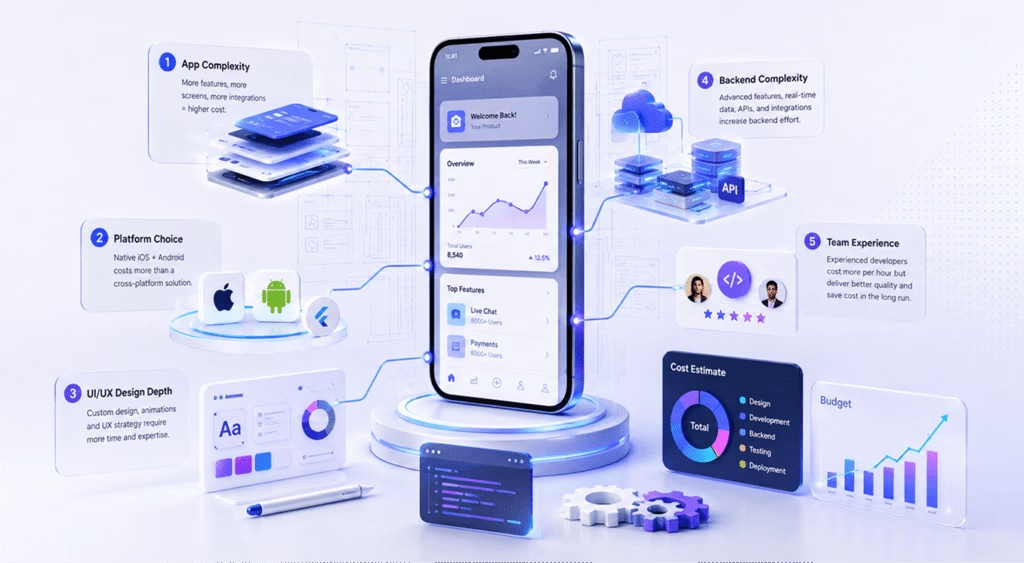
Price ranges only make sense once you understand what actually moves the number. These five factors account for most of the variation you will see when comparing quotes.
App complexity A 5-screen app with login and a product catalogue is a completely different project from a 40-screen platform with real-time notifications, multiple user roles, and a vendor dashboard. Every additional screen, feature, and user flow adds development hours. Simple apps require 300 to 500 hours. Complex platforms can require 2,500 to 5,000 hours or more. This is the single biggest driver of cost.
Platform choice Building for Android only is the most cost-efficient starting point, and it makes sense for most India-first products given Android’s 95% market share here. For international audiences, you will typically need both platforms. Cross-platform frameworks like Flutter let you build for both Android and iOS from one shared codebase, cutting 30 to 40% off the cost compared to two separate native builds. Going fully native on both platforms separately is the most expensive approach and is only justified for specific use cases.
UI/UX design depth Using pre-built component libraries is faster and cheaper. A fully custom branded experience with original visual design, micro-animations, and a complete design system takes more time and adds cost. Custom design typically adds $1,200 to $4,800 to a project, but it has a measurable effect on user retention and how the product is perceived once it is live.
Backend complexity An app that stores user profiles and displays static content has a simple backend. An app with live GPS tracking, real-time chat, payment processing, and multiple third-party API integrations has a complex backend that takes significantly longer to architect properly. Backend work is where most quoted costs diverge between agencies, because it is easy to underspecify at the proposal stage and expensive to fix once development is underway.
Team experience Junior developers in India charge $8 to $15 per hour. Senior developers at established agencies charge $30 to $60 per hour. The senior developer typically delivers faster, produces less rework, and documents the codebase so your team can maintain it. The hourly rate looks higher. The total project cost over two years is often lower because you are not paying to fix what was built incorrectly the first time.
App Development Cost in Bangalore, India 2026: Tier-by-Tier Breakdown

| Tier | App Type | Key Features | USD Range | INR Range | Timeline | Team Size |
| Tier 1 | Basic / MVP | 5 to 10 screens, authentication, core user flow, basic backend | $4,800 to $9,600 | ₹4 to 8 lakhs | 6 to 10 weeks | 2 to 3 people |
| Tier 2 | Mid-complexity | 15 to 25 screens, payments, push notifications, API integrations, admin panel | $9,600 to $24,000 | ₹8 to 20 lakhs | 10 to 20 weeks | 3 to 5 people |
| Tier 3 | Advanced | Dual user roles, real-time features, marketplace logic, custom dashboards | $24,000 to $60,000 | ₹20 to 50 lakhs | 20 to 32 weeks | 5 to 8 people |
| Tier 4 | Enterprise / AI-powered | Multi-platform, AI/ML features, ERP integrations, compliance-grade security, scalable microservices | $60,000+ | ₹50 lakhs+ | 6+ months | 8+ people |
For context: a Tier 2 project built with a US-based team typically costs $80,000 to $150,000. The same project with a Bangalore team of equivalent seniority runs $9,600 to $24,000. That cost gap is the primary reason international businesses look to India for product development. Most Bangalore startups building their first app fall into Tier 1 or Tier 2.
Flutter vs React Native vs Native: Which Saves You More?

This is the single most impactful cost decision in your project, and many vendors will not raise it unless you ask.
Flutter app development is currently the most cost-efficient choice for most startups and product-stage businesses. One codebase deploys on both Android and iOS, saving 30 to 40% compared to building two separate native apps. Flutter performs well on both platforms, looks genuinely native, and has strong long-term support from Google. At Sigosoft, Flutter is our most recommended starting point for businesses building their first mobile product.
React Native offers the same cross-platform advantage and has a larger developer talent pool in India, which keeps hourly rates slightly lower in some engagements. It is a strong fit when your team already works in JavaScript or Node.js, since the knowledge transfers well across the stack.
Native development, building separate apps for Android and iOS, is the right call when your product relies heavily on device hardware: camera pipelines, Bluetooth, augmented reality, background sensors, or anything requiring deep OS-level access. It costs more and takes longer. When the use case genuinely demands it, the performance difference is real. Sigosoft builds native when the project calls for it, and will tell you honestly when it does not.
For a first consumer or B2B app, Flutter is almost always the most practical and cost-effective starting point.
Hidden Costs Most Vendors Leave Off the Quote

The quote you receive covers the build. What it usually does not cover is what comes after. These are the costs that catch most first-time app owners off guard in year one:
- Apple Developer Program: $99 per year (approximately ₹8,500) to distribute your app on the App Store
- Google Play Console: $25 one-time registration fee (approximately ₹2,100)
- Backend hosting: $25 to $240 per month depending on traffic and infrastructure, whether AWS, Google Cloud, Firebase, or similar platforms
- Third-party API costs: Google Maps, Stripe or Razorpay for payments, Twilio or MSG91 for OTP verification, and similar services all charge based on usage. These fees are recurring and grow as your user base scales.
- Annual app maintenance: Industry standard is 15 to 20% of your original build cost per year. A $12,000 app realistically needs $1,800 to $2,400 annually to stay current, bug-free, and compatible with new operating system releases.
- App Store Optimization: $180 to $600 (approximately ₹15,000 to ₹50,000) to set up the metadata, screenshots, and keyword structure that determines whether users find your app when they search
- QA and security testing: This should account for 15 to 20% of your total build budget. Skipping it is how a $10,000 project becomes a $20,000 emergency after launch.
Budget 25 to 30% above your initial quote to cover total first-year costs. If a vendor’s proposal does not reference any of these items, ask about each one specifically before you sign anything.
Industry-Wise Cost Estimates

Development costs vary meaningfully by industry because compliance requirements, security expectations, and performance standards are not the same across sectors. These are realistic ranges based on actual project requirements.
FinTech (payments, wallets, lending): $18,000 to $48,000 (₹15 to 40 lakhs) Security is non-negotiable in this category. PCI DSS compliance, two-factor authentication, encryption at rest and in transit, and regulatory data handling all expand the scope significantly. Whether you are building for Indian users under RBI guidelines, for US markets under FFIEC standards, or for European users under PSD2, fintech apps require more rigorous testing and more experienced backend engineering than most other app categories.
HealthTech and Telemedicine: $14,400 to $42,000 (₹12 to 35 lakhs) Video consultation, patient record integration, and EMR connections add substantial complexity. Healthcare apps carry strict data privacy obligations regardless of geography: HIPAA for US users, GDPR for European markets, and India’s DPDP Act for domestic users. Uptime requirements are also higher because the consequences of downtime are more serious than in most other product categories.
EdTech: $9,600 to $30,000 (₹8 to 25 lakhs) Cost depends heavily on whether you need live video classes or asynchronous content delivery. Live video is expensive to build and infrastructure-heavy to operate at scale. Most EdTech MVPs targeting students, working professionals, or corporate learners land in the $9,600 to $18,000 range.
Logistics and Fleet Tracking: $18,000 to $36,000 (₹15 to 30 lakhs) Real-time GPS, route optimisation, and separate driver and operations interfaces often mean building two parallel app interfaces. The backend must handle a high volume of concurrent live connections reliably, which requires careful architecture from day one.
E-commerce and D2C: $12,000 to $36,000 (₹10 to 30 lakhs) A focused single-vendor storefront is achievable at the lower end of this range. A multi-vendor marketplace with seller dashboards, inventory management, and split payment processing is a significantly larger project. Build single-vendor first, validate purchasing behaviour with real customers, then add marketplace features in version two.
Should You Start With an MVP?

For most businesses, yes, and the reason is practical rather than philosophical.
You probably have a clear picture of what your users need. But there is almost always a gap between what you think they want and what they will actually use consistently once the app is in their hands. Building a full-featured product before you know where that gap is means spending $30,000 to $40,000 on functionality that real users ignore.
An MVP is your core user journey built lean. Not a rough prototype you would hesitate to show anyone, but a real, working app with enough features to get genuine behavioural data from actual users. You launch it, watch how people use it, talk to the ones who drop off, and use that information to decide what to build next.
A well-scoped MVP built in Bangalore costs $4,800 to $9,600 and can be live in 6 to 10 weeks. That is fast enough to run a real validation cycle before your next funding conversation. If the idea holds up, you have user data to support your pitch. If it needs a different direction, you have spent under $10,000 to find out instead of over $40,000.
This is the approach we recommend at Sigosoft for most first-time product builds: start with the core, put it in front of real users, and scale what actually works.
How to Read App Development Quotes

You will receive quotes ranging from $5,000 to $40,000 for what sounds like the same project. Here is how to tell a serious proposal from one that will cost you more in the long run.
Watch out for these signs: a single lump sum with no itemised breakdown; pricing described as “starting from $X” with no further detail; no mention of QA, testing, or a testing budget anywhere in the document; no clause covering what happens after launch; a vendor who asks only about your feature list and never about your business model, your users, or your growth timeline; no discussion of how scope changes mid-project are handled, because they always happen.
A trustworthy proposal looks different. It breaks out design, development, QA, and deployment as separate line items so you can see where the cost comes from. It explains both fixed-price and Time and Material engagement models and helps you understand which one fits your situation. It includes a post-launch maintenance option from the start. It documents security practices and, for compliance-sensitive industries, references ISO/IEC 27001:2022 alignment. A serious agency will also tell you when your initial scope is larger than what your current stage actually requires.
A quote with no scope of work attached is not a quote. It is a number that will grow once the project starts.
What Should You Actually Budget?
Mobile app development cost in Bangalore, India in 2026 runs from $4,800 for a focused MVP to $60,000 and beyond for enterprise-grade or AI-powered platforms. Compared to equivalent development in the US or UK, you are looking at 60 to 70% lower cost for the same level of technical quality when you work with an experienced team here.
The cheapest quote is rarely the right one. What matters is finding a team that prices transparently, scopes thoroughly, and is still reachable and accountable six months after your app goes live.
Sigosoft has built mobile apps for businesses in Bangalore, across India, in the USA, and in the UAE. If you have a product idea and want to know what it would cost to build it properly, we will send you a detailed, line-item estimate within 48 hours.
