
Remote patient monitoring app development means building three things that work together: a patient app that collects readings from medical devices, a backend that checks those readings against clinical thresholds, and a care-team dashboard that turns out-of-range values into calls, visits or escalations. The same stack, with 24/7 staffing and daily reviews, becomes virtual ward software.
Quick answer
- Connect devices over Bluetooth Low Energy, or through Apple HealthKit and Android Health Connect.
- Time-stamp and validate every reading on the server, then store it as a FHIR Observation.
- Design alerts in tiers so nurses are not flooded.
- Alert on missing data, not just bad data.
- Build billing logic around the market: CMS codes in the US, DHA telemonitoring rules in Dubai.
What RPM software development actually involves
RPM software development is mostly integration and workflow work. The screens are the easy part. The hard parts are getting reliable data from consumer and medical devices, deciding what counts as abnormal for each patient, and making sure a human sees the right alert at the right time.

A typical build has these layers:
- Device layer.
Blood pressure cuffs, glucometers, pulse oximeters and weight scales. Some pair over Bluetooth Low Energy using standard GATT health profiles. Others only share through the phone’s health store. - Patient app.
A Flutter or native app that pairs devices, reads Apple HealthKit and Android Health Connect, and uploads readings with the device’s own timestamp. - Ingestion API.
Rejects duplicates and impossible values, records when data arrived versus when it was measured, and queues it for processing. - Rules engine.
Compares each reading with the patient’s thresholds and trend. - Care-team dashboard.
Shows who needs attention now, with the reading history one click away. - Record layer.
Stores readings as structured data that your EHR, and in the UAE the health information exchange, can use.
Designing alerts that nurses will trust
Alert fatigue is the most common reason RPM programmes stall. A 2025 review of AI in remote monitoring notes that adoption depends on reliable data, workflow integration, transparent alerts and human oversight to limit alert fatigue.

Four tiers work well as a starting point. Normal readings are logged only. Watch readings go into a review list. Alert readings trigger a call to the patient. Critical readings escalate straight to the on-call clinician. The treating doctor sets the thresholds per patient, and the software must record who changed them and when.
Missing data is just as important as abnormal data. A patient whose scale has not synced for three days may be unwell, or the battery may be flat. Dubai’s rules treat this as a requirement, as the next section shows.

Remote patient monitoring in the US: CMS 2026 codes
Billing drives product design in the US. The Medicare Physician Fee Schedule for 2026 added shorter-duration codes. According to Nixon Law Group’s summary of the final rule, the new device supply code 99445 can be billed when 2 to 15 days of data are transmitted in a 30-day period. The existing 99454 still covers 16 to 30 days. A companion code, 99470, covers the first 10 minutes of monthly treatment management, compared with 20 minutes for 99457.

For software, this means the platform must count monitoring days and management minutes per patient per month automatically. Code selection can no longer wait for a biller’s spreadsheet at month end. Confirm current rates and rules with CMS or a US billing specialist before building a business case.
Remote patient monitoring in the UAE: DHA telemonitoring rules
Dubai treats telemonitoring as a regulated telehealth service. Standard Eleven of the DHA Standards for Telehealth Services, version 4 sets out requirements that map directly to features:
- Only DHA-licensed facilities with telehealth services may provide telemonitoring, using DHA-approved platforms and MOHAP-approved devices.
- Every device must be tested with the patient before use.
- The monitoring order must be signed and dated by the treating physician and the patient.
- The data system needs alerts for service interruptions, data interruptions, disconnection or loss, threshold breaches, and provider, device and patient-initiated alerts.
- Monitoring data must form part of the electronic health record.
- The service must be available 24/7, with continuity measures to avoid interruptions.
- Patients must consent to devices that collect location or other non-health data.
For the wider cost and market picture in the region, see our guide to telemedicine in the GCC.
From RPM to virtual ward software
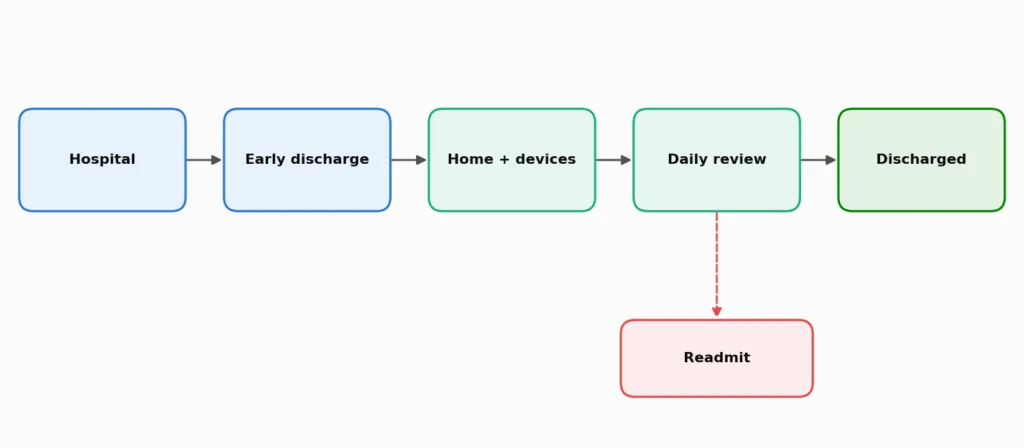
Virtual ward software, also called hospital at home software, is RPM with hospital-level intensity. Patients who would otherwise be in a bed are monitored at home, reviewed daily and visited when needed.
England shows what scale looks like. NHS England reported 10,421 virtual ward beds in September 2023, and a health minister’s parliamentary answer put the figure at 12,825 in March 2025. The UK Parliament’s research briefing equates that to 20 beds per 100,000 GP-registered people.

The NHS virtual wards operational framework gives one local example: North West London managed 4,311 patients through virtual ward pathways between April 2022 and April 2023, with an estimated 8,622 bed days saved.
What virtual ward software adds on top of RPM:
- Bed management.
Admit, transfer and discharge a “virtual bed” with a clear owner. - Daily ward round view.
Every patient’s last 24 hours on one screen. - Visit scheduling.
Community nurse visits tied to readings. - Escalation to hospital.
A one-step readmission path with the monitoring history attached. - Device logistics.
Tracking which kit is at which home, and when it comes back.
Saudi Arabia runs a related national model through Seha Virtual Hospital, which includes hospital-at-home follow-up. We cover it in a separate article on Saudi virtual hospital software.
Common mistakes
- Trusting the phone’s clock.
Store both the device time and the server receive time. - Alerting on every reading.
Tiered thresholds and trend rules cut noise. - Ignoring silent patients.
No data is a signal. Alert on gaps. - Hard-coding thresholds.
They belong to each patient and each prescriber. - Treating billing as an afterthought.
In the US, day and minute counts decide whether a month is billable. - Hosting outside the patient’s country.
UAE and Saudi rules generally require in-country storage of health data.
FAQ
What is the difference between RPM and a virtual ward?
RPM usually supports long-term conditions with periodic review. A virtual ward replaces or shortens a hospital stay, with daily clinical review and a fast route back to hospital.
Which devices should an RPM app support first?
Start with the readings your first clinical pathway needs, often blood pressure, glucose, oxygen saturation and weight, and check each device’s approval status in your market.
How long does remote patient monitoring app development take?
It depends on device count, integrations and compliance scope. Device integration and clinical workflow sign-off usually take longer than the app screens.
Does RPM data need to go into the EHR in Dubai?
Yes. DHA’s telehealth standard says telemonitoring data should form part of the electronic health record.
Sources
- DHA Standards for Telehealth Services, Version 4 (2025)
- Nixon Law Group: CMS finalizes 2026 remote monitoring updates
- NHS England: 10,000 virtual ward beds target delivered (2023)
- PublicTechnology: virtual ward beds in March 2025
- UK Parliament POST: Virtual wards and hospital at home
- NHS England: Virtual wards operational framework
- IntuitionLabs: AI in remote patient monitoring
