
An AI medical scribe listens to a consultation, transcribes it, and drafts a clinical note that the doctor reviews and signs. In a telemedicine app, the cleanest way to add one is to capture the call audio on your side, send it to a speech-to-text engine, pass the transcript to a language model that writes a structured draft, and hold that draft in a review screen until the doctor approves it. Nothing enters the medical record unsigned.
Quick answer
- Capture audio per speaker from the video call, not from the device microphone.
- Transcribe, then draft a note (for example SOAP) with a language model.
- Force a doctor review and e-signature before anything reaches the EHR.
- Get patient consent in the flow. In Dubai, DHA’s telehealth standard now requires it for ambient AI.
- Keep audio, transcripts and drafts in-country if you serve UAE patients.
What an ambient AI scribe does in a video consultation
An ambient AI scribe works in the background. The doctor talks to the patient normally and does not dictate. The tool separates who said what, pulls out the complaint, history, findings and plan, and turns them into a draft note.
Telemedicine is a good fit for this. The call audio is already digital, speakers are on separate streams, and the note can appear on the same screen the doctor is already using. Researchers writing in npj Digital Medicine in 2026 pointed out that ambient scribes built into telehealth platforms can capture the conversation in real time without breaking the flow of the visit.
The architecture: from call audio to a signed note
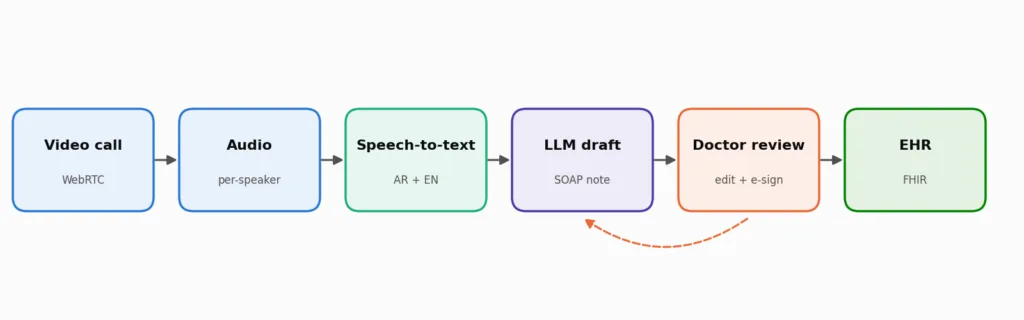
A production AI medical scribe has five stages. Each one is a separate service you can swap later.
1. Capture
If your video layer is WebRTC, record the doctor and patient audio tracks separately on the media server. Separate tracks make speaker labelling far more accurate than splitting one mixed recording. Start capture only after consent is recorded, and show a visible indicator to both people while it runs.
2. Transcription
Speech-to-text turns each track into timestamped text. Test it with your real accents and specialties before choosing a vendor. Medical terms, drug names and numbers are where accuracy drops first.
3. Drafting
A language model receives the transcript and a template, such as SOAP (Subjective, Objective, Assessment, Plan) or your specialty’s format. The prompt should tell the model to write only what was said. It should flag missing items rather than fill them in.
4. Review and sign-off
The doctor sees the draft beside the transcript. They edit, reject or approve it. Only approval with an e-signature moves it forward. Keep the original draft, the edits and the signer in an audit log.
5. Writing to the record
Save the signed note to your EHR as a structured document. If you use FHIR, a Composition or DocumentReference resource is the usual fit. In Dubai, the record then feeds NABIDH through your normal integration.
For the hosting, encryption and access controls around this pipeline, see our guide to secure cloud architecture for telemedicine apps.
What the evidence says about AI clinical documentation
The strongest evidence so far comes from two randomized trials published in NEJM AI in late 2025.
At UCLA, 238 outpatient physicians across 14 specialties were randomly assigned to Microsoft DAX, Nabla or no scribe between November 2024 and January 2025. The trial report shows the tools were not used in most eligible visits: DAX in 33.5% of 24,696 visits and Nabla in 29.5% of 23,653.
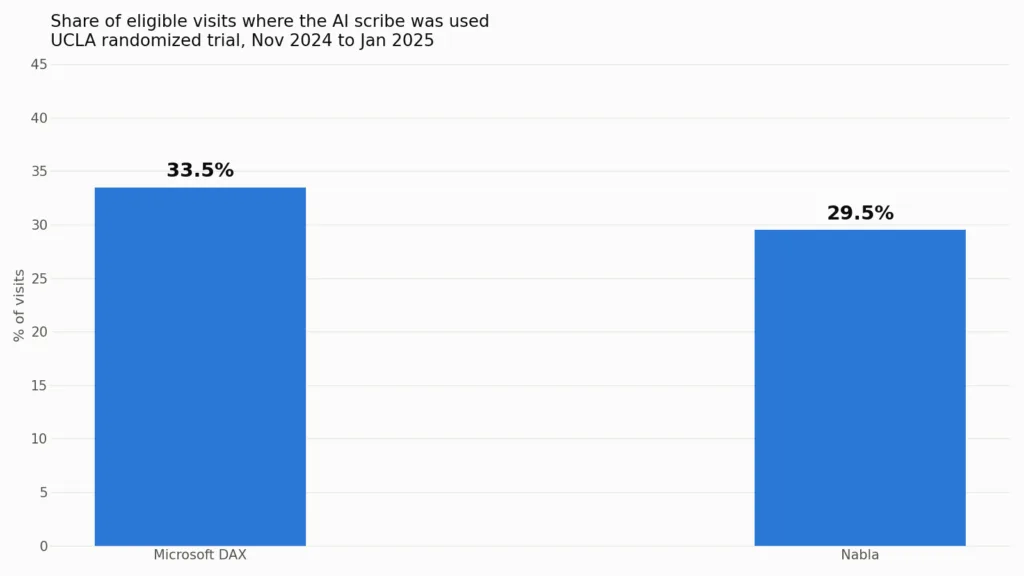
That uptake figure matters for product teams. Doctors choose when to switch the scribe on, so adoption depends on how easy it is to start, how good the first draft is, and how fast review feels.
A second trial by Afshar and colleagues followed 66 practitioners over 24 weeks. Time spent on notes fell by 0.36 hours per day, about 22 minutes. A reduction in work done outside working hours was also reported, but it was no longer significant once the most extreme days were removed.

The fair reading: AI clinical documentation saves real time for doctors who use it, but the savings are moderate, and adoption is not automatic.
Building an AI medical scribe for UAE telehealth
Dubai’s rules changed in late 2025. The DHA Standards for Telehealth Services, version 4, issued on 26 September 2025 and effective 26 November 2025, list “consent for the use of Ambient AI tools” among the key updates. Section 10.6 sets out what that means:
- Patient consent is required when ambient AI supports encounter documentation that a clinician reviews and e-signs.
- The treating DHA-licensed physician must consent to using the tool and must review any AI-generated content before it becomes part of the permanent record.
- AI tools used in telehealth must follow documented clinical validation, ethical disclosure and patient consent.
- Data must stay on secure UAE-based infrastructure unless the law permits otherwise.

Section 5.4 of the same standard also says telehealth providers using AI, including ambient AI, are subject to requirements aligned with the DHA’s Artificial Intelligence policy. The International Bar Association notes that DHA’s AI policy, launched in 2021, is more specific on accountability and transparency than Abu Dhabi’s.
The hosting rule is where many builds go wrong. Sending call audio to an overseas speech or language model API breaks UAE data localisation, even if the app itself is hosted in the UAE. Pick transcription and model providers that can run in a UAE region, or host open models yourself.

We cover the wider licensing picture in how to start a telemedicine business in the UAE.
This section is a technical summary, not legal advice. Confirm your specific setup with DHA or a qualified UAE healthcare lawyer.
Arabic and English in the same consultation
In Dubai and Abu Dhabi clinics, patients and doctors often switch between Arabic and English mid-sentence. A scribe tuned only for English will drop or garble the Arabic parts, and those are often where the patient describes symptoms in their own words.

Test with recorded, consented sample consultations that include code-switching. Measure accuracy separately for the Arabic segments. The UCLA trial limited use to English-only visits because translation had not been validated, which shows how seriously this gap is taken even in large US studies.
Build or buy the scribe engine
| Option | Good for | Watch out for |
|---|---|---|
| Commercial scribe product with an API | Fast launch, proven note templates | Where audio is processed; Arabic support; per-visit pricing |
| Cloud speech and language model services | Control over prompts and templates | Region availability; you own clinical validation |
| Self-hosted open models | Full data control in-country | GPU cost, ongoing tuning, in-house ML skills |
Most telemedicine teams start with the first or second option and keep the review screen, consent flow and audit log in their own code. Those parts carry the compliance weight, and they do not change when you switch vendors. Our telemedicine app development guide covers the rest of the feature set around this.
Common mistakes
- Recording before consent is stored.
Consent has to be captured and saved first, then recording starts. - Letting drafts reach the EHR automatically.
Every AI note needs a named clinician’s review and signature. - Mixing both speakers into one audio stream.
Speaker separation gets worse and so do the notes. - Ignoring where the AI runs.
A UAE-hosted app that calls an overseas model API still moves health data abroad. - Testing only in clean English.
Real consultations include accents, Arabic and background noise. - No audit trail of edits.
Keep the original draft, the edits and who signed.
FAQ
Is an AI medical scribe the same as dictation software?
No. Dictation turns the doctor’s speech into text. An ambient AI scribe listens to both sides of the conversation and drafts a structured note from it.
Does a patient have to agree to an ambient AI scribe in Dubai?
Yes. DHA’s telehealth standard version 4 requires patient consent when ambient AI tools support documentation, and the physician must review the AI content before it enters the record.
How much time does AI clinical documentation save?
In one NEJM AI randomized trial, time on notes fell by about 22 minutes per clinician per day. Results vary by specialty and by how often doctors actually use the tool.
Can we use a US-based AI API for UAE patients?
Not for identifiable health data, unless an exception under UAE law applies. Health data tied to UAE services generally has to stay in the country.
Sources
- Lukac et al., Ambient AI Scribes in Clinical Practice, NEJM AI (2025)
- Afshar et al., Pragmatic RCT of Ambient AI, NEJM AI (2025)
- DHA Standards for Telehealth Services, Version 4 (2025)
- Ohde et al., Scaling ambient AI scribes, npj Digital Medicine (2026)
- International Bar Association: AI in healthcare regulation in the UAE (2026)
