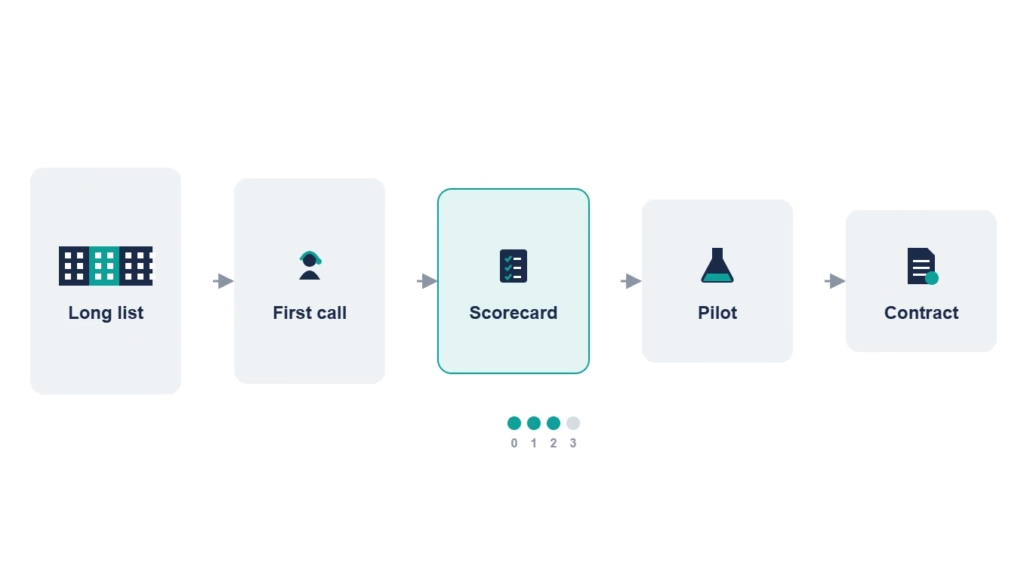
Choose the AI development company that can show you AI running in production, understands how your business actually works, connects AI to the systems you already use, puts data and model ownership in writing, and keeps the system working after launch. Score every shortlisted vendor on those points before you compare portfolios or price. A polished demo predicts very little.
The gap between a demo and a working system is wide. Deloitte’s Tech Trends 2026 report found that 38% of organisations were piloting AI agents but only 11% had them in production. A 2026 Gartner survey of 1,303 enterprises, reported by TechTarget, found that only 22% had scaled AI across multiple business units.
In our discovery calls, the projects that stall rarely fail at the model. They fail when nobody mapped the business process first, when the AI cannot read from or write to the ERP, when no one decided which actions need a person’s approval, or when there is no plan for who fixes it after go-live. The scorecard in this guide gives those questions most of the weight.
What does an AI development company actually build?
Most buyers now need AI that does work inside their operations, not a standalone chatbot. The term “AI development company” covers five quite different kinds of work, and the right partner depends on which one you are buying.
| Type of AI work | What it does | Typical example | What to check in a vendor |
|---|---|---|---|
| Traditional AI and machine learning | Learns patterns from your historical data to predict or classify | Demand forecasting, fraud scoring, route optimisation | Data science depth, how models are retrained when data changes |
| Generative AI applications | Uses a large language model (LLM), the kind of model behind ChatGPT and Claude, to read and write text | A knowledge assistant that answers staff questions from policy documents | Retrieval from your documents, answer accuracy, how it handles questions it cannot answer |
| AI-powered workflow automation | Adds AI steps to a defined business process that runs automatically | Reading supplier invoices and posting them for approval | Process mapping, integration, exception handling |
| Agentic AI | Software that plans and carries out multi-step tasks, choosing which tools and systems to use | An agent that takes an order from WhatsApp, checks stock and prepares a sales order | Guardrails, approvals, audit logs, testing of complete runs |
| Custom enterprise software with integrated AI | An operational system such as an ERP, POS or delivery platform with AI built into specific steps | A delivery platform with AI-assisted route planning and a customer chatbot | Core software engineering quality as much as AI skill |
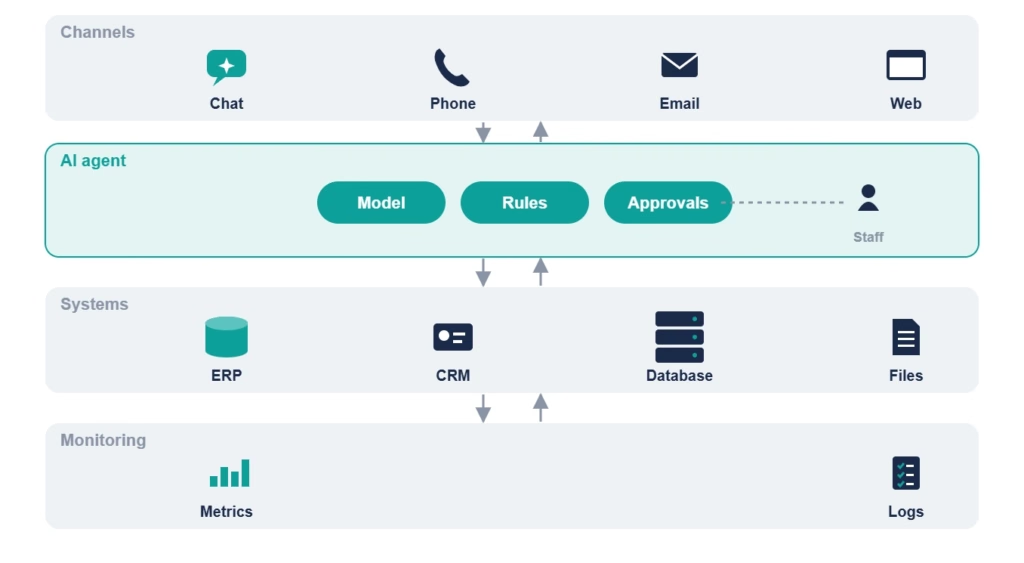
The last three are where most business value sits in 2027, and they all depend on the same thing: reliable access to your business systems. A vendor that has only built chatbots may struggle with an ERP integration, while a vendor that has built ERP and delivery software understands the data and workflows an AI agent will need to touch.
What does AI business automation look like in practice?
AI business automation means an AI agent completing a business task across several systems, with people approving the steps that carry risk. The example below is hypothetical and is only meant to show the moving parts.
For example, a hypothetical distributor with 40 vans receives most orders from shop owners on WhatsApp, often as voice notes or photos of handwritten lists. An AI agent connected to its ERP could handle each order like this:
- Understand the order from the message, voice note or image, and match each item to a product code.
- Check stock for each item through the ERP.
- Validate the customer’s price list, credit limit and delivery area.
- Prepare a draft sales order.
- Send the draft to a sales coordinator for approval when something is unusual, such as a credit limit breach, a price below the floor or an item the agent could not match.
- Create the confirmed order in the ERP.
- Send the customer a confirmation on WhatsApp with the expected delivery date.
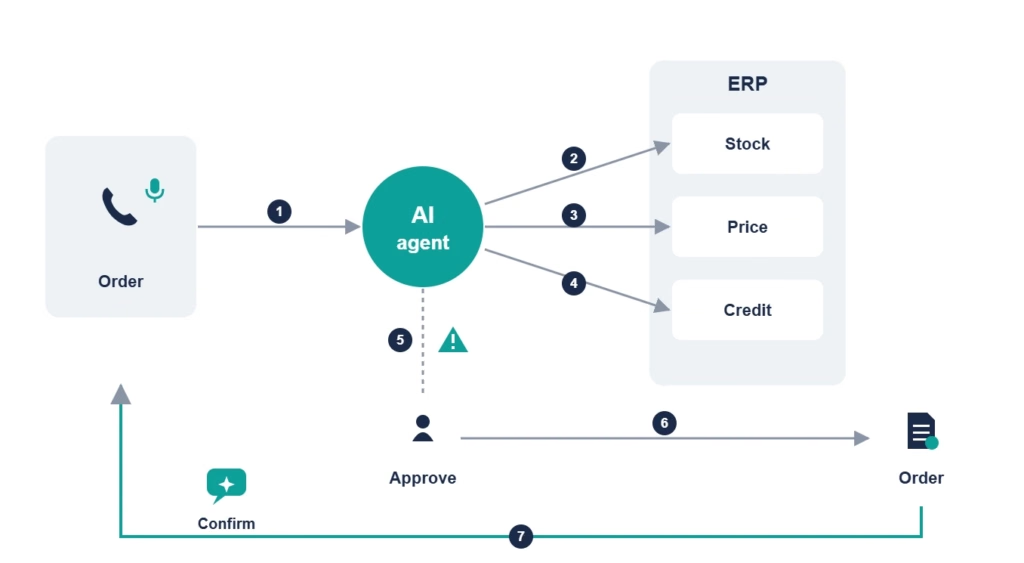
Steps 2, 3 and 6 are integration work, and they decide whether the project succeeds. If the agent cannot read live stock or write the order back, someone ends up retyping everything. Step 5 is exception handling: the rules for what the agent must not decide alone. Monitoring then shows how many orders went through untouched, how many needed a person and why, so the rules can be tuned week by week.
A vendor who has built ordering systems before will ask about these steps on the first call. The Grain n Grace Sales Spark app we built is not an AI project, but it shows the same plumbing: a Flutter sales app where field sales staff create customer orders that go straight into ERPNext. An AI agent taking orders from WhatsApp needs exactly that write path into the ERP, plus approvals and logging around it.
Which type of AI partner suits your company?
There are five common types of AI partner, and the right one depends on how deeply the AI has to work inside your existing operations. A large consultancy may be more than a 200-person distributor needs, while a freelancer rarely has the cover to support a live agent at night.
| Partner type | Best for | Typical engagement | Strengths | Watch-outs |
|---|---|---|---|---|
| Global consultancy | Enterprise-wide AI strategy and operating model change in large, regulated groups | Large, multi-phase programmes, often strategy first and build later | Board-level credibility, change management, broad compliance knowledge | Build work may be subcontracted; costs rise quickly for mid-sized companies; ask who writes the code |
| Large offshore IT services firm | Big integration programmes with defined scope and long support contracts | Multi-year contracts and dedicated teams | Scale, process maturity, round-the-clock staffing | The AI team may be separate from the people who know your ERP; check the proposed team has shipped LLM work |
| AI product studio or specialist development company | A few AI use cases connected to existing systems, built and supported by one team | Fixed-scope pilots that move into phased builds and support | Hands-on engineers, integration and AI skills in the same team, faster decisions | Smaller bench; check support cover, security certification and key-person risk |
| Automation agency (n8n, Make, Zapier) | Connecting SaaS tools and adding AI steps to simple workflows quickly | Small projects and monthly retainers | Fast to start, low cost for simple flows | Limits appear with complex logic, high volumes, on-premise systems or strict data residency; workflows may sit in an account you do not control |
| Freelancer or marketplace talent | Prototypes, proofs of concept and narrow, well-specified tasks | Hourly or small fixed-price work | Lowest entry cost, flexible | No continuity or written SLA; security and IP terms vary; you become the project manager |
n8n, Make and Zapier are workflow tools that move data between applications using triggers and pre-built connectors. They are useful, but an agent that writes orders into an on-premise ERP usually needs custom integration code as well.
How should I score AI development companies on equal terms?
Use a weighted scorecard filled in with evidence the vendor gives you, not impressions from the pitch. Score each criterion from 0 to 3:
- 0: no evidence
- 1: basic or theoretical capability
- 2: demonstrated capability with some limitations
- 3: proven production capability with verifiable evidence
Then divide the score by 3 and multiply by the weight. A vendor scoring 2 on a criterion weighted 12 earns 8 points. The weights add up to 100, so a vendor scoring 3 on everything gets 100.
The weights favour what happens after the demo. Integration, evaluation, ownership, human controls and post-launch operations together carry 49 of the 100 points.
| # | Criterion | Why it matters | What good evidence looks like | Red flag | Weight |
|---|---|---|---|---|---|
| 1 | Proven AI in production | Demos are easy; production systems face messy data and real users | A live system you can use or watch on a screen share, with how long it has run and who uses it | Only demos, or work they cannot show “because of NDA” with no anonymised alternative | 12 |
| 2 | Understanding of your business processes | Automation built on a misunderstood process automates the wrong thing | They map your current workflow, including exceptions, before proposing AI | They propose a solution before asking how the work is done today | 8 |
| 3 | ERP, CRM and third-party integration | AI that cannot read and write to your systems becomes a separate tool nobody opens | Connectors or APIs they have built for systems like yours, and a written integration plan for your stack | “We’ll export a CSV” or vague answers about write access | 12 |
| 4 | AI agent and workflow automation capability | Multi-step automation needs orchestration, retries and state, not just prompts | A walk-through of one complete agent run, from trigger to final action, including logs | Every example is a single question-and-answer chatbot | 8 |
| 5 | Evaluation, testing and reliability | Without measurement you cannot tell whether a change made the AI better or worse | An evaluation set (real inputs with agreed correct outputs) agreed before build, a target score and tests on every change | Testing described as “we tried it and it worked” | 12 |
| 6 | Security certification and data protection | Your customer and financial data will pass through their systems | A current ISO/IEC 27001:2022 certificate (the international standard for information security management) or SOC 2 report covering the delivery team | Certificate held by a parent or partner company, not the team doing the work | 8 |
| 7 | Data residency | Some sectors and countries require data to stay in a region | Clear options for where data, logs and vector stores sit, including private or on-premise models | Every request goes to one public API region with no alternative | 4 |
| 8 | IP, source code and model ownership | Prompts, workflows and evaluation sets are assets you paid for | Contract assigning code, prompts, configurations, evaluation sets and any fine-tuned models to you, plus admin access to every account | Vendor keeps the platform or licenses your own workflows back to you | 10 |
| 9 | AI model and API running costs | AI has a monthly bill that grows with usage | A cost estimate per order, document or conversation at your volumes, with who pays the model provider | Only a build price, with running costs “to be confirmed” | 6 |
| 10 | Human-in-the-loop controls and exception handling | Some decisions must be checked by a person before they take effect | Defined approval steps, escalation rules and what the agent does when it is unsure | Fully autonomous actions on payments, prices or customer records | 7 |
| 11 | Monitoring, governance and post-launch support | Model behaviour drifts as data, prompts and providers change | Dashboards for accuracy, cost and failures; decision logs; a written support SLA with response times by severity | No plan beyond go-live, or support “on a best-effort basis” | 8 |
| 12 | Industry experience and verifiable references | Domain knowledge shortens discovery and avoids basic mistakes | Projects with similar processes, a reference call with a live client, and ratings shown with their review counts | Generic case studies, or a rating with no review count | 5 |
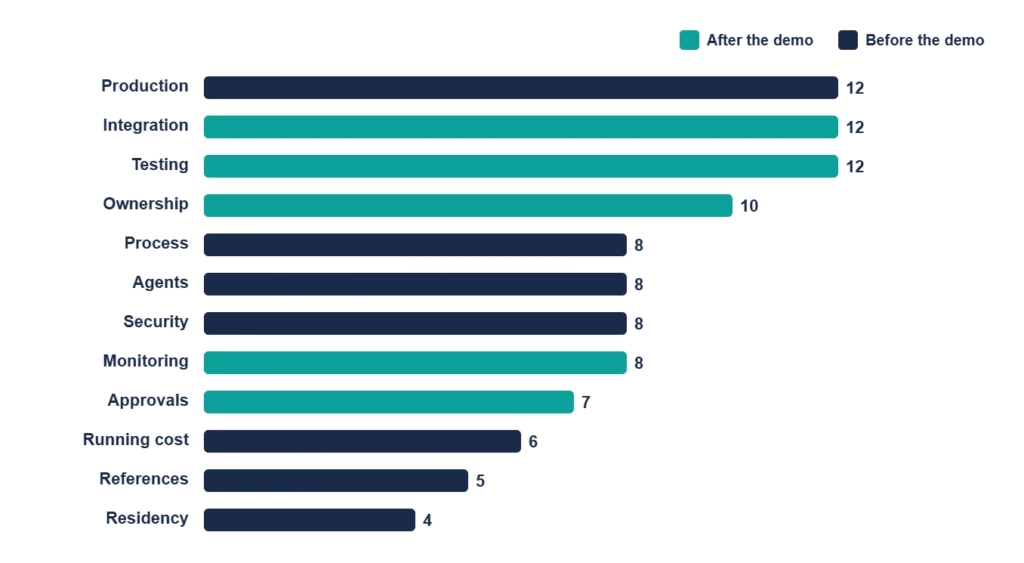
Two vendors within five points of each other are effectively tied. Break the tie with a paid discovery phase or a small pilot measured against the evaluation set from criterion 5, not with another presentation.
For example, a hypothetical vendor that scores 3 on criteria 1, 5 and 6, 2 on criteria 3, 8 and 11, and 1 on everything else would total 64.7 out of 100. Two of its weak spots, process understanding and human controls, are exactly where post-launch problems come from, so they are worth raising before you sign.
What questions should I ask an AI development company before signing?
Ask questions that make the vendor describe how the system will be measured, connected, controlled and supported, because those answers are hard to fake. These are the ten we would put to any vendor on a first call.
- “Can you show me an AI system you built that is live today?” A good answer is a screen share of a working system, with how long it has run and who uses it.
- “How would you map our current process before building anything?” Listen for workshops with the people who do the work, a written process map and a list of exceptions.
- “Which of our systems will the AI read from and write to, and how?” A strong vendor names the ERP or CRM modules, the API or database access needed, and what happens when that system is down.
- “How will you measure whether the AI’s output is correct?” Expect an evaluation set built from your real data, a target score agreed before build, and tests that run on every prompt or model change. Our note on AI software testing covers the tooling side of quality assurance.
- “Which actions will the AI take on its own, and which need approval?” Good vendors raise this first and design approval steps for anything touching money, prices or customer records.
- “Where will our data, logs and embeddings be stored?” Embeddings are numeric versions of your documents that let the AI search them. A good answer names regions, providers and a private-model option if you need one.
- “What exactly will we own at the end?” Expect a clear list: source code, prompts, workflow definitions, evaluation sets, any fine-tuned models and admin access to every account.
- “What will this cost per month to run at our volumes?” A good answer works from your expected orders, documents or conversations and separates model fees, hosting and support.
- “What is your support SLA, and who answers at night?” You want response times by severity, in writing, with the roles of the people on call.
- “Can I speak to a client whose system has been live for at least six months?” A pilot reference tells you about sales skills. A six-month reference tells you about support.
What are the red flags when choosing an AI software partner?
The clearest red flag is a vendor who cannot explain how they will test the AI’s output. Most other warning signs follow from it, because nothing that is not measured can be promised.
Watch for these in proposals and calls:
- the proposal prices the build but leaves model and hosting costs “to be confirmed”
- the demo uses sample data and they resist trying it on a few of your real documents or messages
- workflows, prompts or agents will run inside the vendor’s own accounts, with no plan to transfer them
- every answer about security points to the cloud provider’s certifications rather than their own
- nobody on the team has worked with your ERP, CRM or messaging platform
- support ends at go-live
- the contract assigns you the code but not the prompts, configurations or evaluation sets
One red flag is not always a reason to walk away. It is a reason to put the missing item in the contract before you sign.
How much does it cost to hire an AI development company in 2027?
The cost depends mostly on how many systems the AI must connect to and how much it is allowed to do on its own, not on which model it uses. Two projects both described as “an AI chatbot” can differ several times over in cost, because one answers questions from a website and the other reads orders from an ERP and updates a CRM.
The five common project types below rise in complexity from top to bottom. Ask every vendor to place your project in one of them and to explain their estimate against the drivers listed.
| Project type | What it involves | Main build cost drivers | Ongoing costs |
|---|---|---|---|
| AI proof of concept | Testing one use case on a sample of real data, usually without production integration | Data preparation, building the evaluation set, a simple interface | Usually none after the test, apart from deciding next steps |
| AI chatbot or knowledge assistant | Answering questions from your documents on the web, WhatsApp or an internal tool | Document preparation and retrieval, channel setup, languages, testing answer accuracy | Model usage per conversation, hosting, keeping documents current |
| AI workflow automation | AI steps inside a defined process, such as reading invoices or classifying tickets | Process mapping, integration with two or three systems, exception rules | Model usage per item processed, monitoring, rule changes |
| ERP- or CRM-integrated AI | AI that reads and writes business records, such as creating orders or updating leads | Write access and data validation, approval workflows, audit logging, security review | Model usage, support SLA, changes when the ERP or CRM is upgraded |
| Multi-agent business automation | Several agents handling a chain of tasks across departments and channels | Orchestration, permissions per agent, end-to-end testing, governance | Higher model usage, continuous monitoring, a named owner for agent behaviour |
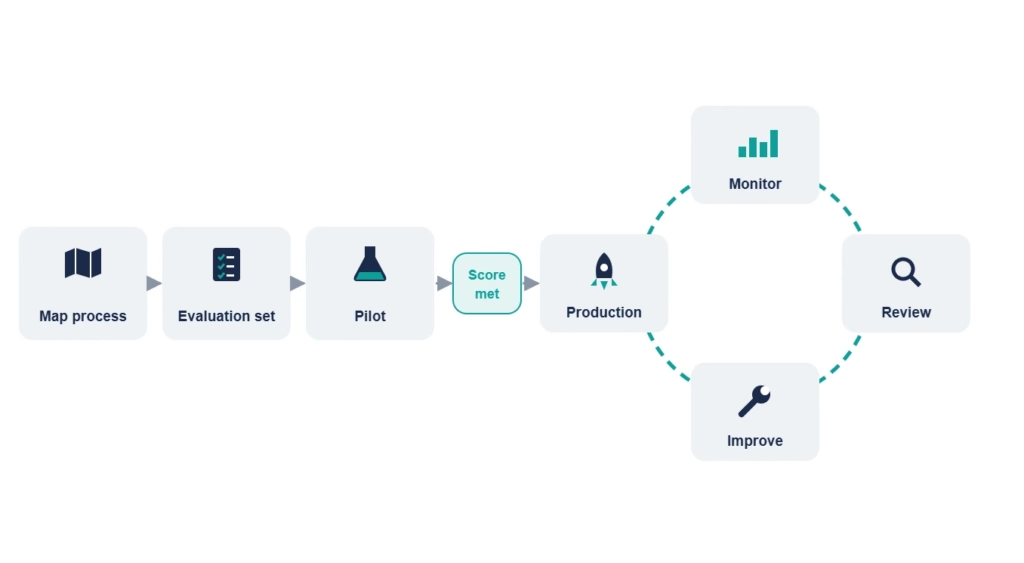
Running costs deserve their own line in every proposal. Most AI systems pay a model provider for each request, so the bill grows with usage. Ask each vendor to estimate it from your own volumes and to show what they would change if volumes doubled, such as using smaller models for simple steps or caching repeated answers.
If you already run an ERP, adding AI to it is usually cheaper and less disruptive than replacing it. Our page on AI for an existing ERP explains where that approach works.
Should I hire an AI development company in India, the UAE or the US?
Choose the location that matches where your data must live, which regulations apply to your AI and when your team needs to reach the builders. A lower day rate rarely makes up for a vendor who cannot meet your data residency or compliance needs.
Time zones shape how quickly problems get fixed. A team in India overlaps comfortably with GCC working hours and can cover the US with an early or late shift, while a US-based team suits companies whose operations staff are in the Americas. Ask where the on-call engineers sit, not where the sales office is.
Three regulatory dates matter for 2027:
- India: the Digital Personal Data Protection Act, 2023 is being brought into force in phases under the Digital Personal Data Protection Rules, 2025, notified on 13 November 2025. The core obligations, including notice and consent, security safeguards, breach reporting and data principal rights, apply from 13 May 2027 (Khaitan & Co via Mondaq). An AI system that processes Indian customer or employee data should be designed for consent, purpose limits and deletion from the start.
- UAE: under the Ministry of Finance decisions on the Electronic Invoicing System, businesses with annual revenue of AED 50 million or more must go live from 1 January 2027, and businesses below that threshold from 1 July 2027. If your AI reads, creates or approves invoices, the vendor needs to understand the required format and the role of Accredited Service Providers.
- European Union: if your AI serves users in the EU, the EU Artificial Intelligence Act applies. The Digital Omnibus on AI, published in July 2026, moved obligations for stand-alone high-risk AI systems to 2 December 2027 and for AI embedded in regulated products to 2 August 2028 (White & Case).
Data residency cuts across all three. If customer data must stay in India or the UAE, check that the vendor can host models, logs and vector stores in that region, or run a private model on your own infrastructure. A UAE company may well hire an Indian team with GCC experience and UAE hosting; what matters is that the contract names where data sits and who is accountable.
Where does Sigosoft fit?
Sigosoft suits SMEs and mid-market companies in India, the GCC and the US that want AI connected to their day-to-day operations, such as an ERP, a CRM, a delivery platform or a WhatsApp channel, and supported under a written SLA. Our AI work covers AI agents and workflow automation, AI for an existing ERP (Odoo, ERPNext or custom), AI CRM automation, AI voice agents and WhatsApp Business API integration, AI document processing, and AI operations and governance after launch.
Much of our background is operational software, which is where AI agents end up doing their work. SAIMPEX, a multi-service delivery super app for Mauritania, includes AI route optimisation, an AI chatbot and AI voice search alongside apps for customers, vendors, kitchens and delivery partners. Business Connect combines offline POS, inventory, CRM, ERP and HRM in one desktop platform; it is not an AI project, but it is the kind of system an agent has to read from and write to.
We are ISO/IEC 27001:2022 certified, sign an NDA before details are shared, and give you 100% of the IP by contract. Our written SLA commits to a 2-hour first response for critical issues. Public ratings: Clutch 5.0 (11 reviews), Google 4.8 (59 reviews) and G2 5.0 (4 reviews). We are not the right partner for frontier model research or for training foundation models from scratch.
If you have a process in mind, such as order intake, invoice handling or lead follow-up, talk to our team about where AI can take work off your staff and what it would need to connect to. You can also read more about Sigosoft.
Frequently asked questions
What is the difference between an AI development company and an AI consultancy?
An AI consultancy mainly advises: it assesses use cases, builds a roadmap and may design the operating model. An AI development company builds, integrates and supports the software. Many firms do both, so check who writes and maintains the code, and whether strategy and build are priced separately.
Do we need to replace our ERP before adding AI agents?
Usually not. Most modern ERPs, including Odoo and ERPNext, expose APIs that an agent can use to read stock, prices and customers and to create records. Older systems may need a small integration layer first. Replacing an ERP only to add AI is rarely the cheapest route.
Should we run a paid pilot before signing a full contract?
Yes, when the use case is new to you or the vendor. Keep the pilot to one workflow, agree the evaluation set and success threshold before it starts, and use real data. A pilot that ends with a score against agreed tests is worth more than one that ends with a demo.
Can we switch AI vendors later without starting again?
Only if the contract and setup allow it. You need the code, prompts, workflow definitions and evaluation sets, plus admin access to the model provider, hosting and automation accounts. Ask for a short handover document at go-live listing every system, credential owner and dependency.
Who should own the AI project on our side?
A named business owner who feels the problem every week, supported by someone from IT who controls system access. The business owner signs off the evaluation set and decides when the AI is good enough to go live. Without that person, projects drift between departments.
Thanks for the feedback!

Sajin Johnson Sigosoft team
Part of the Sigosoft team building AI automation, custom software and apps for businesses worldwide.
Start the discussion
Questions or experiences to share? Our team reads and replies.