
Seha Virtual Hospital is the Saudi Ministry of Health’s national virtual hospital, launched in February 2022. It connects specialists in a central hub to hospitals across the Kingdom for services such as tele-stroke, tele-ICU, tele-radiology and specialist clinics. The Ministry says Guinness World Records recognises it as the world’s largest virtual healthcare provider. For anyone building virtual hospital software in Saudi Arabia, its model shows what matters: hub-and-spoke workflows, fast escalation, in-Kingdom hosting and deep integration with national platforms.
Quick answer
- Seha Virtual Hospital works as a hub supporting many local hospitals, not as a patient-first video app.
- A 2026 study reported 224 telemedicine centres by 2024 and outpatient visits rising from 1,717 in 2021 to 27,896 in 2024.
- The clearest software lessons are clinician-to-clinician workflows, image sharing, and measured outcomes.
- Private platforms need Saudi-hosted data and integration with national systems such as NPHIES.
What Seha Virtual Hospital is
The Ministry of Health describes Seha Virtual Hospital (SVH) as an integrated virtual care model that combines medical expertise and digital technology to deliver specialised services remotely, inside the Kingdom and abroad. The Ministry also states it is recognised by Guinness World Records as the largest virtual healthcare provider in the world, and was the first virtual hospital to receive Canadian accreditation at Diamond level.
A 2026 review in the Saudi Journal of Anaesthesia described it as covering 12 main specialties and more than 35 sub-specialties, including hospital-at-home follow-up for chronically ill patients. In August 2026, the Saudi Press Agency called SVH a key pillar of the Health Sector Transformation Program under Vision 2030.
Growth in numbers
The most detailed public figures come from a retrospective study by Ministry authors, published in Telemedicine and e-Health in January 2026. It reported that SVH had no active centres in 2020, 130 by 2021, and 224 by 2024.

Outpatient visits rose from 1,717 in 2021 to 27,896 in 2024. Specialty volumes grew fastest in time-critical care: stroke cases went from 41 in 2022 to 4,393 in 2024, and oncology cases from 24 to 714.

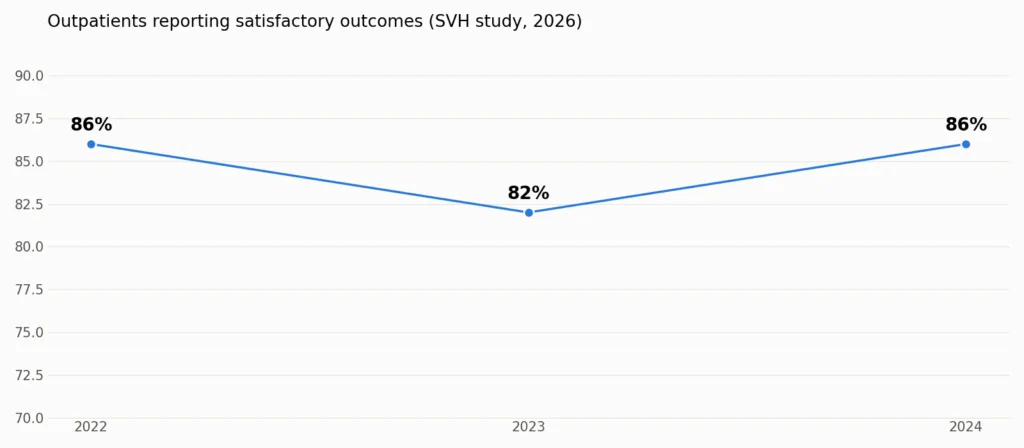
Satisfaction held up during that growth. The same study found 86% of outpatients reported satisfactory outcomes in 2022 and 2024, with a dip to 82% in 2023.
Lesson 1: build for the hub, not only the patient
Most telemedicine apps connect one patient to one doctor. SVH mainly connects clinicians to clinicians: a local hospital team and a remote specialist looking at the same patient.

Software for this model needs features patient apps rarely have:
- Case referral queues by specialty, with urgency levels.
- Shared patient context: vitals, labs, imaging and notes visible to both sites.
- Multi-party calls with the bedside team, the specialist and sometimes the patient.
- Clear accountability, recording which site holds clinical responsibility at each step.
- Scheduling across sites for recurring tele-rounds, such as daily ICU rounds.
Lesson 2: time-critical pathways need their own workflow
Stroke is the clearest example. The value comes from getting a neurologist’s decision while treatment is still possible.

The software requirements follow from that: one-tap activation from the emergency department, fast upload of CT images without losing resolution, a guaranteed video link, structured decision capture, and time-stamps at every step so the team can measure door-to-decision times. Saudi Arabia’s national telehealth application guidelines also state that image resolution should stay unchanged during transfer or storage.
Lesson 3: measure outcomes from day one
SVH’s growth is documented because it was measured. A 2026 policy viewpoint in the Journal of Medical Internet Research used SVH as a case study and concluded that remote models perform comparably to in-person care when patient selection is appropriate, escalation pathways are explicit and teams are integrated into local workflows. The same authors warned that evidence on national virtual hospitals is still limited and context-dependent.
For a product team, that means building reporting into the platform: case volumes by specialty, response times, transfers avoided, readmissions and satisfaction. These are also the numbers hospital buyers ask for.
Building virtual hospital software in Saudi Arabia
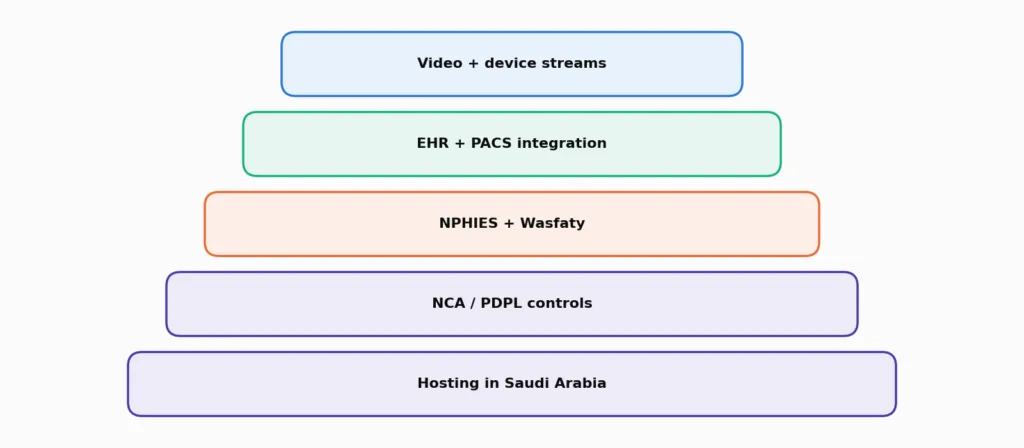
Private providers and hospital groups are building their own virtual care services alongside the national model. The technical foundation looks like this.
- Hosting in the Kingdom.
The national telehealth guidelines say data storage should be hosted within Saudi Arabia’s borders. - Data protection and cybersecurity.
Plan for the Personal Data Protection Law (PDPL) and National Cybersecurity Authority (NCA) controls. Get Saudi legal review for your specific service. - National platform integration.
Insurance eligibility and claims run through NPHIES, and e-prescriptions commonly through Wasfaty. Scope these integrations early, as they shape your data model. - Clinical systems.
EHR and PACS integration for records and imaging. - Arabic-first interfaces for patients and staff.
For regional cost ranges and feature choices, see our guide to telemedicine in the GCC. Remote monitoring for hospital-at-home services is covered in our article on remote patient monitoring app development, and the core feature set in our telemedicine app development guide.
Common mistakes
- Copying a consumer video app.
Hospital-to-hospital care needs referral queues, shared context and multi-party calls. - Compressing medical images.
Transfer and storage should keep original resolution. - Hosting outside Saudi Arabia.
In-Kingdom storage is the expectation for health data. - Leaving NPHIES for later.
Insurance integration affects patient registration and billing design. - No outcome reporting.
Buyers and regulators want measured results.
FAQ
What is Seha Virtual Hospital?
It is the Saudi Ministry of Health’s national virtual hospital, established in February 2022, delivering specialist care remotely to hospitals across the Kingdom.
How many hospitals does Seha Virtual Hospital support?
A 2026 peer-reviewed study reported 224 telemedicine centres by 2024. Some later reports give higher figures, so check the Ministry’s page for the current number.
Can a private company build a virtual hospital in Saudi Arabia?
Private providers do run virtual care services. They need the right licensing, Saudi-hosted data, and integration with national systems. Get Saudi regulatory advice for your model.
What services does Seha Virtual Hospital offer?
Published sources mention tele-stroke, tele-ICU, oncology case review, specialist clinics and hospital-at-home follow-up, among others.
Sources
- Saudi Ministry of Health: Seha Virtual Hospital
- Alabdulaali et al., SVH outcomes, Telemedicine and e-Health (2026)
- Policy considerations for national virtual hospitals, JMIR (2026)
- Virtual hospitals in Saudi Arabia: a scoping review, Saudi Journal of Anaesthesia (2026)
- Saudi Press Agency, August 2026
- NHIC Telehealth Application Guidelines
