
Quick Answer
- Custom NDIS software: AUD $40,000 to $80,000 depending on scope
- Typical build timeline: 8 to 16 weeks
- Core integrations needed: PRODA authentication, myplace/PACE claims, SCHADS Award payroll logic
- Off-the-shelf platforms like ShiftCare and Brevity typically run AUD $15,000 to $30,000 a year at 100+ staff, verified against current published pricing
- The NDIS Amendment (Integrity and Safeguarding) Act 2026 (Royal Assent 8 April 2026) adds new registration and fraud-detection obligations that most subscription tools aren’t built to handle
- ISO 27001:2022 certification of your development partner is now a genuine procurement filter for larger providers
As at 31 March 2026, the NDIS had 774,456 participants with approved plans, and total scheme expenses for the nine months to March hit $38 billion, tracking toward a full-year cost above $50 billion (Source: Insight PBS, Q3 NDIS Quarterly Report). That scale, combined with a fresh round of compliance law, is why more mid-size providers are quietly moving off ShiftCare or Brevity and building something of their own.
On 8 April 2026, the National Disability Insurance Scheme Amendment (Integrity and Safeguarding) Act 2026 received Royal Assent. It expands the NDIS Quality and Safeguards Commission’s powers, introduces new civil penalties (up to 10,000 penalty units, currently $3.3 million, for serious contraventions) and broadens banning orders (Source: MinterEllison). From 1 July 2026, mandatory registration also kicks in for platform providers and Supported Independent Living operators (Source: Michael West Media). Off-the-shelf care management tools weren’t built around this legislation, and most vendors are still catching up.
Why Are Providers Moving to Custom NDIS Software?
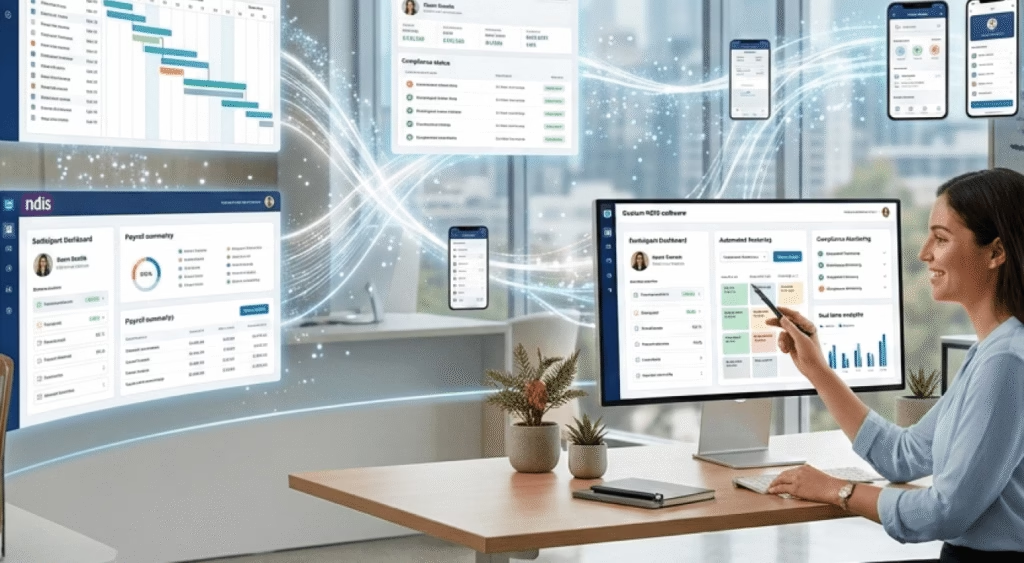
Three things are pushing providers toward bespoke platforms in 2026.
First, subscription costs stack up in ways that surprise people. ShiftCare charges per staff member (roughly $8 to $25 a month per user across its Basic to Enterprise tiers), while Brevity charges per client (around $4.49 to $6.49 a month per participant, plus setup fees some reviewers describe as steep) (Source: Teiro, ShiftCare vs Brevity comparison). A provider running 100 staff and 200 participants on ShiftCare Premium is looking at roughly $2,000 a month, or $24,000 a year, before add-ons like SMS credits.
Second, off-the-shelf tools don’t flex around specialist service models. Providers running Supported Independent Living, Specialist Disability Accommodation or complex community access programs frequently hit walls with generic rostering logic, and end up bolting on spreadsheets to cover the gap.
Third, data portability is a real problem. If you decide to leave a subscription platform, migrating years of participant records, incident reports and progress notes is rarely as clean as vendors suggest.
Offshore development teams like Sigosoft typically deliver the same build for 40 to 60% less than an Australian-based dev shop charges, largely due to labour cost differences rather than any shortcut on quality or compliance rigour.
What Compliance Requirements Must NDIS Software Meet?

Software built for NDIS providers in 2026 needs to account for a wider net than it did even twelve months ago.
- PRODA authentication: Provider Digital Access remains the login mechanism for the My NDIS Provider Portal and the legacy myplace portal, so any software integration still needs to work through PRODA-authenticated access, not around it.
- PACE and myplace claims: PACE is the NDIA’s participant and provider system, now used for all new and reassessed plans. Payment claims are still processed through the myplace provider portal using bulk upload templates (Source: Team DSC, A PACE Update).
- SCHADS Award payroll logic: penalty rates, allowances, and shift-based overtime calculations need to be built into rostering, not bolted on afterwards.
- Worker screening tracking: NDIS Worker Screening Checks are valid for five years, and the first wave began expiring on 1 February 2026, so software needs to actively flag renewal dates rather than leave it to spreadsheets.
- Fraud and integrity reporting: with the Fraud Fusion Taskforce now running joint investigations across the NDIA, AFP and NDIS Commission, audit trails and claim documentation need to be defensible, not just present.
- Privacy Act 1988 (Cth): data handling and storage location remain a baseline requirement, and AWS Sydney region hosting is the practical way to demonstrate data sovereignty.
Core Modules Worth Building

A platform built for a mid-size provider typically needs five modules working together, not five separate tools.
Participant management covers care plans, funding budgets by category, goal tracking, progress notes and a family or stakeholder portal for visibility without full system access.
Rostering and scheduling handles shift creation, SCHADS Award conflict warnings, qualification matching (so an unscreened worker can’t be rostered against a client requiring a current check), availability management and bulk editing for recurring shifts.
Invoicing and claims should auto-generate claims against the NDIS Price Guide, prepare bulk upload files for the myplace portal, support split invoicing across funding sources, and track spend against plan budgets in real time.
Compliance needs incident reporting workflows, continuous improvement plans, audit-ready documentation packs and Practice Standards checklists mapped to your actual service types.
Staff mobile app should support shift acceptance, GPS-verified check-in and check-out, progress note entry, participant signature capture, and offline mode, since a meaningful share of SIL and community access locations still have patchy connectivity.
How Does PRODA and myplace Integration Actually Work?

This is the part providers most often get wrong when scoping a build. PRODA hasn’t been phased out, and it isn’t going anywhere soon: it’s the identity verification layer that gives staff access to the My NDIS Provider Portal. Claims themselves are still lodged through the myplace provider portal using a bulk upload template (CSV format), not a live API.
The practical build approach: your software should generate a correctly formatted bulk claim file from completed, approved shifts, flag likely rejections before submission (wrong support item codes, budget overruns against a participant’s remaining plan balance), and reconcile confirmed payments back against your invoicing records automatically.
The time saving is real. A provider processing 500 shifts a week manually through PRODA-gated portals can lose 20 or more staff hours weekly on data entry and error correction. Automating that generation and reconciliation step is usually the single highest-ROI module in the whole build.
What’s a Realistic Technology Stack?

For a platform this size, a proven and unremarkable stack tends to age better than something exotic: React for the admin web console, Flutter for the staff mobile app (one codebase, both iOS and Android), Node.js or Laravel for the backend, PostgreSQL for the database, and AWS Sydney region for hosting to keep data within Australia. Xero or MYOB integration handles payroll and accounting sync, and Twilio covers SMS shift notifications.
Need help figuring out which modules your organisation actually needs first?
Sigosoft runs a free 30-minute scoping call where we map your current ShiftCare or Brevity setup against a custom build, so you’re comparing real numbers, not vendor brochures.
Build vs Buy: What Does the Math Actually Say?

Take a provider running 100 staff and 200 participants.
On ShiftCare Premium (around $20 per user monthly), that’s roughly $24,000 a year. On Brevity’s per-client model (around $6 per client monthly, plus setup fees), that’s closer to $14,400 a year before extras. Custom development for an equivalent platform runs $61,000 to $117,000 as a one-off cost.
Break-even against a $24,000 annual subscription lands around 30 to 48 months. That’s longer than the “18 to 30 months” figure often quoted in vendor sales material, and it’s worth going in with the honest number. For a provider planning to operate for five-plus years, and one that needs functionality off-the-shelf tools don’t offer (SIL-specific workflows, multi-site management, deep PRODA automation), custom development still tends to win on total cost and on ownership. For a smaller or newer provider still finding its service model, a subscription platform is usually the smarter starting point.
Cost Breakdown by Component
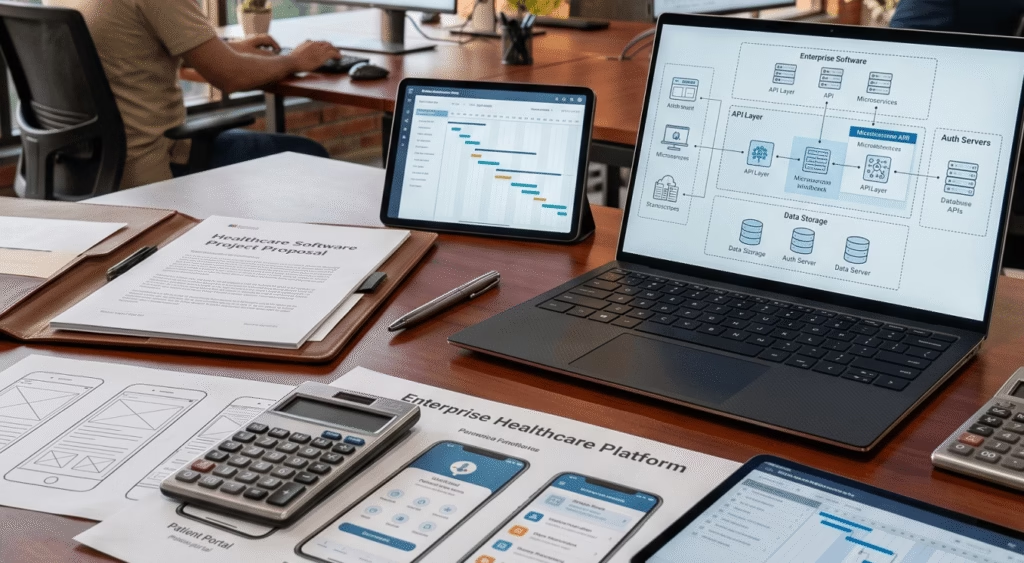
| Component | AUD Cost |
| UI/UX design | $8,000 to $15,000 |
| Staff mobile app (iOS and Android) | $15,000 to $25,000 |
| Admin web platform | $18,000 to $35,000 |
| PRODA/myplace claims integration | $8,000 to $18,000 |
| SCHADS payroll engine | $6,000 to $12,000 |
| QA and compliance testing | $6,000 to $12,000 |
| Total | AUD $61,000 to $117,000 |
Common Mistakes Providers Make
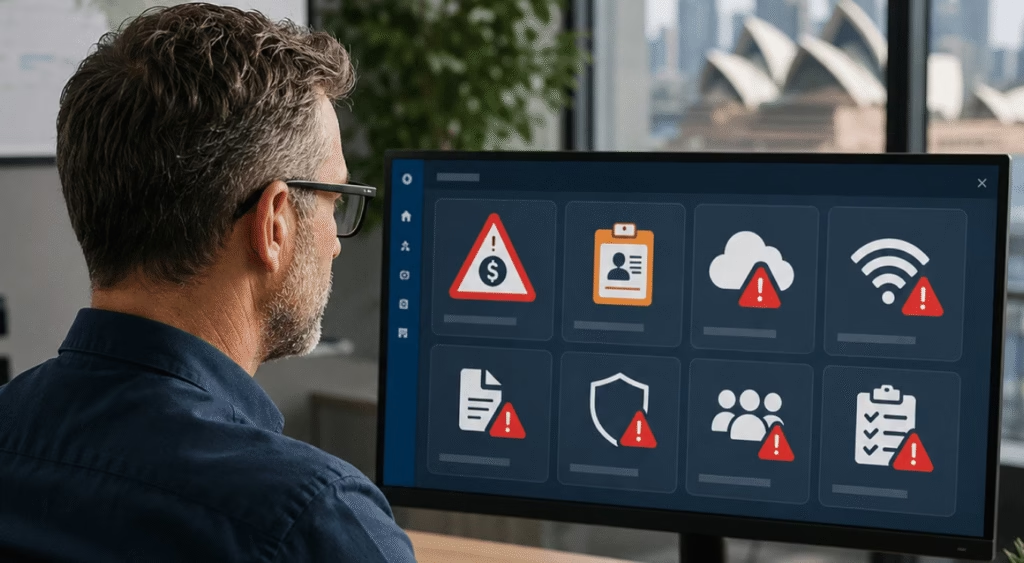
Treating SCHADS Award logic as an afterthought
Payroll errors from misapplied penalty rates are expensive to unwind and worse for staff trust.
Hosting outside Australia
It creates unnecessary Privacy Act exposure and is one of the first things procurement teams and auditors ask about.
Skipping offline mode
Plenty of SIL houses and regional service areas have unreliable connectivity, and a staff app that can’t function offline just gets abandoned in the field.
Ignoring worker screening expiry tracking
With five-year checks now starting to lapse across the workforce, this needs to be a built-in alert, not a manual calendar reminder.
Launching without a compliance review
Get someone who actually understands NDIS Practice Standards to test the platform against real audit scenarios before go-live, not after.
Realistic Timeline
An MVP covering rostering, participant management and basic claims generation typically takes 12 to 14 weeks. A full platform with SCHADS payroll, deep myplace claims automation and compliance modules runs 16 to 20 weeks.
Frequently Asked Questions

Does my NDIS software need to integrate with PACE or PRODA?
Yes, but understand the split: PRODA is how staff authenticate into NDIA portals, and claims still go through the myplace provider portal via bulk upload files. Your software should generate those files correctly and reconcile payments automatically.
What does SCHADS Award compliance mean for rostering software?
It means the system calculates penalty rates, allowances and overtime correctly at the point a shift is rostered, not just after payroll is run. This prevents both underpayment and overpayment errors before they happen.
Can offshore developers understand Australian NDIS requirements?
Yes, provided the team has direct experience building NDIS-specific platforms. Sigosoft has worked on compliance-driven healthcare software for over 10 years and holds ISO 27001:2022 certification, which addresses the data security expectations NDIS providers increasingly require from vendors.
What happens to my data if I switch from ShiftCare or Brevity to custom software?
You own the migration process. A proper build includes a data export and import plan for participant records, care plans and historical claims, so nothing gets left behind in the old system.
Does the April 2026 Integrity and Safeguarding Act affect software requirements?
Yes. It expands the NDIS Commission’s information-gathering powers and introduces stronger penalties for non-compliance, which raises the bar for audit trails, incident documentation and claims accuracy that your software needs to support.
Can the platform handle both NDIS and aged care services?
Yes, with the right architecture. Many providers now deliver both, and a well-designed system separates funding sources (NDIS Price Guide vs aged care packages) while keeping participant records unified.
Is it cheaper to build once or keep paying a subscription?
It depends on your time horizon. Under three years, subscriptions usually win. Past five years, and especially at 100+ staff, custom development tends to be the cheaper option and gives you full data ownership.
Ready to see what a custom platform would actually cost for your organisation’s size and service mix? Book a scoping session with Sigosoft’s healthcare development team, or send through your current ShiftCare or Brevity invoice and we’ll benchmark it against a custom build within 48 hours.