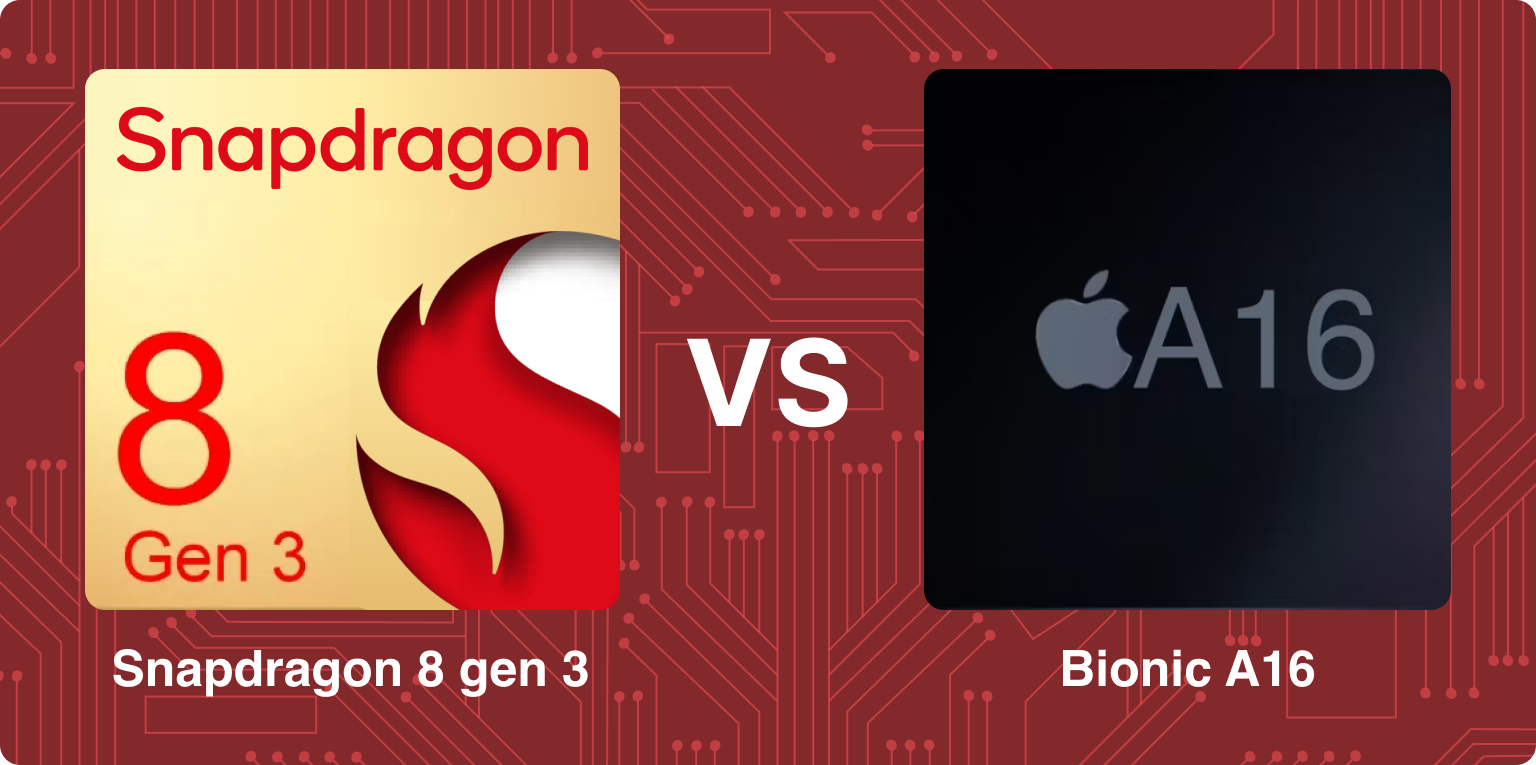
The world of smartphone processors is a constant race for performance and efficiency. Two titans dominate this arena: Apple’s Bionic series and Qualcomm’s Snapdragon line. In 2022, the Bionic A16 reigned supreme. But 2024 brings a new challenge: the Snapdragon 8 Gen 3. Let’s compare them to see which chip reigns supreme.
Snapdragon 8 Gen 3 vs Apple A16 Bionic
| Category | Snapdragon 8 Gen 3 | Apple A16 Bionic | Winner |
|---|---|---|---|
| CPU setup | 1+5+2 cores | 2 + 4 cores | Tie |
| Clock speed | ~3.46 GHz | ~3.3 GHz | Snapdragon |
| Single-core | Higher (leaks) | Very strong | Tie |
| Multi-core | Strong | More efficient | A16 |
| GPU power | Higher graphics | Stable graphics | Snapdragon |
| RAM type | LPDDR5X | LPDDR5 | Snapdragon |
| Storage | UFS 4.0 | NVMe | A16 |
| Efficiency | 3nm | 4nm | Snapdragon |
| AI engine | Hexagon | Neural Engine | Tie |
| Camera ISP | Triple 18-bit | Deep Fusion | Tie |
| Gaming | More FPS | Cooler & stable | Snapdragon |
| 5G | X75 modem | Older modem | Snapdragon |
| Wi-Fi | Wi-Fi 7 | Wi-Fi 6E | Snapdragon |
| Ecosystem | Depends on brand | Fully optimized | A16 |
| Smoothness | Fast | Industry best | A16 |
| Best for | Gaming & power | Stability & longevity | Depends |
CPU Architecture and Performance
1. Core Configuration

Both chipsets utilize an ARM architecture with different core layouts. The A16 features a 6-core CPU (2 high-performance cores + 4 efficiency cores), while the Snapdragon 8 Gen 3 reportedly uses a 1+5+2 configuration (1 ultra-performance core + 3 performance cores + 4 efficiency cores).
2. Clock Speeds

While official figures for the Snapdragon 8 Gen 3 are scarce, leaks suggest a 5% higher clock speed (3460 MHz) on the primary core than the A16 (3300 MHz).
3. Benchmarks

Benchmark scores can be misleading, but leaked Geekbench scores show the Snapdragon 8 Gen 3 potentially edging out the A16 in single-core performance. However, due to its efficient core cluster, the A16 might retain a lead in multi-core tasks.
4. Here’s the Takeaway

The Snapdragon 8 Gen 3 might boast a slight raw performance edge, especially in single-core tasks. However, real-world performance heavily depends on software optimization, which Apple is known for.
GPU: Graphics Processing Unit
1. Architecture

Both chipsets utilize custom-designed GPUs. The A16 likely retains its 5-core GPU design, while the Snapdragon 8 Gen 3 significantly upgrades GPU frequency.
2. Gaming Performance

The Snapdragon 8 Gen 3’s higher GPU frequency suggests potentially better graphics rendering capabilities. However, the A16’s architecture and Apple’s focus on Metal graphics API optimization shouldn’t be underestimated.
3. Takeaway

The Snapdragon 8 Gen 3 appears to have raw graphical muscle. However, actual game optimization for each chip will be crucial for real-world gaming performance.
Memory and Storage

1. RAM
Both chipsets likely support LPDDR5 RAM, with phone manufacturers offering various configurations.
2. Storage

Both integrate high-speed NVMe storage, ensuring fast app loading and data transfer.
3. Takeaway

This is a tie. RAM and storage speeds depend more on phone manufacturers’ choices than the chip.
Power Efficiency: A Crucial Factor

Battery life is a significant concern. Here’s where things get interesting:
1. Fabrication Process

The A16 uses a 4nm process, while the Snapdragon 8 Gen 3 might utilize a more power-efficient 3nm process. This could give the Snapdragon 8 Gen 3 an edge in battery life.
2. Efficiency Cores

Both chipsets have dedicated low-power cores for basic tasks, but Qualcomm claims a 20% improvement in efficiency for the Snapdragon 8 Gen 3.
3. Takeaway

The Snapdragon 8 Gen 3 is superior in power efficiency, thanks to its potentially more advanced fabrication process and improved efficiency core design.
Camera and Image Processing (ISP)

1. Image Signal Processor (ISP)

Both SoCs integrate a dedicated ISP for image processing.
2. Computational Photography

Apple and Qualcomm are leaders in computational photography techniques, offering features like HDR, noise reduction, and improved low-light performance.
3. Takeaway

This is a close call. Both chipsets are likely to deliver excellent image quality, but the outcome depends on phone manufacturers’ camera hardware choices and software optimization.
Connectivity: Keeping You Connected

1. 5G

Both chipsets support the latest 5G standards, ensuring blazing-fast internet speeds.
2. Wi-Fi

Both likely support the latest Wi-Fi 6E standard for high-speed wireless connectivity.
3. Takeaway

This is another tie. Both chipsets offer cutting-edge connectivity options.
The Verdict: A Matter of Choice

The Bionic A16 and Snapdragon 8 Gen 3 are neck-and-neck in this battle. Here’s how to choose:
1. Raw Performance

Snapdragon 8 Gen 3 might have a slight edge, especially for single-core tasks.
2. Power Efficiency

Snapdragon 8 Gen 3 seems more power-efficient on paper.
3. Software Optimization

Apple’s tight control over hardware and software could give the A16 an edge in performance, efficiency, and seamless user experience, setting new standards for mobile computing.
Other Considerations:

1. Gaming Ecosystem

If mobile gaming is a priority, consider each platform’s existing game library optimization. iPhones typically have a more comprehensive range of well-optimized games.
2. AI and Machine Learning

Both chipsets are equipped for AI tasks, but Apple might have an advantage with its Neural Engine dedicated to such workloads.
3. Device Ecosystem

Consider whether you prefer the iOS or Android ecosystem. This heavily influences your chip choice, as the A16 is exclusive to iPhones, and the Snapdragon 8 Gen 3 powers various Android flagships.
Conclusion: A Battle Without a Clear Victor

The Bionic A16 and Snapdragon 8 Gen 3 are both phenomenal smartphone processors. Choosing between them depends on your priorities:
• For sheer raw performance and potential power efficiency, the Snapdragon 8 Gen 3 might be a better choice.
• However, if software optimization, a potent gaming ecosystem, and tight hardware-software integration are crucial, the Bionic A16 remains a compelling option.
Ultimately, the best chip will be the one that powers the phone that best suits your individual needs and preferences. Both these processors will undoubtedly deliver a smooth, powerful, and feature-rich smartphone experience.
Looking Forward: The Future of Snapdragon And Bionic

The battle between Apple and Qualcomm continues to push the boundaries of mobile processing power and efficiency. As we move towards 2025, we can expect even more advancements:
1. Further Refinement of Fabrication Processes

Both companies will likely strive for even more efficient chip manufacturing processes (perhaps reaching 2nm or below).
2. Focus on AI and Machine Learning

Integrating AI and machine learning capabilities into mobile processors will likely become even more prominent, powering features like enhanced camera processing, improved battery management, and personalized user experiences.
3. Focus on Sustainability

As environmental concerns rise, chip manufacturers might prioritize sustainable production methods and energy-efficient designs.
The future of mobile processors is bright, and Bionic and Snapdragon are poised to remain at the forefront of this exciting race. For more interesting blogs, check out Sigosoft.
Si pappa e ciccia, sempre uguali li fanno