
Model Context Protocol (MCP) is becoming a critical foundation as artificial intelligence moves from experimentation into real-world software products and workflows. While AI has advanced rapidly through larger models, better benchmarks, and powerful chat interfaces, a key limitation has emerged: lack of context.
AI systems can reason and generate content, but without access to real data, tools, and environments, they remain constrained. MCP (Model Context Protocol) addresses this challenge by enabling AI systems to securely interact with external software, data sources, and business workflows — transforming AI from conversational tools into context-aware systems.
What Is Model Context Protocol (MCP)?

MCP, or Model Context Protocol, is an open protocol designed to help AI models securely access and understand external context. This context can include:
- Files and documents
- Databases
- APIs and internal tools
- Application state and workflows
Instead of relying only on user prompts or hardcoded integrations, MCP provides a standardized way for AI models to request, receive, and use contextual information from external systems.
In simple terms:
MCP allows AI to understand what exists beyond the chat interface.
Why Context Matters More Than Intelligence

Modern AI models are already powerful. They can write code, summarize information, and answer complex questions. However, intelligence without context has limits.
Without context, AI can:
- Respond generically
- Explain concepts
- Simulate reasoning
With context, AI can:
- Act on real data
- Use tools correctly
- Automate workflows
- Support operational decision-making
As businesses adopt AI at scale, the challenge is no longer “Can the model understand language?” but “Can the model understand the environment it operates in?” MCP directly addresses this gap.
From Chatbots to Context-Aware AI Systems

Most current AI integrations rely on plugins, custom APIs, or tightly coupled logic. While these approaches work for small use cases, they become difficult to maintain and scale.
MCP introduces a cleaner architectural model by:
- Separating AI reasoning from system execution
- Standardizing how tools and data are exposed
- Reducing fragile, one-off integrations
- Improving security and governance
This shift enables AI to move beyond chatbots and into reliable, context-aware systems that operate across applications and workflows.
Why MCP Matters for Enterprise and Product Teams

For enterprises and software teams, MCP unlocks practical AI use cases that were previously complex or risky to implement. These include:
- AI-assisted internal operations
- Context-aware customer support systems
- Intelligent automation across departments
- Decision support based on live business data
- Secure AI access to proprietary systems
By using MCP, teams can design AI-native systems where context is intentional, controlled, and auditable a critical requirement for enterprise adoption.
MCP and the Future of AI Architecture
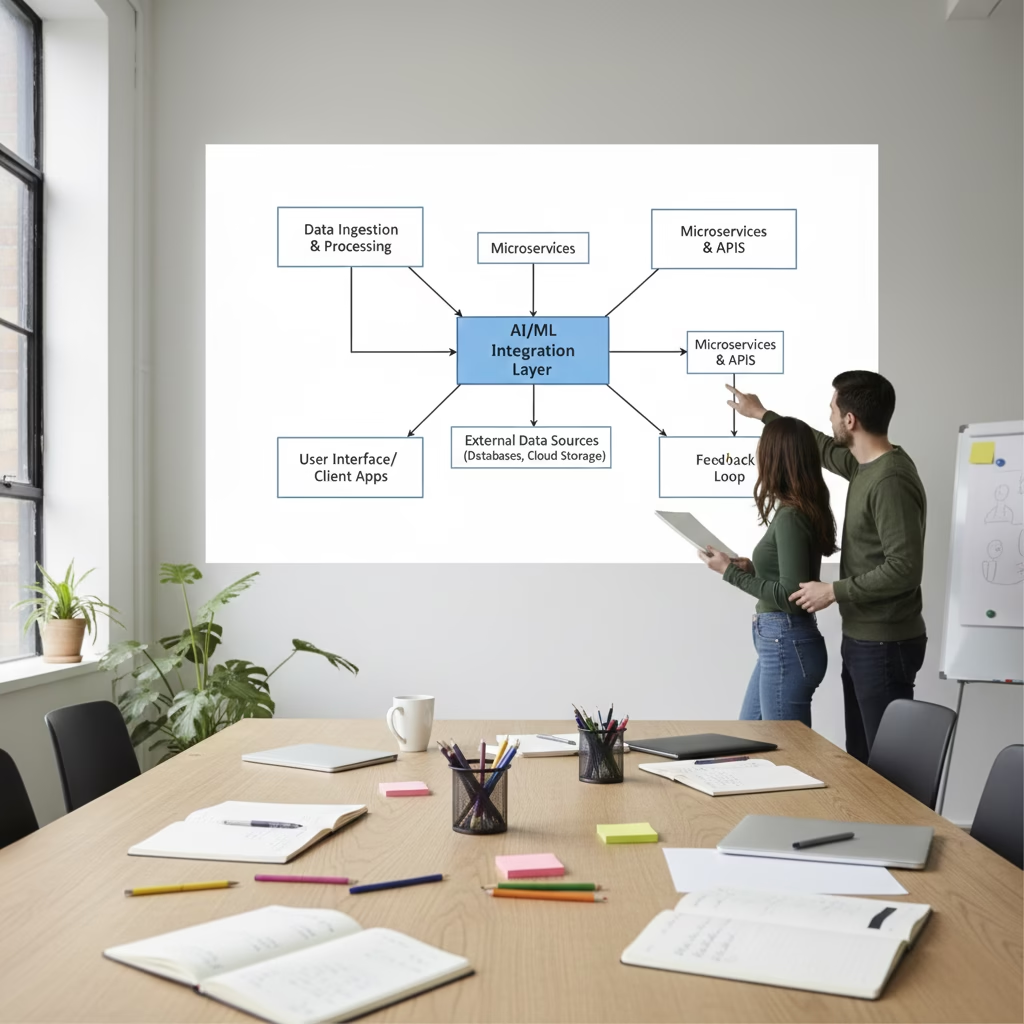
As AI becomes a core layer of software systems, architecture must evolve. MCP points toward a future where:
- AI systems are designed with context as a first-class component
- Models interact with tools through well-defined interfaces
- Automation becomes adaptive instead of brittle
- AI agents collaborate with humans and software systems
This represents a move away from isolated AI features toward integrated AI platforms that understand and operate within real environments.
What Developers and Teams Should Prepare For

MCP signals an important change in how AI-powered software will be built. Teams should start thinking about:
- How context is exposed to AI systems
- Which tools and data AI should access
- How permissions and security are enforced
- How AI decisions are monitored and improved over time
The quality of AI systems will increasingly depend on context design, not just model selection.
Final Thoughts

AI without context is impressive, but limited.
AI with context becomes useful, reliable, and scalable.
MCP (Model Context Protocol) highlights a fundamental truth about the future of artificial intelligence:
the next wave of innovation will be driven not by bigger models alone, but by better integration with real-world systems.
As AI continues to evolve, protocols like MCP will play a crucial role in transforming AI from conversational tools into context-aware systems that deliver real value.
Sources & References
To understand Model Context Protocol (MCP) and the broader shift toward context-aware AI systems, the following authoritative resources provide additional technical and conceptual background:
- Anthropic – Model Context Protocol (Official Documentation)
https://www.anthropic.com/news/model-context-protocol
(Primary source explaining MCP, its purpose, and architecture) - Anthropic MCP Specification (GitHub)
https://github.com/modelcontextprotocol/specification
(Technical specification for MCP and how context is shared with AI models) - Anthropic Blog – Building Reliable AI Systems
https://www.anthropic.com/research
(Insights into safe, structured, and context-aware AI system design) - OpenAI – Tool Use and Function Calling in AI Systems
https://platform.openai.com/docs/guides/function-calling
(Related concepts on how AI models interact with tools and external systems) - Google Research – Responsible and Context-Aware AI
https://ai.google/responsibility
(Industry perspective on integrating AI with real-world systems responsibly)
Related Blogs
If you’re exploring how AI systems move beyond chat and into real-world execution, you may also find these articles useful:
AI Automation: How Intelligent Systems Are Redefining Business Workflows
An in-depth look at how AI-powered automation is transforming operations, decision-making, and productivity across modern businesses.
👉 Read more about AI automation in hospitals and intelligent workflows
Meta Andromeda: A New Direction for Large-Scale AI Infrastructure
A practical overview of Meta’s Andromeda architecture and what it reveals about the future of AI infrastructure, scalability, and performance.