At Sigosoft, we build apps where trust decides whether the product survives, and open-minded dating apps are the hardest version of that problem. Every app in this space has the same hidden failure: women. Not a shortage of women who are curious, but a shortage of women who stay. Couples join to meet women. Single men join to meet women. Women join, get flooded, harassed or made to feel like an accessory to someone else’s fantasy, and quietly leave. When they leave, everyone else follows.
Most apps respond by adding a report button. This post treats the problem as a product and engineering challenge instead: what would an open-minded dating app look like if its architecture was built around women’s experience from day one?
To be clear about where this comes from: Sigosoft doesn’t run a dating app, and this isn’t a product we sell. We build apps for founders as a development service. This is the blueprint I’d share with any founder planning an open-minded dating or community app, whether or not they build it with us.
Key takeaways
- The core problem: women on open-minded apps face message floods, unwanted explicit images, persistent contact after saying no, pressure from couples, and a much higher cost if exposed.
- Why it matters: women are the people everyone else comes to meet. If they leave, the app fails.
- The design: a women-first community where women vouch who joins, control who can contact them, and meet people first at curated events.
- The build: Flutter apps, a secure API with field-level encryption, third-party verification, server-enforced messaging rules, locked media, device-level blocking and an event engine, delivered in three phases.
- The key metric: the share of women still active and attending events after 90 days.
What is an open-minded dating app?
An open-minded dating app is a dating or community app for people outside the traditional one-on-one model, including couples in open relationships, polyamorous people, the queer community and people who are simply curious. Typical features include couple or linked partner profiles, wide gender and orientation options, and filters for relationship style and interests.
The category is growing quickly. Feeld, the best-known app in the space, reported that the “heteroflexible” identity grew 193% year over year on its platform, the fastest of any identity. In India, open-minded apps are already among the more popular dating apps, as the comparison below shows.
Why do women leave open-minded dating apps?

Women leave because the apps are designed for the people who want to meet them, not for women themselves. The most common problems are message overload, unwanted explicit images, contact that continues after a “no”, pressure from couples, fake couple profiles, fear of being exposed, physical safety risks and reports that go nowhere.
Message overload
Pew Research found women are more likely than men to feel overwhelmed by the number of messages they receive on dating apps. On open-minded apps, the flood has a specific shape. One Feeld review warns bi women to expect their inbox to be around 80% couples, and notes that couples looking for a “third” overwhelm solo users, especially solo women.
Unwanted explicit images
In Pew’s research, 57% of women aged 18 to 34 who use dating apps said someone sent them a sexually explicit message or image they didn’t ask for, compared with 28% of men the same age. On an app that calls itself “open-minded”, many men read that label as permission. It isn’t.
Contact that continues after “no”
60% of women users aged 18 to 34 in the same Pew study said someone kept contacting them after they’d said they weren’t interested. On most apps, unmatching ends one chat. It doesn’t stop the same person from finding you at an event, on another profile or through a mutual friend.
Being treated as an accessory
The community has a name for couples searching for a bisexual woman to join them: unicorn hunting. The problem isn’t couples themselves. It’s being approached as a role to fill rather than a person with her own interests, boundaries and pace.
The woman in the couple
A couple’s profile is usually created on one phone, often by one partner. The app has no way of knowing whether both people genuinely want to be there. A woman who feels pressured into a couple’s profile has no private way to say so.
Fake couples
Single men sometimes create couple profiles, occasionally with a borrowed photo of a woman, because couples get more access and more replies. A woman who agrees to meet a “couple” can find a single man at the door.
The cost of exposure
For a woman in India, being recognised on an open-minded app can bring consequences with family, at work and in her social circle that a man rarely faces. The risks are practical: a shared family phone, contact syncing, a notification on a locked screen, a merchant name on a bank or UPI statement, or a screenshot sent to the wrong person. Screenshots and private photos can turn into blackmail.
Physical safety
Meeting a couple for the first time often means meeting two people, in their home, on their terms. Pew found women are far more likely than men to say someone they dated pressured them for sex (42% vs. 19%) or touched them in a way that made them uncomfortable (35% vs. 9%).
Reports that go nowhere
Pew found online daters have mixed feelings about how well dating companies remove fake accounts and users who harass others, and about how well they keep personal information safe. Women who report someone and see nothing happen stop reporting, and eventually stop using the app.
“Free for women” pricing
Making membership free for women quietly tells everyone that women are the attraction and paying men are the customers. It also makes fake female profiles free to create, which is exactly what scammers need.
Why does women’s experience decide whether the app survives?
Because couples and single men are paying to meet women. If women’s experience is poor, the app loses the very thing everyone else is paying for. That makes women’s 90-day retention the single most important number for any open-minded dating app, more important than downloads or first-month revenue.
Top 5 open-minded dating apps, and what founders can learn from them
This isn’t a ranking or an endorsement. Each app solved part of the problem, and each has a lesson for anyone building in this space. Figures are as reported by the companies or reviewers.
1. Feeld
Feeld launched in 2014 as a dating app for people open to experiencing relationships in new ways. One review puts its revenue at $65M in 2024, up 26% year over year, with over 2 million members. Its Constellation feature lets users link up to five partner profiles. In the UK, it uses Yoti for age verification under the Online Safety Act.
Lesson for founders: partner linking and wide identity options are now the minimum, not a differentiator. Scale also brings problems: reviewers still report scammers, bots and OnlyFans solicitation.
2. Nymph
Nymph is run by a German company, Nymph GmbH, and AppBrain ranks it #8 among dating apps in India, with 2.4 million downloads. Recent features include adding a partner to chats, videos that disappear after one view, and support for 60 languages.
Lesson for founders: Indian demand is real, and it fits a bigger trend we explored in whether India will become the largest market for dating apps. Privacy features matter to this audience. But even a positive review mentions inactive profiles and the patience needed to find genuine users. Keeping profiles active and real matters as much as attracting downloads.
3. 3Fun
The company says it has passed 10 million downloads, with around 2.5 million monthly users. Its features include letting both partners chat from one couple accounts, group chats, photo verification, and private photos visible only to matches.
Lesson for founders: in 2019, researchers at Pen Test Partners found 3Fun was exposing users’ near real-time location, dates of birth, sexual preferences, chats and private photos, even for users with privacy settings enabled. The privacy filtering ran only inside the mobile app, not on the server. 3Fun said at the time that it had fixed the flaws. Every privacy rule must be enforced on the server.
4. #Open
#Open was built by Amanda Wilson and David Epstein with a strong focus on consent and boundaries, and users sign a code of conduct. The app now lets members apply for private club memberships, buy event tickets, see who’s attending events and control their own visibility.
Lesson for founders: events are already becoming part of this category. #Open also shows the marketing reality: its founders self-funded the app, and Reddit and Facebook rejected their ad applications. Plan for community-led growth, not paid social ads.
5. helloPOLY
helloPOLY, formerly PolyFinda, was founded by members of the ethical non-monogamy community and matches people on shared interests. Its updates have added tools for hosting local events, finding local groups and poly-friendly therapists, and video chat.
Lesson for founders: founders from inside the community understand needs beyond matching, like local groups and access to therapists who won’t judge. That kind of support builds trust faster than any feature.
Comparison at a glance
| App | Best known for | Lesson for founders |
| Feeld | Scale, identity options, linked partner profiles | Partner linking is now table stakes; scale brings trust problems |
| Nymph | Strong traction in India, privacy features | Demand is real; active, genuine profiles matter as much as downloads |
| 3Fun | Couple-focused features | Enforce every privacy rule on the server |
| #Open | Consent, code of conduct, clubs and events | Events are the direction; plan for community-led growth |
| helloPOLY | Community-founded, local groups, therapist access | Support beyond matching builds trust |
Based on their public descriptions, none of these apps puts women’s control over who can reach them at the centre of the product. That’s the gap the design below is built to fill.
What features should an open-minded dating app have?

An open-minded dating app built for women should include vouch-based onboarding for single men, separate accounts and private consent for each partner in a couple, recipient-controlled messaging, locked media, cross-channel blocking, weighted feedback with human review, strong privacy features, a leak response plan, an event-first meeting flow, women-only circles, and pricing that removes free fake profiles.
Vouch-based onboarding for single men
Single men can’t simply sign up and start browsing. They need a vouch from a verified woman member or a verified couple who has met them, or they attend a small intro event where the host, a woman, approves them. It’s slower, and that’s the point. Event tickets follow the same logic: places for women and couples open first, and men’s places open only once the planned balance is reached.
Per-partner authentication and private consent

Both partners in a couple create their own login on their own phone, verify their own identity, and answer one private question the other never sees: “Are you here because you want to be?” Either partner can pause or leave the couple’s profile privately. This protects women pressured into a profile, and it makes fake couples very hard to create, because a borrowed photo can’t pass a live selfie check on a second phone.
Recipient-controlled messaging
Nobody can message a woman first. She sees who is interested and opens conversations with the people she chooses. After events, conversations open only through mutual interest. The flood disappears, because there’s no door for it to come through.
Media locked by default, with explicit image detection
No images in a first conversation. After that, every image arrives blurred and the recipient decides whether to open it. Images detected as explicit are blocked by default.
Cross-channel blocking at account and device level
When a woman declines, unmatches or blocks someone, that person can’t contact her again through any route: not a new chat, not a second account on the same device, and not by booking an event she’s attending.
Weighted feedback with a human review queue
After every event, women can privately rate how they were treated. A man who receives concerns from two different women is paused from events until a trained reviewer looks at it. Reviews must be done by people, not automatically, and members need a way to respond. But a community where women’s experience directly affects who gets invited back behaves very differently from one where it doesn’t.
Privacy by design: disguised icon, neutral billing, forensic watermarking

- A disguised app icon and neutral notification text.
- No contact syncing and no social logins.
- A neutral name on payment statements.
- Photos blurred to everyone except mutual matches and past event attendees.
- An invisible watermark on every photo view, tied to the viewer, so a leaked screenshot can be traced.
- One tap to delete everything, which actually deletes it.
Incident response for image leaks
No design stops every leak, so the app should help women act fast. Guide them to StopNCII.org, which helps stop intimate images being shared on participating platforms, and in India to the National Cyber Crime Reporting Portal and the 1930 helpline. The account that leaked the image is banned permanently, down to the device.
Event-first meeting flow

Nobody meets a couple or a man alone in a private home for the first time. First meetings happen at curated community events or public venues. Every event has a woman host or safety lead, a code of conduct everyone agrees to when booking, a licensed bar or sealed drinks, no private rooms, and a way to leave at any time with a ride credit. Events are social: people meet, talk and decide later whether to see each other again.
Women-only circles as an onboarding layer
Many curious women want to talk to other women before meeting anyone else. Regular women-only circles give them a place to ask questions, compare notes and build a safety net. A woman who arrives at a mixed event already knowing three other women there is a very different guest from one who walks in alone.
Pricing that removes free fake profiles
Everyone pays something, even a small amount. Women who host events earn a share of ticket revenue, which turns women from the attraction into owners of the community.
What does a first event look like?
Meera, 29, works in Bengaluru and has been curious about open relationships for a year. She’s had an open-minded dating app installed for months but never met anyone, because every conversation felt like a negotiation.
She joins the new app and verifies with a live selfie. Nobody can message her. The first thing she books is a women’s circle on a Sunday afternoon at a café: eight women, a relationship coach and two hours of honest conversation. She leaves with three new contacts and a clearer idea of what she wants.
Two weeks later, she booked a mixed evening event. Places for women and couples filled first. The host has already welcomed her in a small group chat with the other women attending. At the event, she talks to a couple whose partners both verified separately, and to a man vouched for by a woman she met at the circle. Nobody pushes. She leaves at 10:30 with a ride credit.
The next morning, she picks two people she’d like to see again. One picks her back. The conversation opens because she chose it.
How does the model adapt by country?
The women-first design stays the same everywhere; the local layer changes. In India, discretion features matter most because social exposure is the biggest risk. In Brazil and Argentina, where same-sex marriage is legal and open-minded communities are large, the priority shifts to scale and event variety. In Cape Town, Bangkok and Berlin, mixed local and international crowds need multiple languages, foreign ID verification and a clear code of conduct. Payments follow local habits: UPI in India, Pix in Brazil, Mercado Pago in Argentina, PayFast in South Africa, PromptPay in Thailand.
How do open-minded dating apps make money?
The strongest model combines event tickets, memberships, workshops and venue partnerships, with no ads.
- Event tickets: the core revenue, with women hosts earning a share.
- Membership: priority booking, matching after events and full profile visibility. Men’s membership can reasonably cost more, because vetting them costs more.
- Women’s circles and workshops: communication, boundaries and open relationships, led by coaches or therapists.
- Venue partners: licensed, welcoming venues pay for guaranteed, well-behaved guests.
- No ads: ads make a trust-based product feel cheap.
Which metrics matter most?
Track women’s experience first. These are the numbers I’d put on a founder’s dashboard every week:
- Women still active after 90 days
- Share of women who attend a second event
- Number of women hosting events
- Conversations opened by women
- Time from a woman’s report to action
- Repeat concerns about the same member
If these numbers are healthy, everything else follows.
How do you build an open-minded dating app?

A practical build uses Flutter for iOS and Android, a secure API with PostgreSQL and field-level encryption, a third-party verification provider, a real-time layer for chat and events, server-enforced rules for messaging and blocking, and an admin panel with a moderation queue, delivered in three phases starting with one city.
The stack
Mobile app: Flutter.
One codebase for iOS and Android matters when a founder is launching in one city on a startup budget. Features like screenshot blocking and icon switching need small pieces of native Kotlin and Swift code, which Flutter handles through platform channels. Our Flutter app development page explains when we choose it, and our native Android development page covers the Kotlin side.
Backend: a standard API with a relational database.
PostgreSQL works well because relationships between members, couples, vouchers, events and blocks are naturally relational. Sensitive fields such as orientation and relationship style should be encrypted at the field level, so a database leak alone doesn’t expose them.
Real-time layer.
Chat, event updates and address reveals need instant delivery. Firebase or Pusher handle this well at MVP scale, and we use both in real-time apps we’ve built for clients.
Cloud hosting.
AWS or a similar provider, with media stored separately from profile data, and verification results stored separately again.
Verification and consent
Liveness and age checks.
Use an established third-party provider, as Feeld does with Yoti in the UK. It’s cheaper and more reliable than building face matching in-house, and it keeps the most sensitive data out of the app’s own systems.
Delete ID data after verification.
Store the result (“verified, over 18”), not the document.
Per-partner consent.
Each partner is a separate account with its own login, device and verification, linked by mutual invitation. The private consent answer is never shown to the partner, and a couple’s profile stays active only while both accounts confirm it.
The vouch graph.
Store who vouched for whom, when and in what context, so the admin team can spot patterns, like one member vouching for many men they haven’t met at events.
Messaging and media
Recipient-controlled messaging, enforced on the server. A conversation doesn’t exist until the woman, or a mutual event match, opens it, and the rule lives in the backend so no modified app or direct API call can get around it. This isn’t theoretical: 3Fun’s 2019 exposure happened because privacy filtering ran only in the mobile app.
Locked media.
Images are uploaded, scanned and stored blurred, and the recipient’s tap requests the clear version. Cloud services such as Amazon Rekognition’s content moderation or Google Cloud Vision’s SafeSearch can flag explicit images before delivery, and on-device models can add a first check. For more on where AI helps in this category, from moderation to matching, see our post on how dating apps are using AI in 2026.
Screenshot protection.
Android can block screenshots and screen recording on sensitive screens using a system flag. iOS can’t block screenshots, but the app can detect them, hide content during screen recording and notify the other person.
Forensic watermarking.
Each photo view gets an invisible mark tied to the viewing account, so a leaked screenshot can be traced to the account that took it.
Blocking that actually works
Account and device level.
Android’s Play Integrity API and Apple’s DeviceCheck help recognise a banned device returning with a new account, within each platform’s privacy rules.
Cross-channel enforcement.
The ticketing system checks the block list, so a blocked person can’t book an event a woman who blocked them is attending. The event simply shows as unavailable.
Discretion features
Disguised icon.
Android supports switching launcher icons through activity aliases. iOS supports alternate app icons, though it shows a brief system message when the icon changes.
Neutral notifications.
Push notifications carry no content (“You have an update”), and details load only after the app is opened.
Neutral billing.
Event tickets are real-world services, so app store rules generally allow payment through a regular gateway with a neutral statement descriptor. Digital memberships usually go through Apple and Google billing, which shows the app’s name on receipts, so the app’s store name itself should be neutral.
No contact syncing, no social logins. Phone number or email only.
Coarse location.
Store neighbourhood-level location only. Exact location is used only at check-in and for SOS, and isn’t kept.
Events
Ticketing with a balance engine.
Each event has a planned mix of women, couples and men. Tickets are released in order, and waitlists fill gaps automatically.
Scheduled address revealed.
Venue addresses are stored encrypted and released to confirmed guests a few hours before the start.
QR check-in and SOS.
Guests check in at the door, and SOS shares a live location with the event’s safety lead and a chosen friend.
The afterglow match.
After each event, a time-limited window opens where guests pick who they’d like to see again. Matches open only on mutual picks, and for couples, only when both partners approve.
Moderation and admin
A review queue, not an inbox.
Reports and feedback go into a prioritised queue with response time targets. Concerns from two different women about the same member automatically pause that member from events until a reviewer decides.
The women’s dashboard.
The key metrics above are built into the admin panel from day one.
A phased build plan
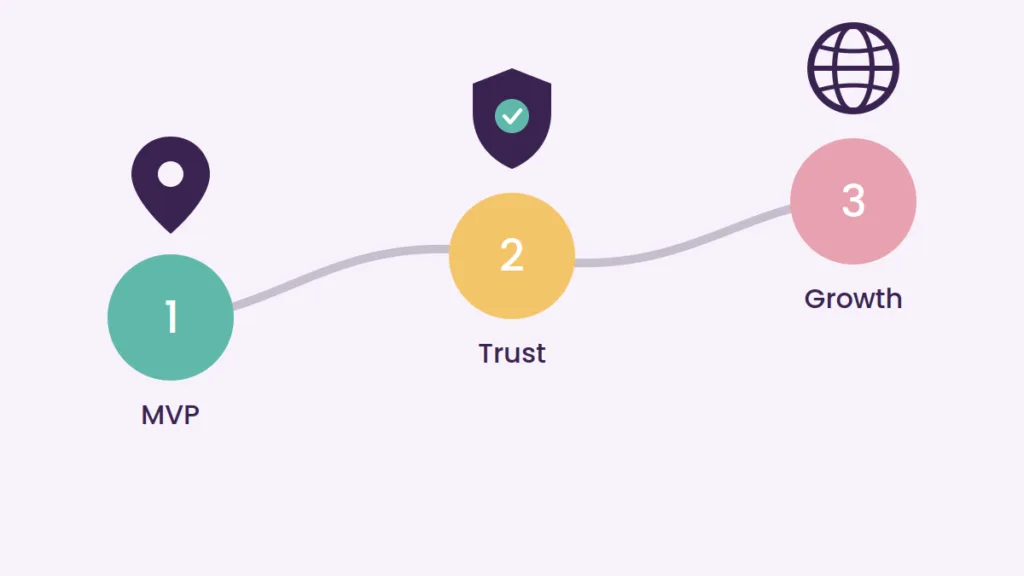
Phase 1: MVP for one city.
Verification and age checks, per-partner couple consent, recipient-controlled messaging, locked media, account and device blocking, event ticketing with the balance engine, QR check-in, the afterglow match, payments, and an admin panel with the review queue.
Phase 2: Trust at scale.
The vouch graph, weighted feedback, forensic watermarking, disguised icons, tools for women’s circles and host payouts.
Phase 3: Growth.
End-to-end encrypted chat, more cities, more languages, a host marketplace and deeper analytics.
End-to-end encryption sits in phase 3 on purpose. It’s valuable, but it makes investigating abuse reports harder, so it needs careful design. In the MVP, messages should be encrypted in transit and at rest.
How much does it cost to build an open-minded dating app?
It depends on scope, and this app sits above a basic dating MVP because of its verification, consent, blocking and event layers. For reference, one 2026 guide puts a basic dating MVP at $30,000 to $80,000, while some offshore agencies quote $12,000 to $18,000 for a basic build. A good development partner should scope phase 1 with you before quoting.
Also budget for running costs that don’t appear in development quotes: per-check verification fees, content moderation services, moderation staff, hosting, and local legal advice in each launch city.
What are the limits and legal risks?
No design removes risk completely. Verification can be fooled, vouching can create cliques, and feedback systems can be misused, which is why human review matters. Events must stay social, alcohol needs licensed venues, and sexual orientation and relationship data is highly sensitive under India’s DPDP Act, 2023 and similar laws elsewhere. This is general orientation, not legal advice. Any founder should get a local legal review before launch.
Common mistakes in open-minded dating app development
Treating women’s safety as a feature list.
A report button isn’t a strategy. Access, contact and meeting rules need to be designed around women from the start.
Enforcing rules only in the app.
Privacy and messaging rules that live only in the front end can be bypassed. Enforce them on the server.
Making the app free for women.
It invites fake profiles and signals that women are the product.
Letting couples sign up on one phone.
Without separate accounts and consent, the app can’t protect the partner who didn’t choose to be there.
Storing ID documents.
Keep the verification result, delete the document.
Sending first meetings to private homes.
First meetings belong at events or public venues.
Growing too fast.
Men usually sign up faster than women. Open men’s places only as fast as women and couples join.
Relying on paid social ads.
Major ad platforms can reject apps in this category. Plan community-led growth.
Measuring downloads.
Women’s retention tells the real story.
FAQ
What is an open-minded dating app?
A dating or community app for people outside the traditional one-on-one model, including couples in open relationships, polyamorous people, the queer community and curious singles. It usually supports couple profiles, wide identity options and relationship-style filters.
What are the best-known open-minded dating apps?
Feeld, Nymph, 3Fun, #Open and helloPOLY are among the best-known. Each has strengths, and each offers a lesson for founders.
Why do women leave open-minded dating apps?
Mainly because of message overload, unwanted explicit images, continued contact after saying no, pressure from couples, fake profiles and the risk of being exposed.
What safety features should an open-minded dating app have for women?
Recipient-controlled messaging, locked media, account and device-level blocking, per-partner couple consent, verification, discretion features, and first meetings at vetted events rather than private homes.
Can screenshots be blocked in a dating app?
On Android, yes, on sensitive screens. On iOS, no, but screenshots can be detected, and forensic watermarking can trace a leaked image to the account that took it.
How much does it cost to build an open-minded dating app?
Published estimates for a basic dating MVP range from about $12,000 to $80,000. An open-minded app with strong safety, consent and event features costs more, and should be scoped in phases.
Which tech stack is best for an open-minded dating app?
Flutter for iOS and Android, a secure API with PostgreSQL and field-level encryption, a third-party verification provider, a real-time service such as Firebase or Pusher, and cloud hosting such as AWS.
Is an open-minded dating app legal in India?
Consensual adult relationships, including same-sex relationships, aren’t crimes in India since the Supreme Court’s 2018 decisions. Obscenity, trafficking and excise laws still apply to events, and data protection law applies to the app. Get legal advice before launching.
Does Sigosoft run an open-minded dating app?
No. Sigosoft is a software development company. This post shares a blueprint for founders, and we can help as a development partner.
Planning an open-minded dating app?
Start with the question most founders skip: why would a woman still be using your app in three months? If you have an answer, or want help finding one, we’d like to talk. As your mobile app development partner, we can help you scope phase 1, choose the right verification and moderation tools, and build an app your community can trust. Talk to our team about your app.
