
You have a business problem. Maybe your team is buried in spreadsheets. Maybe your current tools don’t talk to each other. Maybe you’re scaling fast and the software you started with is creaking at the seams.
Someone on your team says, “There’s a SaaS tool for that.”
Someone else says, “We should build our own.”
Both are right and both can be catastrophically wrong, depending on your situation.
The decision between custom app development vs SaaS is one of the most consequential tech choices a business leader makes. Get it right and you build a competitive moat. Get it wrong and you spend months either over-engineering something you didn’t need, or paying recurring fees for a tool that only half-fits your workflow.
In 2026, this decision has become even more nuanced. AI-assisted development has compressed custom build timelines. SaaS costs are compounding faster than ever as teams grow. And a Retool survey of over 800 business professionals found that 78% expect to build more custom internal tools in 2026 a signal the market is shifting.
This guide gives you the full picture: what each option means, what it actually costs, when each wins, and how to make the right call for your specific business.
What Is Custom App Development?

Custom app development is the process of building software from scratch or significantly customizing an existing framework to fit the exact needs of your business.
Unlike generic tools, a custom application is designed around your workflows, your users, and your data model. You own the code. You decide the roadmap. You scale it the way you want.
Real-World Example: Sigosoft built Sheegr, a fish delivery app in partnership with the Karnataka Fisheries Development Corporation in India. No off-the-shelf SaaS could have handled private flight logistics for fresh fish delivery at that scale. That required purpose-built software and it became a ₹600 Cr project.
Custom apps can be:
- Mobile applications (iOS, Android, cross-platform)
- Web applications (dashboards, portals, platforms)
- Enterprise software (ERP integrations, industry management systems)
- SaaS products (yes you can build and sell your own SaaS)
The build timeline typically ranges from 6 weeks to 9 months, depending on complexity. The upfront investment is higher, but ownership is total.
What Is SaaS?

SaaS Software as a Service is software you access over the internet on a subscription basis. The vendor builds it, hosts it, maintains it, and updates it. You pay monthly or annually to use it.
Think Slack, Salesforce, Shopify, Zoho, or HubSpot. These are fully built, ready-to-deploy tools for common business needs.
Why businesses love SaaS:
- Fast deployment (sometimes same-day)
- Lower upfront cost
- Automatic updates and maintenance
- No infrastructure management
SaaS makes perfect sense when your needs are standard. If you need CRM software, a marketing email tool, or an HR platform, there’s no reason to build one from scratch. Proven tools exist, and they’ve been refined over years of customer feedback.
But the moment your workflow diverges from what the SaaS vendor built for, you start hitting walls.
Custom App Development vs SaaS: Head-to-Head Comparison
Comparison Table
| Factor | Custom App Development | SaaS |
| Upfront Cost | Higher ($15K–$500K+) | Low to none |
| Monthly Cost | Low (hosting + maintenance) | Recurring (per user/feature) |
| Time to Launch | 6 weeks – 9 months | Hours to days |
| Customisation | Unlimited | Limited by vendor |
| Data Ownership | 100% yours | Vendor-controlled |
| Scalability | Built for your growth path | Depends on vendor’s pricing tiers |
| Integration | Any system, your rules | API-dependent, often restricted |
| Security Control | Full control | Shared responsibility |
| Competitive Edge | High proprietary | Low competitors use the same tool |
| Long-term Cost (5yr) | Often lower | Often higher (compounding fees) |
When to Build a Custom App Instead of SaaS
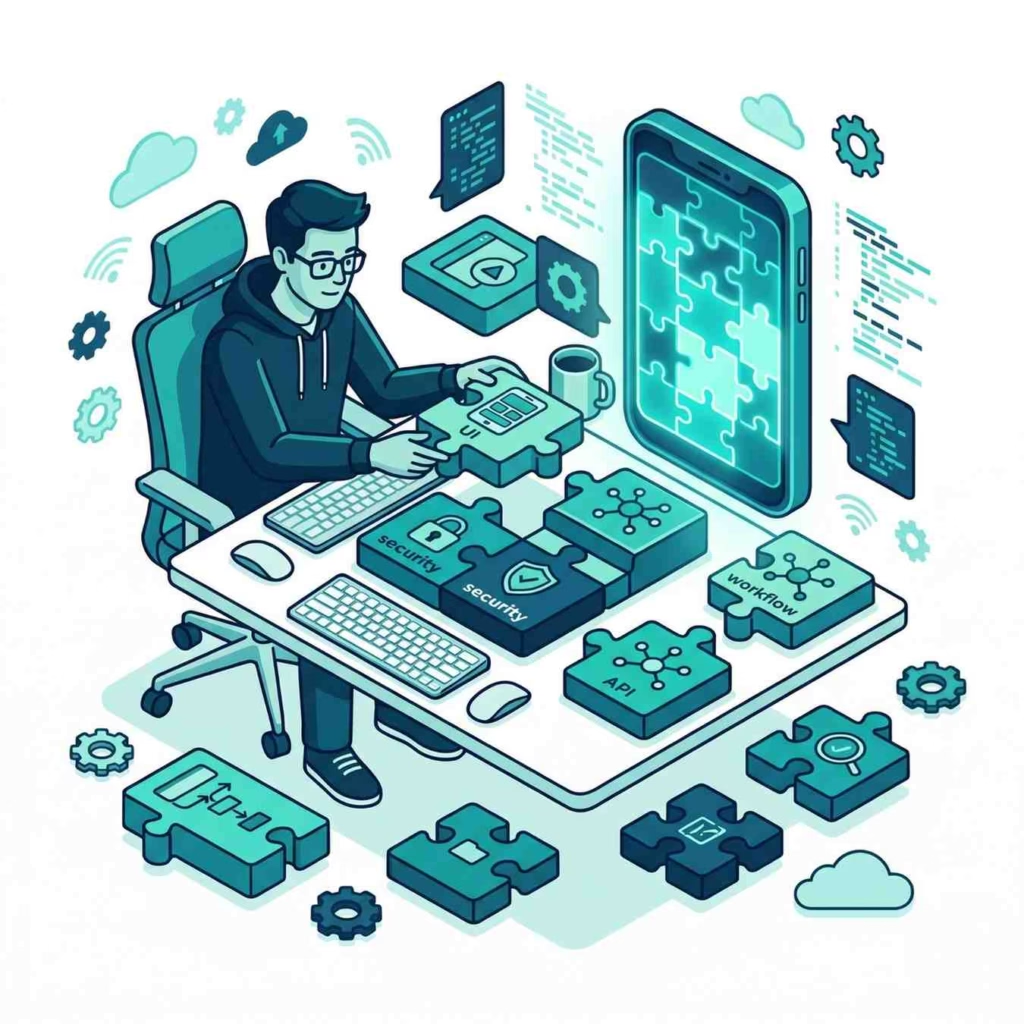
This is the core question most articles dance around. Here’s a direct answer.
Build a custom app when:
Your Workflow Is Unique to Your Industry
If your process has more than 3–4 steps that no existing SaaS handles cleanly, a custom build will almost always serve you better in the long run. SaaS vendors build for the broadest audience not your specific niche.
Sigosoft’s client MedChoice, an Irish healthcare platform, connects hospitals with qualified nurses. The shift-booking logic, compliance checks, and dual-app experience for nurses and hospitals couldn’t be replicated with any off-the-shelf HR or staffing tool. Custom was the only viable path.
Data Privacy and Security Are Non-Negotiable
Regulated industries healthcare, finance, legal, logistics often cannot hand their data to a third-party SaaS vendor. When you build custom, your data stays in your infrastructure, on your terms.
This is especially important for companies operating under HIPAA, GDPR, or ISO 27001 frameworks. Sigosoft, for example, holds ISO 27001:2022 certification a standard it builds into every custom application it delivers.
You Want to Sell Software, Not Just Use It
If your vision includes launching a software product a platform you charge customers to use you need custom development. You’re not just a user; you’re building a SaaS business. That’s a completely different game and requires end-to-end SaaS product development.
You’re Scaling Beyond SaaS Pricing Tiers
SaaS pricing is designed to scale with you meaning your costs compound as you grow. A 200-person team using a SaaS CRM at $50/user/month is paying $10,000 a month $120,000 a year for a tool they don’t fully own. At that volume, custom often becomes the economically smarter choice.
You Need Deep Integration With Legacy or Proprietary Systems
SaaS tools integrate well with other SaaS tools. But if you’re running ERPNext, a bespoke warehouse system, or any proprietary backend, custom development gives you the flexibility to connect everything cleanly. Sigosoft’s Grain n Grace Sales Spark app is a live example built on Flutter and deeply integrated with ERPNext to give field salespeople real-time sync without breaking existing infrastructure.
When SaaS Is the Smarter Choice
Custom isn’t always the answer. In fact, reaching for custom development before validating your idea is one of the most expensive mistakes in business software.
Choose SaaS when:
- You’re early-stage and still validating your business model
- Your needs are standard and well-served by existing tools (email, payroll, scheduling)
- You need to move fast weeks, not months
- Your budget is tight and upfront investment isn’t feasible
- You don’t have a team to manage or maintain custom software
- The workflow you’re solving is not a competitive differentiator
Rule of Thumb: If a SaaS tool does 90% of what you need and the missing 10% doesn’t affect your core operations or customer experience use the SaaS tool.
The Hidden Costs Nobody Talks About
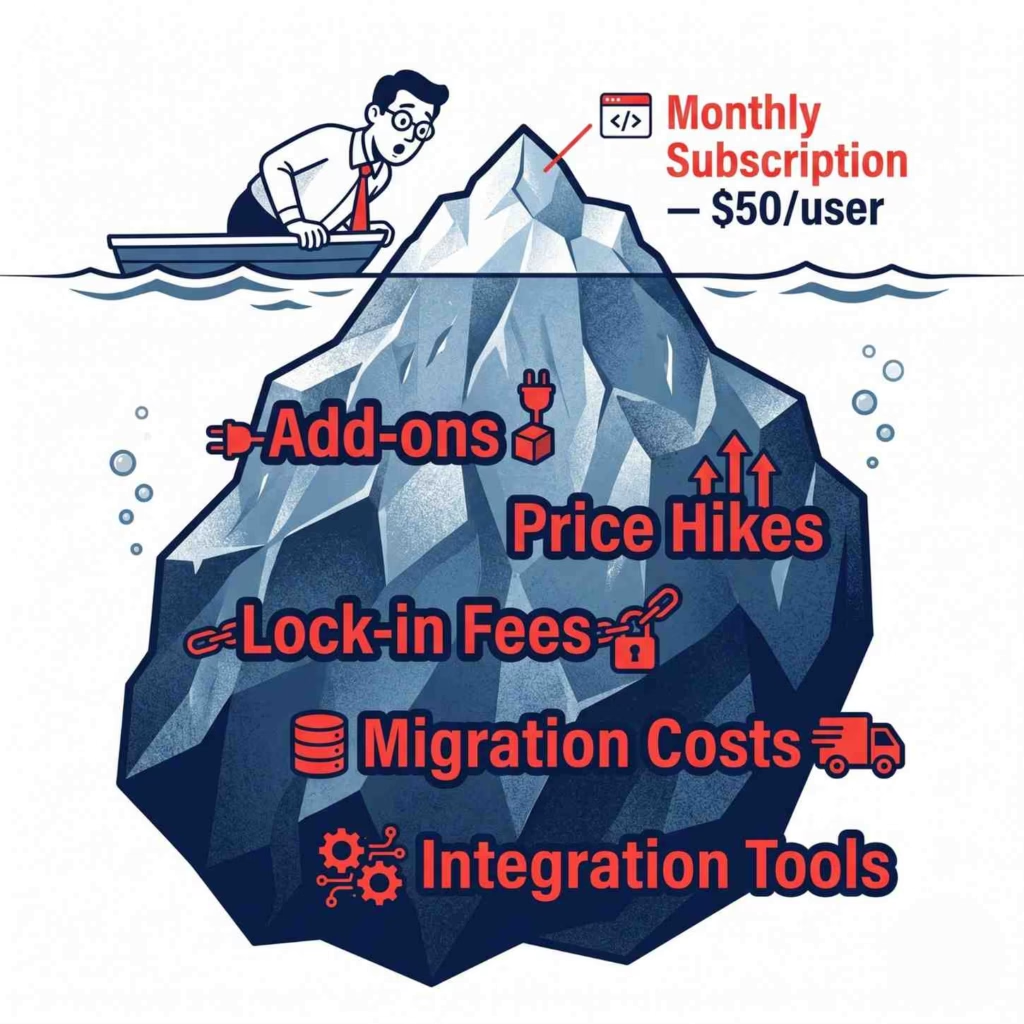
One of the most misleading aspects of the SaaS vs custom software debate is how people compare costs. They compare SaaS’s monthly subscription to the custom build’s upfront price and conclude SaaS is cheaper.
That comparison is incomplete.
Hidden costs of SaaS:
- Per-user fees that scale with headcount
- Add-on modules at extra cost
- Annual price increases (industry average: 8–12% per year)
- Data migration costs if you ever want to leave
- Integration middleware tools (Zapier, Make, etc.) add up
- Multiple subscriptions across a “SaaS stack” that should be one unified system
Hidden costs of custom development:
- Infrastructure (hosting, servers, CDN)
- Ongoing maintenance and updates
- Security patching
- Developer dependency risk if you don’t partner with a reliable vendor
Statistics Box
Zylo’s 2026 SaaS Management Index found that 46% of SaaS licenses go unused each month, representing nearly $19.8 million in wasted spend per organization annually. Before buying another SaaS seat, it’s worth auditing what you’re already paying for.
The honest 5-year total cost of ownership often flips the equation in favour of custom especially for core operational systems.
The Middle Ground: Custom SaaS Development

Here’s what most “build vs buy” articles miss entirely.
You don’t always have to choose between using SaaS and building something totally custom. There’s a third option that leading businesses in 2026 are increasingly choosing: building their own SaaS product.
This means you develop a cloud-hosted, multi-tenant platform your own SaaS built around your specific business model, branded to your business, with your own pricing, features, and customer experience.
This is especially powerful for:
- Entrepreneurs who want to productize a service or workflow
- Enterprises who want to spin off an internal tool as a revenue stream
- Startups building a software-led business from day one
A specialist SaaS product development company like Sigosoft can take you from concept to a deployed, scalable SaaS product handling architecture, UI/UX design, backend infrastructure, payment integration, and ongoing support.
It’s not the fastest path. But for businesses with the right vision, it creates the highest long-term value.
Industry-Specific Recommendations
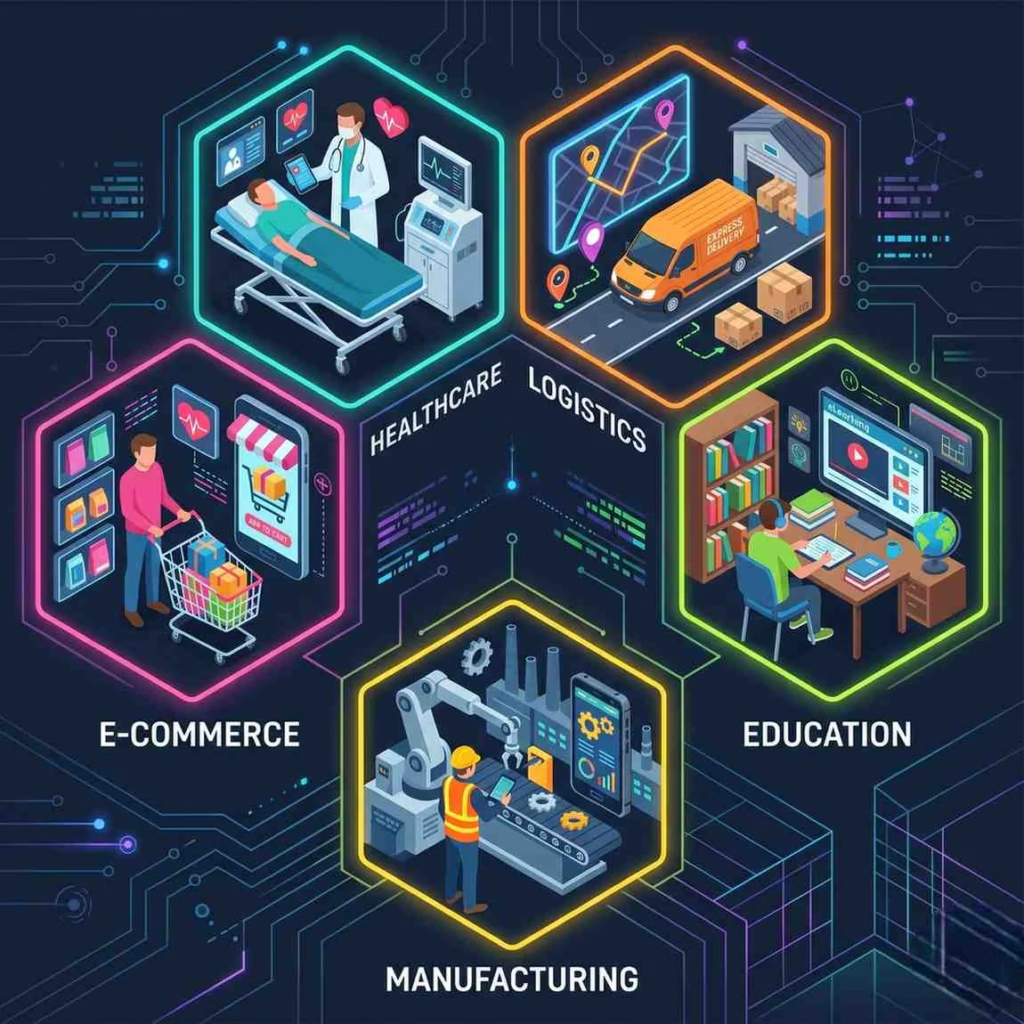
The right answer changes depending on your sector. Here’s a practical breakdown:
Healthcare & Telemedicine
Recommendation: Custom Patient data, compliance requirements, and the need for custom booking/consultation flows make custom non-negotiable in most healthcare applications. Generic SaaS tools rarely meet regulatory standards.
Logistics & Delivery
Recommendation: Custom Route optimization, real-time driver tracking, custom dispatch logic, and integration with third-party fleet tools all require purpose-built solutions. Sigosoft has delivered multiple delivery platforms water, food, fish, fuel that prove this category consistently benefits from custom development.
E-Commerce
Recommendation: Start SaaS, graduate to custom Shopify or WooCommerce is a perfectly sensible starting point. Once you hit complex inventory rules, proprietary pricing algorithms, or multi-country operations, custom becomes the smarter long-term investment.
Education & eLearning
Recommendation: Depends on scale For a single-trainer or small business, a white-label LMS SaaS works fine. For a company building a proprietary learning platform to sell to thousands of learners, custom development is essential.
Manufacturing & Field Sales
Recommendation: Custom Van sales apps, ERP-integrated field tools, compliance tracking, and industry management systems almost always require a custom build to match the complexity of operations on the ground.
Common Mistakes Businesses Make

Common Mistakes Box
1. Building custom before validating the idea The most expensive mistake. Spend months and significant budget building a product only to find out the market wants something different. Validate first. Build after.
2. Staying on SaaS too long Many businesses cling to their SaaS stack even after outgrowing it. Subscription costs compound. Feature gaps widen. The cost of not switching quietly balloons.
3. Choosing a vendor based on price alone A cheap custom development partner often produces brittle, hard-to-maintain code. The real cost reveals itself 12–18 months later when you need to rebuild significant portions. Look for experience, portfolio, and ISO-level processes.
4. Underestimating integration complexity Planning to connect your new custom app to five existing systems? That’s not a footnote it’s a significant portion of the development effort. Budget and plan for it properly.
5. Confusing “custom” with “over-engineered” Custom doesn’t mean complex. The best custom applications are elegantly simple built exactly for what’s needed and no more. Scope creep is the enemy.
6. Ignoring long-term support Custom apps need ongoing maintenance. Factor in a support and maintenance budget from the start or work with a partner who includes it as part of their engagement.
Future Trends in 2026 and Beyond
Future Trends Section
The build vs buy software 2026 landscape is shifting in four important ways:
AI-Accelerated Custom Development
AI-assisted development has compressed custom build timelines dramatically. Features that once took months can now be prototyped in weeks. This is making custom a viable option for businesses that previously couldn’t afford the timeline.
The Rise of AI-Native Custom Apps
Generic SaaS AI features are, by definition, built for everyone. Custom AI applications can be trained on your data, your customer history, and your specific domain logic. The performance gap between a tailored AI model and a generic one is growing and businesses that build custom AI into their core workflows are pulling ahead.
SaaS Consolidation Fatigue
The average business now uses dozens of SaaS tools, many overlapping. The trend in 2026 is consolidation replacing three SaaS subscriptions with one unified custom platform that does everything better. Operations leaders are tired of managing integrations between tools that were never designed to work together.
Vertical SaaS and Micro-SaaS
Rather than building monolithic platforms, businesses are increasingly building narrow, focused SaaS products for specific industries or workflows. A custom SaaS for halal meat delivery logistics. A purpose-built platform for nurse shift management. This hyper-specific approach is generating strong returns for businesses willing to niche down.
ISO-Certified Custom Development as a Trust Signal
Enterprise buyers are increasingly demanding that their software development partners hold ISO 27001 certification. Security and compliance are no longer afterthoughts they’re procurement criteria. This is raising the bar for who businesses choose to build with.
11. Pro Tips Before You Decide

Pro Tips Box
Tip 1: Map your workflow before writing a single brief. Spend a day documenting exactly how your key business processes work. This single exercise will make it obvious whether SaaS can serve you or whether your operations are unique enough to justify custom.
Tip 2: Calculate your 3-year SaaS cost, not just monthly. Take your current SaaS spend, add 10% per year for price increases, multiply by projected headcount growth. Then compare that number to a custom build quote. The math often surprises people.
Tip 3: Ask “is this a differentiator?” If the software touches something that gives you a competitive edge pricing logic, customer experience, proprietary workflow build it. If it doesn’t, buy it.
Tip 4: Start with a discovery phase. Before committing to full custom development, a good development partner will run a discovery phase: mapping requirements, validating feasibility, and producing a technical blueprint. This typically costs a fraction of the full build and eliminates major risks.
Tip 5: Build for what you need in 18 months, not 5 years. Over-engineering for hypothetical future scale is expensive and slow. Build what you need now, with an architecture that can scale but don’t pre-build features nobody has asked for yet.
Conclusion

The debate between custom app development vs SaaS doesn’t have a universal winner. What matters is your business context your workflow complexity, your growth trajectory, your competitive landscape, and your budget horizon.
SaaS is a brilliant starting point for standard needs. Custom development is the right investment when your business is ready to own its technology, differentiate on process, and stop paying rent for tools that only partially fit.
The businesses winning in 2026 aren’t choosing one or the other dogmatically. They’re using SaaS for commodity functions and building custom for the parts of their operation that actually make them different.
If you’re at a decision point whether to migrate off a SaaS tool, build your first custom platform, or develop a SaaS product of your own the starting point is a conversation with a development partner who understands your industry.
Ready to Build the Right Thing?
Sigosoft has delivered 200+ digital solutions across 30+ countries from mobile apps and enterprise platforms to full SaaS products all built to ISO 27001:2022 standards.
Whether you need a custom mobile app, a web platform, or want to launch your own SaaS product, our team can help you map the right path.
Talk to Sigosoft → | See Our Work →
Frequently Asked Questions
Q1: What is the main difference between custom app development and SaaS?
Custom app development creates software built specifically for your business your workflows, your data, your branding. SaaS is pre-built software you subscribe to and share with thousands of other users. Custom gives you ownership and control; SaaS gives you speed and lower upfront cost.
Q2: Is custom app development more expensive than SaaS?
Upfront, yes custom development typically costs more. But over a 3–5 year horizon, the equation often flips. SaaS subscriptions compound with user growth and feature add-ons, while a custom app’s ongoing cost is typically limited to hosting and maintenance. The smarter question is: what’s the total cost of ownership over three years?
Q3: When should a business build a custom app instead of using SaaS?
When to build a custom app instead of SaaS comes down to five situations: your workflow is unique, your data is sensitive, you want to sell software, your SaaS costs are compounding, or you need deep system integrations that SaaS APIs can’t support cleanly.
Q4: How long does custom app development take?
It depends on scope. A focused mobile app or web application typically takes 6–16 weeks. A full enterprise platform or complex SaaS product may take 4–9 months. A professional development partner will provide a phased timeline after a discovery process.
Q5: Can I start with SaaS and switch to custom later?
Yes and this is often the recommended path for early-stage businesses. Validate your business model with SaaS tools first. Once you have traction, revenue, and clear requirements, invest in custom development. The main challenge is data migration, which is manageable with proper planning.
Q6: What is a SaaS product development company?
A SaaS product development company is a software development partner that specialises in building cloud-hosted, subscription-based software products. Rather than building software for internal use, they help entrepreneurs and businesses build software they can sell designing the architecture, multi-tenancy, billing systems, onboarding flows, and scalability from the ground up.
Q7: How do I know if my business needs a custom SaaS product?
If you have a repeatable business process that other companies in your industry also struggle with, and no existing SaaS solves it well, you may have the foundation for a SaaS product. The key questions are: would others pay for this? Can it be delivered as a subscription? Is there a big enough market?
Q8: What industries benefit most from custom app development?
Healthcare, logistics and delivery, manufacturing, field sales, legal, education, and financial services consistently benefit from custom development primarily because of regulatory requirements, complex workflows, and the competitive advantage of owning proprietary technology.
Q9: Is it risky to build a custom app?
There are real risks timeline overruns, scope creep, technical debt but they’re manageable with the right partner. Look for a development company with a proven portfolio, a structured discovery process, ISO-certified security practices, and transparent project management. Partnering with the wrong vendor is the most common source of risk.
Q10: What’s the build vs buy software decision framework for 2026?
A practical framework:
- Standard workflow + tight budget + fast timeline → Buy (SaaS)
- Unique workflow + growth stage + data sensitivity → Build (Custom)
- Want to sell software + scalable revenue model → Build (Custom SaaS)
- Complex operations + multiple existing systems → Build or Hybrid
- Validating a new idea → Start with SaaS, move to custom after traction