
A telemedicine MVP should do five things well: book an appointment, run a reliable video consultation, issue a valid e-prescription, take payment, and keep a proper medical record. Everything else can wait. What cannot wait are the decisions that are expensive to change later: where data is hosted, how consent and identity are recorded, and how the data model maps to clinical standards. Get those right in the MVP, and later features become additions instead of rebuilds.
Quick answer
- Launch with one specialty and one market.
- Build five core features: booking, video, e-prescription, payments, records.
- Decide hosting region, identity, consent storage and data model on day one.
- Leave AI, remote monitoring, insurance and exchange integration for later versions, but design so they fit.
What a telemedicine app MVP must include
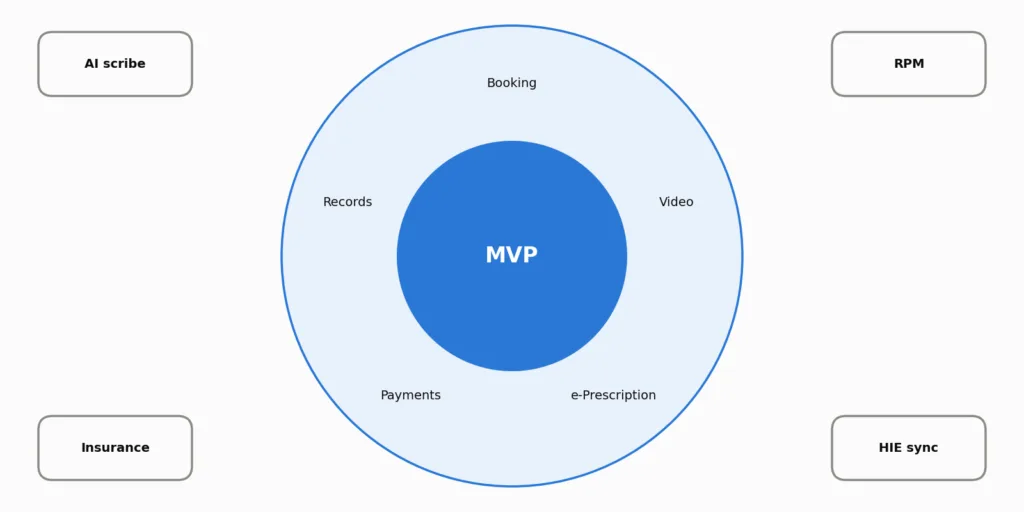
- Booking.
Doctor availability, time zones, reminders, cancellation and refund rules. - Video.
A consultation that connects on weak networks, with an audio fallback. Our article on reliable telemedicine video calls with WebRTC covers this in depth. - e-Prescription.
Structured drug entry, the doctor’s registration number and signature, and blocks on drugs that cannot be prescribed remotely in your market. - Payments.
A local payment gateway, receipts and refunds. - Records.
A consultation note, attachments and a history the doctor can see next time.
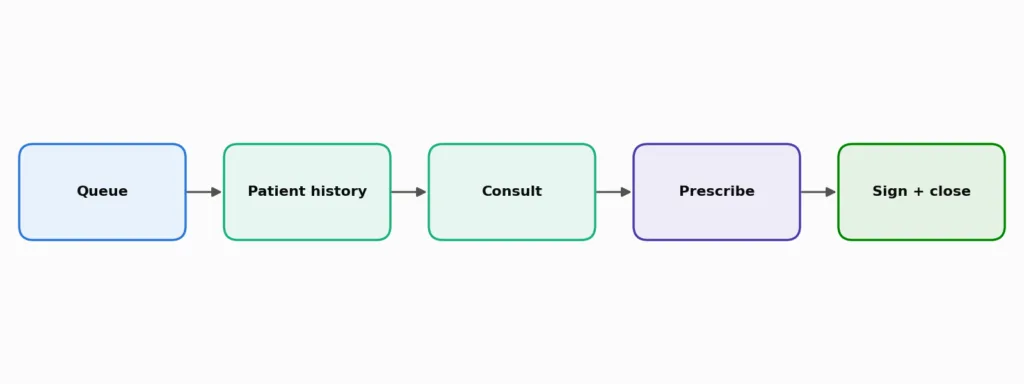
Two supporting pieces are easy to forget: a doctor-side workflow and an admin panel to verify doctors’ licences.
Start narrow: one specialty, one market
Regulation is market-specific. In Dubai, a telehealth platform must be approved by DHA before launch and must integrate its records with NABIDH, according to the DHA Standards for Telehealth Services. In India, consultations follow the 2020 Telemedicine Practice Guidelines, and the DPDP Act adds data protection duties. Launching in two markets at once doubles that work.
Specialty matters too. Dermatology needs good image upload. Mental health needs longer sessions and extra privacy. General practice needs fast prescribing. Pick one, learn from real consultations, then expand.

For the business and licensing side, see how to start a telemedicine business in the UAE.
A sample MVP stack
There is no single right stack. This is one common, well-supported combination.

- Flutter for the patient and doctor apps on iOS and Android from one codebase.
- Laravel for the API, admin panel and background jobs.
- PostgreSQL for structured clinical and booking data.
- A video service: your own WebRTC stack with TURN servers, or a managed video API with in-region hosting.
- A local payment gateway for your market.
Choose based on your team’s skills and your hosting requirements. A managed video API that routes calls through another country can break data localisation rules in the UAE or Saudi Arabia.
Decide these early
Some decisions are cheap to change later. Others mean migrating data or rewriting core services.
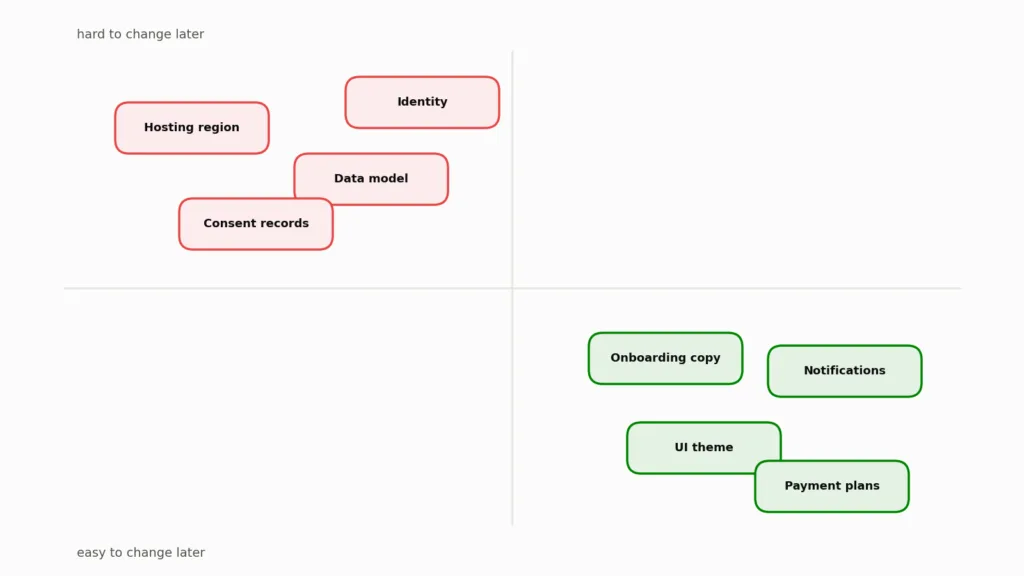
Hard to change later:
- Hosting region.
Moving health data between countries after launch is slow and risky. - Data model.
Store diagnoses, drugs and observations as coded, structured data that can map to FHIR. It makes NABIDH, Malaffi or ABDM integration far easier later. - Consent records.
Version and time-stamp every consent from the first patient. - Identity.
Emirates ID in the UAE, ABHA in India. Plan the fields and verification from the start.
Easy to change later: UI theme, notification wording, onboarding screens, pricing plans.
Compliance foundations in the MVP
Build the foundation before the features. You do not need every certificate on launch day, but the architecture should not block them.

- In-country hosting with backups in the same country.
- Encryption in transit and at rest.
- Consent and identity captured and stored properly.
- Audit logs of who viewed or changed a record.
Our guide to secure cloud architecture for telemedicine apps covers these in detail.
What to leave for v1 and v2
- AI medical scribe.
Valuable, but it needs its own consent flow and validation. - Remote patient monitoring.
Device integration and 24/7 alert handling are a project on their own. - Insurance.
Eligibility and claims integration take time in every market. - Health information exchange sync.
Required in some markets, such as Dubai, so check whether your launch market needs it in the MVP.
For the full feature set and cost ranges, see our telemedicine app development guide and our overview of telemedicine in the GCC. If you are weighing a white-label product against a custom build, read custom telemedicine platform in the UAE.
Common mistakes
- Too many specialties at launch.
Each has different workflows. - Free-text diagnoses and drugs.
They block later integrations. - Offshore hosting to save money.
Migration later costs more. - Ignoring the doctor side.
Doctors abandon slow, clumsy tools. - No licence verification for doctors.
Regulators and patients both expect it. - Video with no fallback.
Poor networks are normal, not an edge case.
FAQ
What features should a telemedicine MVP have?
Booking, video consultation, e-prescription, payments and medical records, plus a doctor workflow and an admin panel for doctor verification.
How long does it take to build a telemedicine app MVP?
It depends on scope, market and integrations. Regulatory approval and integrations such as NABIDH can take longer than building the app itself, so plan them into the timeline from the start.
Should the MVP include AI features?
Usually not. Add AI such as an ambient scribe once the core consultation flow is stable and you have consent and review processes in place.
Can we launch in the UAE and India with one MVP?
Technically yes, but hosting, identity, prescribing and consent rules differ. Launching in one market first is faster and safer.
