Zocdoc built one of the best-known doctor booking marketplaces in the US: patients search for a doctor, see real open slots and book in a few taps. If you want to build something similar for your market, whether a city-wide marketplace or a booking app for a hospital group, the features are the easy part. The hard parts are live availability, getting clinics to keep their calendars accurate, and meeting the health data rules where you operate.
This guide covers how Zocdoc works and makes money, the features an app like it needs, what changes in the UAE and India, and how to get from idea to a working pilot.
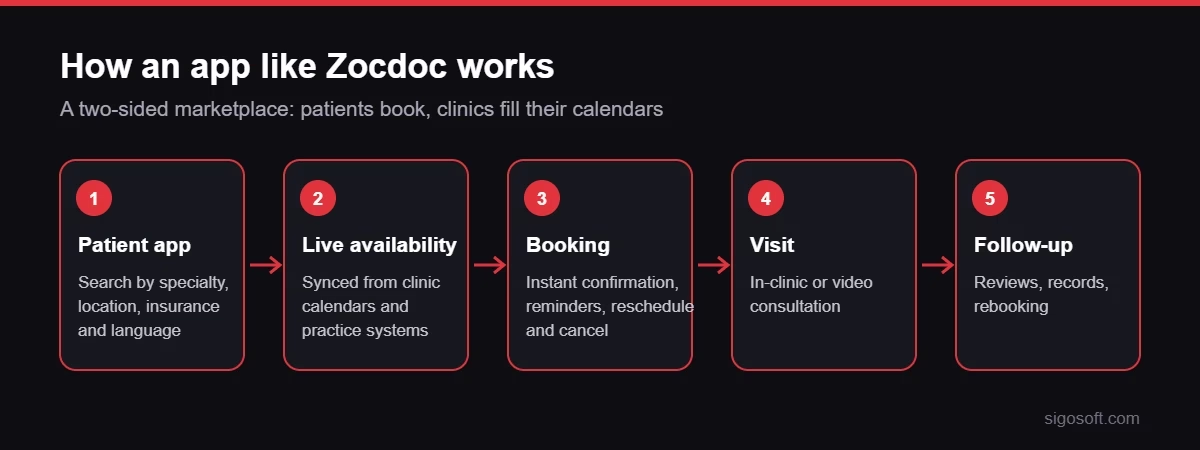
What Zocdoc does
Zocdoc is a two-sided marketplace. On one side, patients search by specialty, location, insurance and language, read verified reviews and book an appointment instantly. On the other, doctors and practices publish their availability and receive new patients. Zocdoc also offers practice tools for scheduling and patient communication.
The product is simple to describe. Its advantage is the network: enough doctors in each city that patients find a slot, and enough patients that doctors keep their calendars updated.
Zocdoc 如何賺錢
Zocdoc’s pricing has changed over time, and the change is a useful lesson for anyone planning a similar product. For years it charged doctors a flat annual subscription. It then moved to charging providers a fee per new patient booking, to lower the barrier for practices in smaller markets that did not get enough patients to justify a flat fee.
Today Zocdoc describes its Marketplace as pay-per-booking with no monthly fees or spend minimums, alongside sponsored placements sold through an auction. Patients use it free.
For your own app, the takeaway is to match pricing to the value clinics actually receive. A new clinic in a small market will not pay a large subscription before it sees bookings; a per-booking fee or a free tier lets you grow supply first.
Features an app like Zocdoc needs
A doctor booking platform has three parts, and each needs its own design:
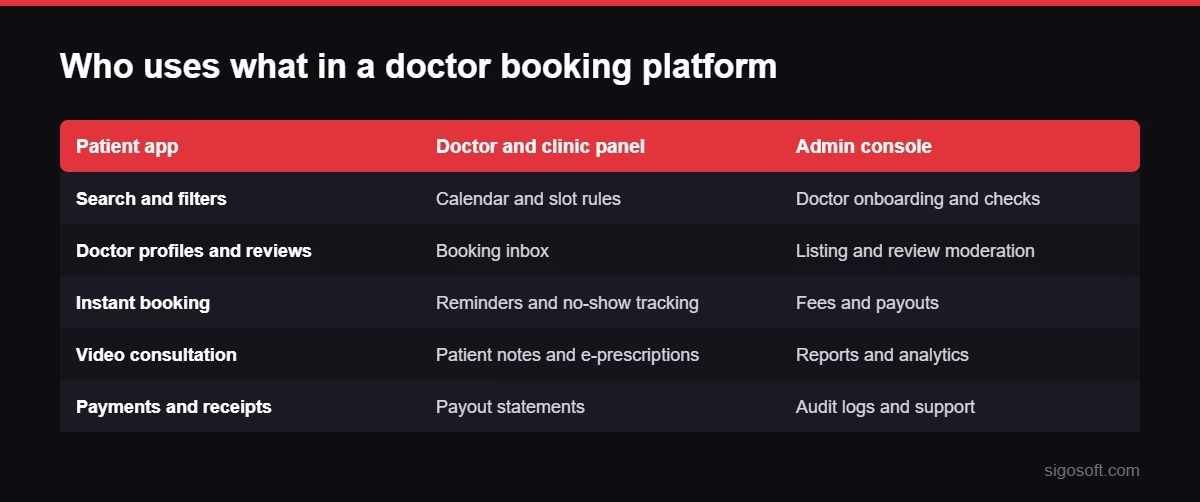
- Patient app: search and filters (specialty, area, language, insurance, gender, fees), doctor profiles with qualifications and reviews, instant booking, reminders, rescheduling, payments and, if you offer it, video consultation.
- Doctor and clinic panel: working hours and slot rules, leave and holidays, a booking inbox, patient notes, no-show tracking and payout statements. Many clinics will use this on a phone between patients, so it has to be fast on mobile.
- 管理員控制台: doctor onboarding and licence checks, listing and review moderation, commission and fee settings, reports, refunds and support tools.
If you add teleconsultation, the video, prescription and records features turn the booking app into a telemedicine product. Our 遠距醫療應用開發指南 covers that side in detail.
The hard part: availability that stays accurate
Patients forgive a plain interface. They do not forgive arriving for a slot that was never really free. Accurate availability depends on three things:
- 日曆同步。 Clinics that already use a practice management or hospital information system should not have to enter slots twice. Plan integrations early, and offer a simple built-in calendar for clinics that have none.
- Slot locking. Two patients must not be able to book the same slot at the same moment. This is a backend design decision, not something to patch later.
- No-show control. Reminders cut missed appointments. In the Gulf and India, reminders over WhatsApp usually get more attention than SMS or email; our WhatsApp Business API 集成 work covers templates, opt-in and delivery tracking.
What changes in the UAE and India
The booking flow is the same everywhere, but the rules around it are not.
阿聯酋
- Every doctor listed must hold a valid licence from the relevant authority (DHA in Dubai, DoH in Abu Dhabi, or MOHAP elsewhere). Build licence number and expiry checks into doctor onboarding.
- If you offer video consultations, the facility providing them must follow the telehealth standards of its regulator. Our DHA遠距醫療標準清單 walks through the Dubai requirements.
- Health data related to care in the UAE is restricted from leaving the country under Federal Law No. 2 of 2019, with limited exceptions. See where UAE telemedicine data can be hosted before you choose a cloud region.
- Clinics in Dubai and Abu Dhabi share records through NABIDH and Malaffi, which matters once your app stores consultation notes.
印度
- A booking app that collects health information is a data fiduciary under the DPDP Act, with consent, notice and breach duties. Read what the DPDP Act means for healthcare apps.
- Linking consultations to the patient’s ABHA number lets records flow between providers with consent. Our ABHA整合指南 explains the V3 APIs and milestones.
In the US, the equivalent rules come from HIPAA and state telehealth laws. Whatever the market, a 滲透測試 before launch is a sensible step for an app that holds patient data.
Ways to make money
| 型號 | 怎麼運作的 | 效果最佳時 |
|---|---|---|
| Per-booking fee | Clinics pay for each new patient booked | You are growing supply in new areas |
| Clinic subscription | Monthly fee for listing and practice tools | Clinics already get steady bookings |
| 贊助商列表 | Clinics bid for top placement in search | You have enough demand in a specialty |
| Teleconsult commission | A share of each paid video consultation | You run or partner with a telehealth service |
Avoid business models built on selling patient data. Beyond the legal risk under HIPAA, the UAE health data law and the DPDP Act, it destroys the trust a booking marketplace depends on.
How to build it, step by step
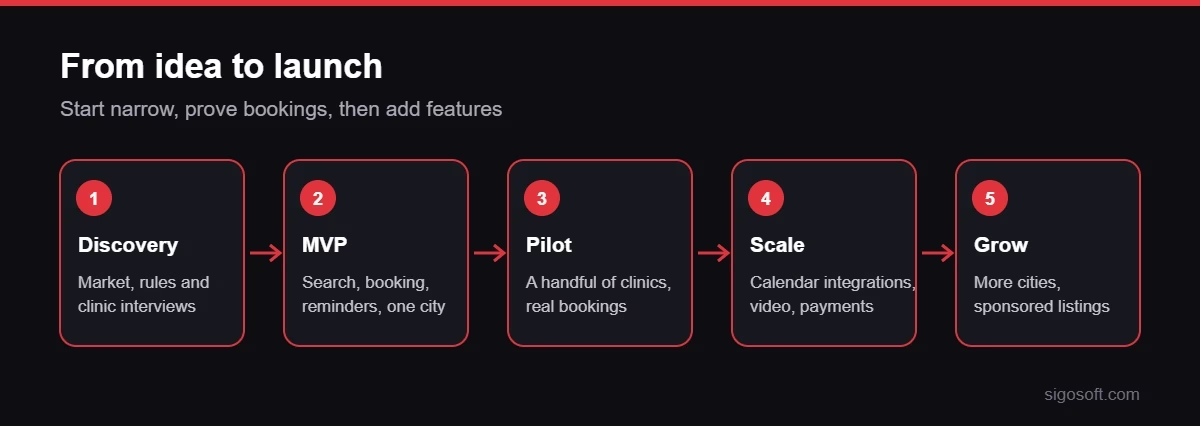
- 發現。 Interview clinic owners and front-desk staff. Confirm which licences, data rules and payment methods apply in your launch city.
- MVP. Search, doctor profiles, booking, reminders and a simple clinic calendar, in one city and a few specialties. Our post on 建構遠距醫療最小可行產品 explains what to leave out.
- 飛行員。 Onboard a small group of clinics and measure real bookings, no-shows and how often calendars go stale.
- 規模。 Add calendar integrations, payments, video consultation and reviews once the pilot shows clinics will keep using it.
- 增長。 Expand city by city, and add sponsored listings only when there is enough demand to sell.
成本驅動因素是什麼?
The budget depends far more on scope than on screens. The biggest cost drivers are the number of calendar and practice-system integrations, whether you include video consultation and e-prescriptions, payments and payouts across clinics, the number of languages (Arabic and English in the Gulf), and compliance work such as data residency and audit logging. For UAE budgets and timelines, see our UAE telemedicine app cost breakdown.
常見問題
Is it legal to build a Zocdoc clone?
Yes. Building a doctor booking marketplace with similar features is common. Do not copy Zocdoc’s brand, design or content, and make sure every listed doctor is licensed in your market.
Should I start with booking or with video consultations?
Start with in-clinic booking unless video is your core offer. It is simpler to launch, faces fewer regulatory steps and proves whether clinics will keep their availability up to date.
Can I white-label the platform for a single hospital group?
Yes. The same modules work as a branded booking app for one group, without the marketplace features such as sponsored listings and multi-clinic payouts.
How do I get doctors to join?
Make joining free or low-risk, onboard their calendars for them, and show them bookings quickly. Supply is usually harder to win than patients.
Planning a doctor booking app?
Sigosoft 構建 telemedicine and doctor booking apps for clinics, hospital groups and marketplaces in India and the Gulf. Tell us about your market and launch city and we will send you a scoped plan for an MVP.
來源
- Zocdoc: How the pay-per-booking model works
- Becker’s Hospital Review: Zocdoc scraps subscription pricing model
- Al Tamimi & Company: Health data transfers outside the UAE
感謝您的反饋!

阿迪爾·本·哈吉 Sigosoft 團隊
Aadil Bin Haj 是 Sigosoft 的技術內容撰稿人,他撰寫了 28 篇關於應用程式規劃和建置的文章。他的指南涵蓋了印度的食品配送平台、阿聯酋企業的送水應用、拍賣應用、語音聊天應用和遠距醫療平台。他的文章是針對創辦人及營運團隊,幫助他們決定開發什麼應用程式以及開發流程。
開始討論
有什麼問題或經驗想分享嗎?我們的團隊會閱讀並回覆。